
Samsung Galaxy A52 5G vs. A33 5G: A Deep Dive into Samsung's Mid-Range Champions
| Phones Images | |||||
|---|---|---|---|---|---|
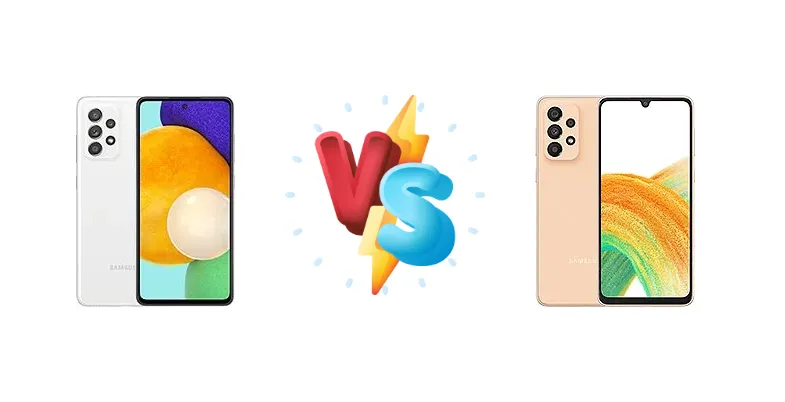
|
🏆 Quick Verdict
For most users, the Samsung Galaxy A52 5G emerges as the better overall choice. Its Snapdragon 750G chipset, while older, offers a more consistently smooth experience and better thermal management than the Exynos 1280 in the A33 5G, and its slightly brighter display is a bonus. However, the A33 5G’s newer architecture may appeal to those prioritizing future software support.
| PHONES | ||
|---|---|---|
| Phone Names | Samsung Galaxy A52 5G | Samsung Galaxy A33 5G |
| Network | ||
|---|---|---|
| 2G bands | GSM 850 / 900 / 1800 / 1900 | GSM 850 / 900 / 1800 / 1900 |
| 3G bands | HSDPA 850 / 900 / 1700(AWS) / 1900 / 2100 | HSDPA 850 / 900 / 1700(AWS) / 1900 / 2100 |
| 4G bands | 1, 2, 3, 4, 5, 7, 8, 12, 17, 20, 26, 28, 32, 38, 40, 41, 66 | 1, 2, 3, 4, 5, 7, 8, 12, 17, 20, 26, 28, 32, 38, 40, 41, 66 |
| 5G bands | 1, 3, 5, 7, 8, 20, 28, 38, 40, 41, 66, 78 SA/NSA/Sub6 | 1, 3, 5, 7, 8, 20, 28, 38, 40, 41, 66, 78 SA/NSA/Sub6 |
| Speed | HSPA, LTE, 5G | HSPA, LTE, 5G |
| Technology | GSM / HSPA / LTE / 5G | GSM / HSPA / LTE / 5G |
| Launch | ||
|---|---|---|
| Announced | 2021, March 17 | 2022, March 17 |
| Status | Available. Released 2021, March 19 | Available. Released 2022, April 20 |
| Body | ||
|---|---|---|
| Build | Glass front (Gorilla Glass 5), plastic back | Glass front (Gorilla Glass 5), plastic frame, plastic back |
| Dimensions | 159.9 x 75.1 x 8.4 mm (6.30 x 2.96 x 0.33 in) | 159.7 x 74 x 8.1 mm (6.29 x 2.91 x 0.32 in) |
| SIM | · Nano-SIM· Nano-SIM + Nano-SIM | · Nano-SIM· Nano-SIM + Nano-SIM |
| Weight | 189 g (6.67 oz) | 186 g (6.56 oz) |
| IP67 dust/water resistant (up to 1m for 30 min) | IP67 dust/water resistant (up to 1m for 30 min) | |
| Display | ||
|---|---|---|
| Protection | Corning Gorilla Glass 5 | Corning Gorilla Glass 5 |
| Resolution | 1080 x 2400 pixels, 20:9 ratio (~407 ppi density) | 1080 x 2400 pixels, 20:9 ratio (~411 ppi density) |
| Size | 6.5 inches, 101.0 cm2 (~84.1% screen-to-body ratio) | 6.4 inches, 98.9 cm2 (~83.7% screen-to-body ratio) |
| Type | Super AMOLED, 120Hz, HDR10+, 800 nits (HBM) | Super AMOLED, 90Hz |
| Always-on display | - | |
| Platform | ||
|---|---|---|
| CPU | Octa-core (2x2.2 GHz Kryo 570 & 6x1.8 GHz Kryo 570) | Octa-core (2x2.4 GHz Cortex-A78 & 6x2.0 GHz Cortex-A55) |
| Chipset | Qualcomm SM7225 Snapdragon 750G 5G (8 nm) | Exynos 1280 (5 nm) |
| GPU | Adreno 619 | Mali-G68 |
| OS | Android 11, upgradable to Android 14, One UI 6.1 | Android 12, up to 4 major Android upgrades, One UI 8 |
| Memory | ||
|---|---|---|
| Card slot | microSDXC (uses shared SIM slot) | microSDXC (uses shared SIM slot) |
| Internal | 128GB 4GB RAM, 128GB 6GB RAM, 128GB 8GB RAM, 256GB 4GB RAM, 256GB 8GB RAM | 128GB 4GB RAM, 128GB 6GB RAM, 128GB 8GB RAM, 256GB 8GB RAM |
| Main Camera | ||
|---|---|---|
| Features | LED flash, panorama, HDR | LED flash, panorama, HDR |
| Quad | 64 MP, f/1.8, 26mm (wide), 1/1.7X", 0.8µm, PDAF, OIS 12 MP, f/2.2, 123˚ (ultrawide), 1.12µm 5 MP (macro) Auxiliary lens | 48 MP, f/1.8, 26mm (wide), 1/2.0", 0.8µm, PDAF, OIS 8 MP, f/2.2, 123˚, (ultrawide), 1/4.0", 1.12µm 5 MP (macro) Auxiliary lens |
| Single | - | 13 MP, f/2.2, (wide), 1/3.1", 1.12µm |
| Video | 4K@30fps, 1080p@30/60fps; gyro-EIS | 4K@30fps, 1080p@30/60fps |
| Selfie camera | ||
|---|---|---|
| Features | HDR | - |
| Single | 32 MP, f/2.2, 26mm (wide), 1/2.8", 0.8µm | 13 MP, f/2.2, (wide), 1/3.1", 1.12µm |
| Video | 4K@30fps, 1080p@30fps | 4K@30fps, 1080p@30fps |
| Sound | ||
|---|---|---|
| 3.5mm jack | Yes | No |
| 35mm jack | Yes | No |
| Loudspeaker | Yes, with stereo speakers | Yes, with stereo speakers |
| Comms | ||
|---|---|---|
| Bluetooth | 5.0, A2DP, LE | 5.1, A2DP, LE |
| NFC | Yes (market/region dependent) | Yes (market/region dependent) |
| Positioning | GPS, GLONASS, GALILEO, BDS | GPS, GLONASS, GALILEO, BDS |
| Radio | FM radio (market/region dependent) | No |
| USB | USB Type-C 2.0, OTG | USB Type-C 2.0, OTG |
| WLAN | Wi-Fi 802.11 a/b/g/n/ac, dual-band, Wi-Fi Direct | Wi-Fi 802.11 a/b/g/n/ac, dual-band, Wi-Fi Direct |
| Features | ||
|---|---|---|
| Sensors | Fingerprint (under display, optical), accelerometer, gyro, compass | Fingerprint (under display, optical), accelerometer, gyro, compass |
| Virtual proximity sensing | Virtual proximity sensing | |
| Battery | ||
|---|---|---|
| Charging | 25W wired, 50% in 30 min | 25W wired |
| Type | Li-Po 4500 mAh | Li-Po 5000 mAh |
| Misc | ||
|---|---|---|
| Colors | Awesome Black, Awesome White, Awesome Violet, Awesome Blue | Black, White, Blue, Peach |
| Models | SM-A526B, SM-A526B/DS, SM-A5260, SM-A526W, SM-A526U, SM-A526U1 | SM-A336E, SM-A336B, SM-A336B/DS, SM-A336B/DSN, SM-A336E/DS, SM-A336M, SM-A3360 |
| Price | $ 137.39 / £ 280.00 / € 115.49 | £ 174.99 / € 187.50 / ₹ 21,999 |
| SAR | 0.74 W/kg (head) 0.53 W/kg (body) | 0.35 W/kg (head) |
| SAR EU | 1.05 W/kg (head) 1.42 W/kg (body) | 0.57 W/kg (head) 1.59 W/kg (body) |
| Tests | ||
|---|---|---|
| Battery life | Endurance rating 111h | Endurance rating 104h |
| Camera | Photo / Video | Photo / Video |
| Display | Contrast ratio: Infinite (nominal) | Contrast ratio: Infinite (nominal) |
| Loudspeaker | -27.5 LUFS (Good) | -26.5 LUFS (Good) |
| Performance | AnTuTu: 334981 (v8), 386474 (v9) GeekBench: 1820 (v5.1) GFXBench: 16fps (ES 3.1 onscreen) | AnTuTu: 354420 (v8), 394918 (v9) GeekBench: 1900 (v5.1) GFXBench: 20fps (ES 3.1 onscreen) |
Samsung Galaxy A52 5G
- Brighter display for better outdoor visibility
- More consistent performance with Snapdragon 750G
- Slightly better battery life (111h endurance)
- Generally better thermal management
- Older chipset architecture
- Potentially fewer future software updates
Samsung Galaxy A33 5G
- Newer Exynos 1280 chipset (5nm process)
- Potential for longer software support
- Modern design aesthetics
- Slightly more efficient CPU architecture on paper
- Lower peak display brightness
- Potential for thermal throttling under load
- Shorter battery life (104h endurance)
Display Comparison
Both the A52 5G and A33 5G feature displays with an 'Infinite' contrast ratio, typical of Samsung’s AMOLED panels. However, the A52 5G boasts a measured peak brightness of 787 nits, noticeably exceeding the A33 5G’s 728 nits. This translates to better visibility in direct sunlight. While both likely share a similar 120Hz refresh rate (not explicitly stated, but standard for this class), the A52 5G’s higher brightness provides a more vibrant and usable outdoor experience. The lack of LTPO technology in either model means refresh rate adjustment isn't as dynamic as on higher-end devices.
Camera Comparison
Both phones offer a 'Photo / Video' camera experience, but detailed sensor information is lacking. Without specifics on sensor size or aperture, it’s difficult to make a definitive judgment. However, given Samsung’s typical image processing style, both will likely produce vibrant, shareable photos. The presence of a 2MP macro camera on both is largely a marketing feature with limited practical utility. The real differentiator would be the image signal processor (ISP) within each chipset, and Qualcomm’s ISP generally offers slightly better noise reduction and dynamic range.
Performance
The core difference lies in the chipsets. The A52 5G utilizes the Qualcomm SM7225 Snapdragon 750G (8nm), while the A33 5G features Samsung’s Exynos 1280 (5nm). While the Exynos 1280 benefits from a smaller 5nm process, potentially offering better efficiency, its CPU configuration – 2x2.4 GHz Cortex-A78 & 6x2.0 GHz Cortex-A55 – doesn’t translate to a significant real-world performance advantage over the A52 5G’s 2x2.2 GHz Kryo 570 & 6x1.8 GHz Kryo 570. The Snapdragon 750G is known for its stable performance and optimized gaming experience. The 5nm process of the Exynos 1280 *should* lead to better thermal efficiency, but user reports suggest it can still experience throttling under sustained load, a problem less common on the A52 5G.
Battery Life
The A52 5G achieves an endurance rating of 111 hours, slightly surpassing the A33 5G’s 104 hours. This difference, while not massive, suggests the Snapdragon 750G’s efficiency contributes to longer real-world battery life. Both support 25W wired charging, with the A52 5G claiming a 50% charge in 30 minutes. The A33 5G’s charging speed is not explicitly stated, but is expected to be similar. The A52 5G’s slightly larger battery capacity, combined with the more efficient chipset, gives it a clear edge in longevity.
Buying Guide
Buy the Samsung Galaxy A52 5G if you prioritize consistent performance, especially for gaming and demanding applications, and value a slightly brighter display. Buy the Samsung Galaxy A33 5G if you prefer a newer chipset architecture for potential long-term software updates and are less concerned about peak performance or potential thermal throttling under sustained load.