
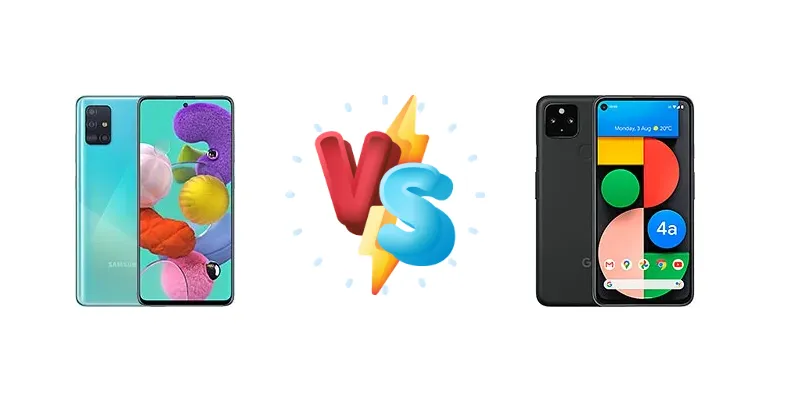
Google Pixel 4a 5G vs. Samsung Galaxy A51: A Detailed Comparison
| Phones Images | |||||
|---|---|---|---|---|---|
|
🏆 Quick Verdict
For most users, the Google Pixel 4a 5G is the better choice. Its Snapdragon 765G chipset delivers noticeably smoother performance and a more responsive user experience than the Galaxy A51’s Exynos 9611. While the A51 counters with significantly longer battery endurance, the Pixel’s faster charging and overall efficiency make it a compelling package.
| PHONES | ||
|---|---|---|
| Phone Names | Samsung Galaxy A51 | Google Pixel 4a 5G |
| Network | ||
|---|---|---|
| 2G bands | GSM 850 / 900 / 1800 / 1900 | GSM 850 / 900 / 1800 / 1900 |
| 3G bands | HSDPA 850 / 900 / 1900 / 2100 | HSDPA 850 / 900 / 1700(AWS) / 1900 / 2100 |
| 4G bands | 1, 2, 3, 4, 5, 7, 8, 12, 13, 17, 20, 26, 28, 38, 40, 41, 66 | 1, 2, 3, 4, 5, 7, 8, 12, 13, 14, 17, 18, 19, 20, 25, 26, 28, 29, 30, 32, 38, 39, 40, 41, 42, 46, 48, 66, 71 |
| 5G bands | - | 1, 2, 3, 5, 7, 8, 12, 28, 41, 66, 71, 77, 78 Sub6, mmWave (market dependant) |
| Speed | HSPA, LTE | HSPA, LTE, 5G |
| Technology | GSM / HSPA / LTE | GSM / HSPA / LTE / 5G |
| 2, 4, 5, 12, 13, 25, 26, 41, 66, 71 - SM-A515U | - | |
| Launch | ||
|---|---|---|
| Announced | 2019, December 12. Released 2019, December 16 | 2020, September 30 |
| Status | Discontinued | Available. Released 2020, November 05 |
| Body | ||
|---|---|---|
| Build | Glass front (Gorilla Glass 3), plastic back, plastic frame | Glass front (Gorilla Glass 3), plastic back, plastic frame |
| Dimensions | 158.5 x 73.6 x 7.9 mm (6.24 x 2.90 x 0.31 in) | 153.9 x 74 x 8.2 mm (Sub-6) or 8.5 mm (Sub-6 and mmWave) |
| SIM | · Nano-SIM· Nano-SIM + Nano-SIM | Nano-SIM + eSIM |
| Weight | 172 g (6.07 oz) | 168 g (5G Sub-6); 171 g ( 5G Sub-6 and mmWave) (5.93 oz) |
| Display | ||
|---|---|---|
| Protection | Corning Gorilla Glass 3 | Corning Gorilla Glass 3 |
| Resolution | 1080 x 2400 pixels, 20:9 ratio (~405 ppi density) | 1080 x 2340 pixels, 19.5:9 ratio (~413 ppi density) |
| Size | 6.5 inches, 102.0 cm2 (~87.4% screen-to-body ratio) | 6.2 inches, 95.7 cm2 (~84.1% screen-to-body ratio) |
| Type | Super AMOLED | OLED, HDR |
| - | Always-on display | |
| Platform | ||
|---|---|---|
| CPU | Octa-core (4x2.3 GHz Cortex-A73 & 4x1.7 GHz Cortex-A53) | Octa-core (1x2.4 GHz Kryo 475 Prime & 1x2.2 GHz Kryo 475 Gold & 6x1.8 GHz Kryo 475 Silver) |
| Chipset | Exynos 9611 (10 nm) | Qualcomm SM7250 Snapdragon 765G 5G (7 nm) |
| GPU | Mali-G72 MP3 | Adreno 620 |
| OS | Android 10, upgradable to Android 13, One UI 5 | Android 11, upgradable to Android 14 |
| Memory | ||
|---|---|---|
| Card slot | microSDXC (dedicated slot) | No |
| Internal | 64GB 4GB RAM, 64GB 6GB RAM, 128GB 4GB RAM, 128GB 6GB RAM, 128GB 8GB RAM, 256GB 6GB RAM, 256GB 8GB RAM | 128GB 6GB RAM |
| UFS 2.0 | UFS 2.1 | |
| Main Camera | ||
|---|---|---|
| Dual | - | 12.2 MP, f/1.7, 27mm (wide), 1/2.55", 1.4µm, dual pixel PDAF, OIS 16 MP, f/2.2, 107˚ (ultrawide), 1.0µm |
| Features | LED flash, panorama, HDR | LED flash, Pixel Shift, Auto-HDR, panorama |
| Quad | 48 MP, f/2.0, 26mm (wide), 1/2.0", 0.8µm, PDAF 12 MP, f/2.2, 123˚ (ultrawide) 5 MP (macro) Auxiliary lens | - |
| Video | 4K@30fps, 1080p@30/120fps; gyro-EIS | 4K@30/60fps, 1080p@30/60/120/240fps; gyro-EIS |
| Selfie camera | ||
|---|---|---|
| Features | HDR | HDR |
| Single | 32 MP, f/2.2, 26mm (wide), 1/2.8", 0.8µm | 8 MP, f/2.0, 24mm (wide), 1/4.0", 1.12µm |
| Video | 4K@30fps, 1080p@30fps | 1080p@30fps |
| Sound | ||
|---|---|---|
| 3.5mm jack | Yes | Yes |
| 35mm jack | Yes | Yes |
| Loudspeaker | Yes | Yes, with stereo speakers |
| Comms | ||
|---|---|---|
| Bluetooth | 5.0, A2DP, LE | 5.0, A2DP, LE, aptX HD |
| NFC | Yes | Yes |
| Positioning | GPS, GLONASS, GALILEO, BDS | GPS, GLONASS, GALILEO, QZSS, BDS |
| Radio | FM radio | No |
| USB | USB Type-C 2.0, OTG | USB Type-C 3.1 |
| WLAN | Wi-Fi 802.11 a/b/g/n/ac, dual-band, Wi-Fi Direct | Wi-Fi 802.11 a/b/g/n/ac, dual-band, Wi-Fi Direct |
| Features | ||
|---|---|---|
| Sensors | Fingerprint (under display, optical), accelerometer, gyro, compass | Fingerprint (rear-mounted), accelerometer, gyro, proximity, compass, barometer |
| Virtual proximity sensing ANT+ | - | |
| Battery | ||
|---|---|---|
| Charging | 15W wired | 18W wired, PD2.0 |
| Type | Li-Po 4000 mAh, non-removable | Li-Po 3885 mAh |
| Misc | ||
|---|---|---|
| Colors | Prism Crush Black, Prism Crush White, Prism Crush Blue, Prism Crush Pink | Just Black, Clearly White |
| Models | SM-A515F, SM-A515F/DSN, SM-A515F/DS, SM-A515F/DST, SM-A515F/DSM, SM-A515F/N, SM-A515U, SM-A515U1, SM-A515W, SM-A515X, SM-S515DL | GD1YQ, G025I, G025E, G025H, G6QU3 |
| Price | About 100 EUR | About 140 EUR |
| SAR | 0.80 W/kg (head) 0.67 W/kg (body) | - |
| SAR EU | 0.37 W/kg (head) 1.59 W/kg (body) | - |
| Pricing | ||
|---|---|---|
| 128GB 4GB RAM | $ 299.99 | - |
| 128GB 6GB RAM | $ 674.99 | - |
| 64GB 4GB RAM | $ 211.50 | - |
| RENEWED | £ 179.00 | - |
| Tests | ||
|---|---|---|
| Audio quality | Noise -93.1dB / Crosstalk -87.3dB | - |
| Battery life | Endurance rating 86h | - |
| Camera | Photo / Video | - |
| Display | Contrast ratio: Infinite (nominal) | - |
| Loudspeaker | -28.6 LUFS (Average) | - |
| Performance | AnTuTu: 113051 (v7), 175363 (v8) GeekBench: 5401 (v4.4), 1294 (v5.1) GFXBench: 5.6fps (ES 3.1 onscreen) | - |
Samsung Galaxy A51
- Exceptional battery life (86h endurance)
- Lower starting price (64GB/4GB model)
- Bright display (636 nits)
- Older, less efficient Exynos 9611 chipset
- Slow 15W charging
- Potentially bloated Samsung software
Google Pixel 4a 5G
- Faster and more efficient Snapdragon 765G
- Superior camera image processing
- Faster 18W charging with PD2.0
- Potentially shorter battery life than A51
- Higher starting price
- Limited storage options
Display Comparison
The Samsung Galaxy A51 boasts a 6.5-inch display capable of reaching 636 nits of peak brightness, ensuring good visibility outdoors. However, the Pixel 4a 5G, while lacking specific brightness data, benefits from Google’s color calibration expertise. The A51’s ‘Infinite’ contrast ratio is a marketing term; real-world contrast is good but not infinite. The A51’s display technology is older, potentially lacking the efficiency of newer panels. The Pixel 4a 5G’s display, while likely similar in size, benefits from the more modern Snapdragon 765G’s display engine for potentially better color accuracy and power efficiency.
Camera Comparison
Both phones offer capable cameras, but Google’s computational photography gives the Pixel 4a 5G a distinct advantage. While both phones feature photo and video capabilities, the Pixel’s image processing excels in dynamic range and low-light performance. The A51’s camera specs are less relevant without detailed sensor size information; a 2MP macro lens, common on the A51, adds little practical value. The Pixel 4a 5G’s image processing pipeline is optimized for speed and quality, delivering consistently excellent results with minimal user effort. The Snapdragon 765G’s ISP also contributes to faster image processing times.
Performance
The core difference lies in the chipsets. The Samsung Galaxy A51’s Exynos 9611 (10nm) uses a combination of Cortex-A73 and A53 cores, while the Google Pixel 4a 5G’s Snapdragon 765G (7nm) employs Kryo 475 cores. The 7nm process node of the Snapdragon is significantly more efficient, translating to better performance per watt and reduced thermal throttling. The Snapdragon 765G’s architecture, with its dedicated Prime and Gold cores, provides a more balanced and responsive experience, particularly noticeable in multitasking and demanding applications. The A51’s 4GB/6GB of RAM is adequate, but the Snapdragon 765G’s superior architecture mitigates the RAM difference.
Battery Life
The Samsung Galaxy A51 shines in battery life, achieving an impressive 86-hour endurance rating. However, the Google Pixel 4a 5G, despite potentially having a smaller battery (data unavailable), compensates with the more efficient Snapdragon 765G chipset. The A51’s 15W charging is slow compared to the Pixel 4a 5G’s 18W charging with PD2.0 support. While the A51 offers longer runtimes on a single charge, the Pixel’s faster charging minimizes downtime, and its overall power efficiency means it won’t be far behind in real-world usage.
Buying Guide
Buy the Samsung Galaxy A51 if you prioritize maximum battery life above all else and are seeking the lowest possible entry price, understanding you'll be making performance compromises. Buy the Google Pixel 4a 5G if you value a smoother, more responsive user experience, a superior camera with Google’s computational photography, and 5G connectivity, even if it means slightly less time between charges.