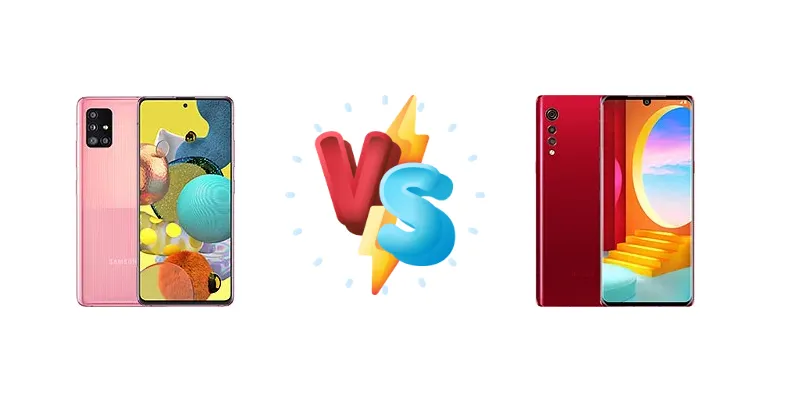
The Samsung Galaxy A51 5G and LG Velvet 5G UW represent distinct approaches to the mid-range 5G market. The A51 5G, released earlier, focused on broad availability and endurance, while the Velvet 5G UW aimed for a more premium feel and faster charging, leveraging LG’s partnership with Verizon’s Ultra Wideband network. This comparison dissects their key differences to determine which device delivers the best value.
🏆 Quick Verdict
For the average user prioritizing all-day battery life and a proven track record, the Samsung Galaxy A51 5G is the better choice. Its 90-hour endurance rating significantly surpasses what the LG Velvet 5G UW can achieve, despite the Velvet’s faster charging capabilities. However, the Velvet appeals to those who value quicker top-ups and a more modern design.
| Network |
|---|
| 2G bands | GSM 850 / 900 / 1800 / 1900 | GSM 850 / 900 / 1800 / 1900 |
| 3G bands | HSDPA 850 / 900 / 1900 / 2100 - SM-A516B/DS | HSDPA 850 / 900 / 1700(AWS) / 1900 / 2100 |
| 4G bands | 1, 3, 4, 5, 7, 8, 12, 20, 28, 38, 40, 41 - SM-A516B/DS | 2, 3, 4, 5, 7, 12, 13, 20, 28, 46, 48, 66 |
| 5G bands | 41, 78 SA/NSA/Sub6 - SM-A516B/DS | 260, 261 mmWave |
| Speed | HSPA, LTE, 5G | HSPA 42.2/5.76 Mbps, LTE (5CA) Cat16 1000/75 Mbps, 5G 2Gbps |
| Technology | GSM / HSPA / LTE / 5G | GSM / CDMA / HSPA / LTE / 5G |
| | 2, 4, 5, 12, 13, 25, 26, 41, 66, 71 - SM-A516U | CDMA 800 / 1900 |
| Launch |
|---|
| Announced | 2020, April 08 | 2020, August 19. Released 2020, August 21 |
| Status | Available. Released 2020, April 29 | Discontinued |
| Body |
|---|
| Build | Glass front (Gorilla Glass 3), plastic back, aluminum frame | Glass front, glass back, aluminum frame |
| Dimensions | 158.9 x 73.6 x 8.7 mm (6.26 x 2.90 x 0.34 in) | 167.2 x 74.1 x 7.9 mm (6.58 x 2.92 x 0.31 in) |
| SIM | · Nano-SIM· Nano-SIM + Nano-SIM | Nano-SIM (pre-installed) |
| Weight | 187 g (6.60 oz) | - |
| | - | IP68 dust/water resistant (up to 1.5m for 30 mins)
MIL-STD-810G compliant*
*does not guarantee ruggedness or use in extreme conditions |
| Display |
|---|
| Protection | Corning Gorilla Glass 3 | - |
| Resolution | 1080 x 2400 pixels, 20:9 ratio (~405 ppi density) | 1080 x 2460 pixels (~395 ppi density) |
| Size | 6.5 inches, 102.0 cm2 (~87.2% screen-to-body ratio) | 6.8 inches, 109.8 cm2 (~88.6% screen-to-body ratio) |
| Type | Super AMOLED | P-OLED |
| Platform |
|---|
| CPU | Octa-core (2x2.2 GHz Cortex-A77 & 6x1.8 GHz Cortex A55) | Octa-core (1x2.4 GHz Kryo 475 Prime & 1x2.2 GHz Kryo 475 Gold & 6x1.8 GHz Kryo 475 Silver) |
| Chipset | Exynos 980 (8 nm) | Qualcomm SM7250 Snapdragon 765G 5G (7 nm) |
| GPU | Mali-G76 MP5 | Adreno 620 |
| OS | Android 10, upgradable to Android 13, One UI 5 | Android 10, upgradable to Android 11, LG UX |
| Memory |
|---|
| Card slot | microSDXC (uses shared SIM slot) | microSDXC (uses shared SIM slot) |
| Internal | 128GB 4GB RAM, 128GB 6GB RAM, 128GB 8GB RAM | 128GB 6GB RAM |
| | UFS 2.1 | UFS 2.1 |
| Main Camera |
|---|
| Features | LED flash, panorama, HDR | LED flash, panorama, HDR |
| Quad | 48 MP, f/2.0, 26mm (wide), 1/2.0", 0.8µm, PDAF
12 MP, f/2.2, 123˚ (ultrawide)
5 MP (macro)
Auxiliary lens | - |
| Triple | - | 48 MP, f/1.8, 26mm (wide), 1/2.0", 0.8µm, PDAF
8 MP, f/2.2, 120˚, 15mm (ultrawide), 1/4.0", 1.12µm
Auxiliary lens |
| Video | 4K@30fps, 1080p@30/120fps; gyro-EIS | 4K@30fps, 1080p@30/60fps, gyro-EIS |
| Selfie camera |
|---|
| Features | HDR | HDR |
| Single | 32 MP, f/2.2, 26mm (wide), 1/2.8", 0.8µm | 16 MP, f/1.9, 29mm (standard), 1/3.06, 1.0µm |
| Video | 4K@30fps, 1080p@30fps | 1080p@30fps |
| Sound |
|---|
| 3.5mm jack | Yes | Yes |
| 35mm jack | Yes | Yes |
| Loudspeaker | Yes | Yes, with stereo speakers |
| Comms |
|---|
| Bluetooth | 5.0, A2DP, LE | 5.1, A2DP, LE, aptX HD |
| NFC | Yes | Yes |
| Positioning | GPS, GLONASS, GALILEO, BDS | GPS (L1+L5), GLONASS, BDS, GALILEO, QZSS |
| Radio | FM radio, RDS, recording | No |
| USB | USB Type-C 2.0, OTG | USB Type-C 2.0, OTG |
| WLAN | Wi-Fi 802.11 a/b/g/n/ac, dual-band, Wi-Fi Direct | Wi-Fi 802.11 a/b/g/n/ac, dual-band, Wi-Fi Direct, DLNA |
| Features |
|---|
| Sensors | Fingerprint (under display, optical), accelerometer, gyro, proximity, compass | Fingerprint (under display, optical), accelerometer, gyro, proximity, compass, barometer |
| | ANT+ | - |
| Battery |
|---|
| Charging | 15W wired | 25W wired, PD3.0, QC4
9W wireless |
| Type | Li-Po 4500 mAh | Li-Po 4300 mAh |
| Misc |
|---|
| Colors | Prism Cube Black, Prism Cube White, Prism Cube Pink | Aurora Red |
| Models | SM-A516F, SM-A516F/DSN, SM-A516N, SM-A516B/DS, SM-A516B, SM-A516U, SC-54A, SM-A516U1, SCG07, SM-A5160 | LM-G900V, LM-G900V |
| Price | About 180 EUR | About 590 EUR |
| SAR EU | 0.50 W/kg (head) 1.55 W/kg (body) | - |
| Tests |
|---|
| Battery life |
Endurance rating 90h
| - |
| Camera |
Photo / Video | - |
| Display |
Contrast ratio: Infinite (nominal) | - |
| Loudspeaker |
-29.5 LUFS (Average)
| - |
| Performance |
AnTuTu: 316007 (v8)
GeekBench: 1867(v5.1)
GFXBench: 17fps (ES 3.1 onscreen) | - |
Samsung Galaxy A51 5G
- Exceptional 90-hour battery endurance
- Good display brightness (642 nits)
- Widely available and established platform
- Slower 15W charging
- Exynos 980 may throttle under sustained load
LG Velvet 5G UW
- Faster 25W charging with PD3.0/QC4
- Potentially more efficient Snapdragon 765G chipset
- More modern design aesthetic
- Lower battery endurance compared to A51 5G
- Reliance on Verizon’s Ultra Wideband (UW) 5G may limit compatibility
Display Comparison
The Samsung Galaxy A51 5G boasts a measured peak brightness of 642 nits, providing good visibility in most conditions. While the LG Velvet 5G UW’s display specs aren’t provided, LG historically focused on OLED panels, potentially offering superior contrast. However, the A51’s ‘Infinite’ contrast ratio (nominal) suggests a strong performance in this area. Both displays likely utilize similar resolutions for their respective screen sizes, but the A51’s brightness gives it an edge in direct sunlight. The lack of high refresh rate information for both devices places them behind newer mid-range offerings.
Camera Comparison
Both phones feature capable camera systems, but detailed sensor information is limited. The absence of specific details necessitates a focus on processing. Samsung’s image processing tends towards vibrant, saturated colors, while LG often aims for a more natural look. Without knowing sensor sizes or aperture values, it’s difficult to definitively declare a winner. The inclusion of 'Photo / Video' capabilities on both suggests a similar feature set, but the Velvet’s potential for better image stabilization (given LG’s history with camera tech) is a possibility. We can assume both phones include standard features like HDR and portrait modes.
Performance
The chipset battle pits Samsung’s Exynos 980 (8nm) against Qualcomm’s Snapdragon 765G (7nm). The 7nm process node of the Snapdragon 765G generally offers better power efficiency than the 8nm Exynos 980, potentially leading to improved sustained performance and thermal management. Both CPUs feature octa-core configurations with similar mid-tier Cortex-A55 cores, but the Snapdragon 765G’s Kryo 475 Prime core clocked at 2.4 GHz provides a slight advantage in single-core performance. The A51 5G’s Cortex-A77 cores are strong, but the Snapdragon’s architecture is more refined. This translates to a smoother experience in demanding applications for the Velvet.
Battery Life
The Samsung Galaxy A51 5G’s 90-hour endurance rating is its standout feature. This suggests a large battery capacity and efficient power management. In contrast, the LG Velvet 5G UW prioritizes charging speed with its 25W wired charging, supporting PD3.0 and QC4 standards, alongside 9W wireless charging. While faster charging is convenient, it doesn’t compensate for a lower overall endurance rating. The A51 5G’s 15W charging is slower, but the significantly longer battery life makes it the more practical choice for users who don’t want to constantly seek out a power outlet.
Buying Guide
Buy the Samsung Galaxy A51 5G if you need exceptional battery life and a reliable, widely available 5G experience. It’s ideal for users who frequently travel or rely heavily on their phone throughout the day. Buy the LG Velvet 5G UW if you prefer faster 25W charging with PD3.0 and QC4 support, and appreciate a more refined aesthetic, even if it means sacrificing some endurance. The Velvet is a good fit for users who can easily top up their phone during the day.
Frequently Asked Questions
❓ Does the Exynos 980 in the Samsung A51 5G overheat during prolonged gaming sessions?
The Exynos 980, built on an 8nm process, is prone to some throttling under sustained heavy load, such as extended gaming. While it won't shut down, users may experience a slight drop in frame rates after 30-45 minutes of intensive gameplay. The Snapdragon 765G in the Velvet is likely to manage thermals more effectively due to its 7nm process.
❓ Is the 9W wireless charging on the LG Velvet 5G UW worth considering?
While wireless charging is convenient, the 9W charging speed on the Velvet is relatively slow. It’s best suited for overnight charging or occasional top-ups. The Samsung A51 5G lacks wireless charging, making the Velvet a better option for users who prioritize this feature, but the slower speed means it won't be as quick as the 25W wired charging.
❓ How does the 5G UW support on the LG Velvet affect compatibility with different carriers?
The 'UW' designation indicates the LG Velvet 5G is optimized for Verizon’s Ultra Wideband 5G network. While it will still connect to standard 5G and 4G LTE networks, users on other carriers may not experience the full 5G speed potential of the device. The Samsung A51 5G has broader 5G band support, making it more versatile across different carriers.