
Samsung Galaxy A51 5G vs. Apple iPhone SE (2020): A Detailed Comparison
| Phones Images | |||||
|---|---|---|---|---|---|
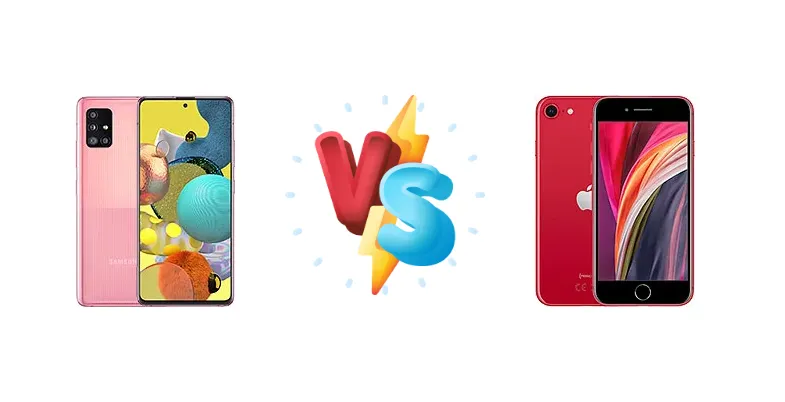
|
🏆 Quick Verdict
For the average user prioritizing battery life and 5G connectivity, the Samsung Galaxy A51 5G is the better choice. However, the iPhone SE (2020) delivers significantly faster processing power in a more compact design, making it ideal for those who value performance and portability above all else.
| PHONES | ||
|---|---|---|
| Phone Names | Samsung Galaxy A51 5G | Apple iPhone SE (2020) |
| Network | ||
|---|---|---|
| 2G bands | GSM 850 / 900 / 1800 / 1900 | GSM 850 / 900 / 1800 / 1900 |
| 3G bands | HSDPA 850 / 900 / 1900 / 2100 - SM-A516B/DS | HSDPA 850 / 900 / 1700(AWS) / 1900 / 2100 |
| 4G bands | 1, 3, 4, 5, 7, 8, 12, 20, 28, 38, 40, 41 - SM-A516B/DS | 1, 2, 3, 4, 5, 7, 8, 11, 12, 13, 17, 18, 19, 20, 21, 25, 26, 28, 29, 30, 32, 34, 38, 39, 40, 41, 42, 46, 48, 66 - A2296 |
| 5G bands | 41, 78 SA/NSA/Sub6 - SM-A516B/DS | - |
| Speed | HSPA, LTE, 5G | HSPA 42.2/5.76 Mbps, LTE (5CA) Cat16 1024/150 Mbps, EV-DO Rev.A 3.1 Mbps |
| Technology | GSM / HSPA / LTE / 5G | GSM / CDMA / HSPA / EVDO / LTE |
| 2, 4, 5, 12, 13, 25, 26, 41, 66, 71 - SM-A516U | 1, 2, 3, 4, 5, 7, 8, 12, 13, 14, 17, 18, 19, 20, 25, 26, 29, 30, 34, 38, 39, 40, 41, 42, 46, 48, 66, 71 - A2275, A2298 | |
| Launch | ||
|---|---|---|
| Announced | 2020, April 08 | 2020, April 15 |
| Status | Available. Released 2020, April 29 | Available. Released 2020, April 24 |
| Body | ||
|---|---|---|
| Build | Glass front (Gorilla Glass 3), plastic back, aluminum frame | Glass front, glass back, aluminum frame |
| Dimensions | 158.9 x 73.6 x 8.7 mm (6.26 x 2.90 x 0.34 in) | 138.4 x 67.3 x 7.3 mm (5.45 x 2.65 x 0.29 in) |
| SIM | · Nano-SIM· Nano-SIM + Nano-SIM | Nano-SIM + eSIM |
| Weight | 187 g (6.60 oz) | 148 g (5.22 oz) |
| - | IP67 dust/water resistant (up to 1m for 30 min) Apple Pay (Visa, MasterCard, AMEX certified) | |
| Display | ||
|---|---|---|
| Protection | Corning Gorilla Glass 3 | Ion-strengthened glass |
| Resolution | 1080 x 2400 pixels, 20:9 ratio (~405 ppi density) | 750 x 1334 pixels, 16:9 ratio (~326 ppi density) |
| Size | 6.5 inches, 102.0 cm2 (~87.2% screen-to-body ratio) | 4.7 inches, 60.9 cm2 (~65.4% screen-to-body ratio) |
| Type | Super AMOLED | Retina IPS LCD, 625 nits (typ) |
| Platform | ||
|---|---|---|
| CPU | Octa-core (2x2.2 GHz Cortex-A77 & 6x1.8 GHz Cortex A55) | Hexa-core (2x2.65 GHz Lightning + 4x1.8 GHz Thunder) |
| Chipset | Exynos 980 (8 nm) | Apple A13 Bionic (7 nm+) |
| GPU | Mali-G76 MP5 | Apple GPU (4-core graphics) |
| OS | Android 10, upgradable to Android 13, One UI 5 | iOS 13, upgradable to iOS 26.1 |
| Memory | ||
|---|---|---|
| Card slot | microSDXC (uses shared SIM slot) | No |
| Internal | 128GB 4GB RAM, 128GB 6GB RAM, 128GB 8GB RAM | 64GB 3GB RAM, 128GB 3GB RAM, 256GB 3GB RAM |
| UFS 2.1 | NVMe | |
| Main Camera | ||
|---|---|---|
| Features | LED flash, panorama, HDR | Quad-LED dual-tone flash, HDR, panorama |
| Quad | 48 MP, f/2.0, 26mm (wide), 1/2.0", 0.8µm, PDAF 12 MP, f/2.2, 123˚ (ultrawide) 5 MP (macro) Auxiliary lens | - |
| Single | - | 12 MP, f/1.8 (wide), PDAF, OIS |
| Video | 4K@30fps, 1080p@30/120fps; gyro-EIS | 4K@24/30/60fps, 1080p@30/60/120/240fps, HDR, OIS, stereo sound rec. |
| Selfie camera | ||
|---|---|---|
| Features | HDR | HDR |
| Single | 32 MP, f/2.2, 26mm (wide), 1/2.8", 0.8µm | 7 MP, f/2.2 |
| Video | 4K@30fps, 1080p@30fps | 1080p@30fps; gyro-EIS |
| Sound | ||
|---|---|---|
| 3.5mm jack | Yes | No |
| 35mm jack | Yes | No |
| Loudspeaker | Yes | Yes, with stereo speakers |
| Comms | ||
|---|---|---|
| Bluetooth | 5.0, A2DP, LE | 5.0, A2DP, LE |
| NFC | Yes | Yes |
| Positioning | GPS, GLONASS, GALILEO, BDS | GPS, GLONASS |
| Radio | FM radio, RDS, recording | No |
| USB | USB Type-C 2.0, OTG | Lightning, USB 2.0 |
| WLAN | Wi-Fi 802.11 a/b/g/n/ac, dual-band, Wi-Fi Direct | Wi-Fi 802.11 a/b/g/n/ac/6, dual-band, hotspot |
| Features | ||
|---|---|---|
| Sensors | Fingerprint (under display, optical), accelerometer, gyro, proximity, compass | Fingerprint (front-mounted), accelerometer, proximity, gyro, compass, barometer |
| ANT+ | - | |
| Battery | ||
|---|---|---|
| Charging | 15W wired | 18W wired, 50% in 30 min 7.5W wireless (Qi) |
| Type | Li-Po 4500 mAh | Li-Ion 1821 mAh (6.91 Wh) |
| Misc | ||
|---|---|---|
| Colors | Prism Cube Black, Prism Cube White, Prism Cube Pink | Black, White, Red |
| Models | SM-A516F, SM-A516F/DSN, SM-A516N, SM-A516B/DS, SM-A516B, SM-A516U, SC-54A, SM-A516U1, SCG07, SM-A5160 | A2275, A2296, A2298, iPhone12,8 |
| Price | About 180 EUR | $ 120.00 / C$ 165.75 / £ 99.95 / € 130.89 |
| SAR | - | 1.17 W/kg (head) 1.16 W/kg (body) |
| SAR EU | 0.50 W/kg (head) 1.55 W/kg (body) | 0.98 W/kg (head) 0.99 W/kg (body) |
| Tests | ||
|---|---|---|
| Battery life | Endurance rating 90h | Endurance rating 59h |
| Camera | Photo / Video | Photo / Video |
| Display | Contrast ratio: Infinite (nominal) | Contrast ratio: 1544:1 (nominal) |
| Loudspeaker | -29.5 LUFS (Average) | -24.1 LUFS (Very good) |
| Performance | AnTuTu: 316007 (v8) GeekBench: 1867(v5.1) GFXBench: 17fps (ES 3.1 onscreen) | AnTuTu: 462253 (v8) GeekBench: 3237 (v5.1) |
Samsung Galaxy A51 5G
- Significantly longer battery life (90h endurance)
- 5G connectivity for faster data speeds
- Larger display for immersive media consumption
- Less powerful processor compared to the A13 Bionic
- Slower charging speed (15W)
Apple iPhone SE (2020)
- Exceptional processing power with the A13 Bionic chip
- Compact and pocketable design
- Superior display contrast ratio (1544:1)
- Significantly shorter battery life (59h endurance)
- Limited 5G support
Display Comparison
The Galaxy A51 5G boasts a larger display, achieving a peak brightness of 642 nits, while the iPhone SE (2020) reaches 670 nits. However, the iPhone SE’s display exhibits a significantly higher contrast ratio of 1544:1 compared to the A51 5G’s ‘infinite’ (nominal) ratio, resulting in richer blacks and more vibrant colors. While both displays are capable, the iPhone SE’s superior contrast provides a more visually engaging experience, despite its smaller size. The A51 5G’s larger size is beneficial for media consumption, but the iPhone SE’s color accuracy is likely superior, typical of Apple’s displays.
Camera Comparison
Both phones offer photo and video capabilities, but details are limited. The iPhone SE (2020) benefits from Apple’s renowned image processing algorithms, delivering consistently good results in various lighting conditions. The Galaxy A51 5G likely relies more on software enhancements to compensate for potentially less advanced hardware. Without specific sensor size or aperture information, it’s difficult to definitively declare a winner, but Apple’s track record suggests a slight edge in overall image quality and video stabilization. The A51 5G may offer more versatility with potentially wider angle or macro lenses (though not specified), but the iPhone SE’s simplicity and consistent performance are compelling.
Performance
The core difference lies in the chipsets. The iPhone SE (2020) is powered by the Apple A13 Bionic (7nm+), a hexa-core processor known for its exceptional single-core performance. The Galaxy A51 5G utilizes the Exynos 980 (8nm). While the Exynos 980 is an octa-core processor, the A13 Bionic’s architecture and manufacturing process give it a substantial performance advantage. This translates to faster app loading times, smoother multitasking, and superior gaming performance on the iPhone SE. The A13’s 7nm+ process also contributes to better thermal efficiency, potentially reducing throttling during sustained workloads.
Battery Life
Battery life is a clear win for the Samsung Galaxy A51 5G, with an endurance rating of 90 hours compared to the iPhone SE (2020)’s 59 hours. This difference is significant and reflects the A51 5G’s larger battery capacity. While the iPhone SE (2020) supports 18W wired charging (50% in 30 minutes) and 7.5W wireless charging, the A51 5G’s longer endurance mitigates the slower 15W wired charging. For users who frequently use their phones throughout the day, the A51 5G offers considerably more peace of mind.
Buying Guide
Buy the Samsung Galaxy A51 5G if you need extended battery life, 5G access, and a larger screen for media consumption. It’s a solid all-rounder for everyday tasks and casual gaming. Buy the Apple iPhone SE (2020) if you prefer a compact, pocketable phone with exceptional processing power for demanding apps and games, and you’re invested in the Apple ecosystem.