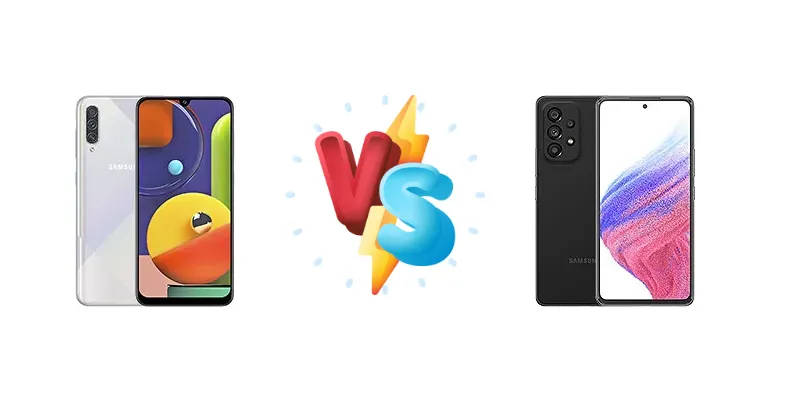
Choosing between the Samsung Galaxy A50s and A53 5G can be tough. Both offer compelling features at mid-range prices, but cater to slightly different needs. This comprehensive comparison will help you decide which phone is the right fit for you.
🏆 Quick Verdict
The Galaxy A53 5G is the clear winner, offering a more modern chipset, 5G connectivity, a brighter display, and faster charging. While the A50s remains a capable device, the A53 5G's upgrades make it a worthwhile investment for most users.
| Network |
|---|
| 2G bands | GSM 850 / 900 / 1800 / 1900 | GSM 850 / 900 / 1800 / 1900 |
| 3G bands | HSDPA 850 / 900 / 1900 / 2100 | HSDPA 850 / 900 / 1700(AWS) / 1900 / 2100 |
| 4G bands | 1, 3, 5, 7, 8, 20, 28, 38, 40, 41 | 1, 2, 3, 4, 5, 7, 12, 14, 20, 29, 30, 38, 39, 40, 41, 46, 48, 66 - SM-A536U |
| 5G bands | - | 2, 5, 41, 66, 77, 78 SA/NSA/Sub6/mmWave - SM-A536U |
| Speed | HSPA, LTE | HSPA, LTE, 5G |
| Technology | GSM / HSPA / LTE | GSM / HSPA / LTE / 5G |
| | - | 2, 5, 48, 66, 77, 78, 260, 261 SA/NSA/Sub6/mmWave - SM-A536V |
| Launch |
|---|
| Announced | 2019, August 22. Released 2019, September | 2022, March 17 |
| Status | Discontinued | Available. Released 2022, March 24 |
| Body |
|---|
| Build | Glass front (Gorilla Glass 3), plastic back, plastic frame | Glass front (Gorilla Glass 5), plastic frame, plastic back |
| Dimensions | 158.5 x 74.5 x 7.7 mm (6.24 x 2.93 x 0.30 in) | 159.6 x 74.8 x 8.1 mm (6.28 x 2.94 x 0.32 in) |
| SIM | · Nano-SIM· Nano-SIM + Nano-SIM | · Nano-SIM· Nano-SIM + Nano-SIM |
| Weight | 169 g (5.96 oz) | 189 g (6.67 oz) |
| | - | IP67 dust/water resistant (up to 1m for 30 min) |
| Display |
|---|
| Protection | Corning Gorilla Glass 3 | Corning Gorilla Glass 5 |
| Resolution | 1080 x 2340 pixels, 19.5:9 ratio (~403 ppi density) | 1080 x 2400 pixels, 20:9 ratio (~405 ppi density) |
| Size | 6.4 inches, 100.5 cm2 (~85.1% screen-to-body ratio) | 6.5 inches, 102.0 cm2 (~85.4% screen-to-body ratio) |
| Type | Super AMOLED | Super AMOLED, 120Hz, 800 nits (HBM) |
| Platform |
|---|
| CPU | Octa-core (4x2.3 GHz Cortex-A73 & 4x1.7 GHz Cortex-A53) | Octa-core (2x2.4 GHz Cortex-A78 & 6x2.0 GHz Cortex-A55) |
| Chipset | Exynos 9611 (10 nm) | Exynos 1280 (5 nm) |
| GPU | Mali-G72 MP3 | Mali-G68 |
| OS | Android 9.0 (Pie), upgradable to Android 11, One UI 3.1 | Android 12, up to 4 major Android upgrades, One UI 8 |
| Memory |
|---|
| Card slot | microSDXC (dedicated slot) | microSDXC (uses shared SIM slot) |
| Internal | 64GB 4GB RAM, 128GB 4GB RAM, 128GB 6GB RAM | 128GB 4GB RAM, 128GB 6GB RAM, 128GB 8GB RAM, 256GB 6GB RAM, 256GB 8GB RAM |
| | UFS 2.1 | - |
| Main Camera |
|---|
| Features | LED flash, panorama, HDR | LED flash, panorama, HDR |
| Quad | - | 64 MP, f/1.8, 26mm (wide), 1/1.7X", 0.8µm, PDAF, OIS
12 MP, f/2.2, 123˚ (ultrawide), 1.12µm
5 MP (macro)
Auxiliary lens |
| Single | - | 32 MP, f/2.2, 26mm (wide), 1/2.8", 0.8µm |
| Triple | 48 MP, f/2.0, 26mm (wide), 1/2.0", 0.8µm, PDAF
8 MP, f/2.2, 13mm (ultrawide), 1/4.0", 1.12µm
Auxiliary lens | - |
| Video | 4K@30fps, 1080p@30fps | 4K@30fps, 1080p@30/60fps; gyro-EIS |
| Selfie camera |
|---|
| Features | HDR | HDR |
| Single | 32 MP, f/2.0, 25mm (wide), 1/2.8", 0.8µm | 32 MP, f/2.2, 26mm (wide), 1/2.8", 0.8µm |
| Video | 4K@30fps, 1080p@30fps | 4K@30fps, 1080p@30fps |
| Sound |
|---|
| 3.5mm jack | Yes | No |
| 35mm jack | Yes | No |
| Loudspeaker | Yes | Yes, with stereo speakers |
| Comms |
|---|
| Bluetooth | 5.0, A2DP, LE | 5.1, A2DP, LE |
| NFC | Yes (market/region dependent) | Yes (market/region dependent) |
| Positioning | GPS, GLONASS, GALILEO, BDS | GPS, GLONASS, GALILEO, BDS |
| Radio | FM radio | No |
| USB | USB Type-C 2.0, OTG | USB Type-C 2.0, OTG |
| WLAN | Wi-Fi 802.11 a/b/g/n/ac, dual-band, Wi-Fi Direct | Wi-Fi 802.11 a/b/g/n/ac, dual-band, Wi-Fi Direct |
| Features |
|---|
| Sensors | Fingerprint (under display, optical), accelerometer, gyro, proximity, compass | Fingerprint (under display, optical), accelerometer, gyro, compass, barometer (market/region dependent) |
| | ANT+ | Virtual proximity sensing |
| Battery |
|---|
| Charging | 15W wired | 25W wired |
| Type | Li-Po 4000 mAh, non-removable | Li-Po 5000 mAh |
| Misc |
|---|
| Colors | Prism Crush Black, Prism Crush White, Prism Crush Green, Prism Crush Violet2 | Black, White, Blue, Peach |
| Models | SM-A507F, SM-A507FN, SM-A5070 | SM-A536B, SM-A536B/DS, SM-A536U, SM-A536U1, SM-A5360, SM-A536E, SM-A536E/DS, SM-A536V, SM-A536W, SM-A536N, SM-S536DL |
| Price | About 290 EUR | $ 151.42 / £ 185.00 / € 169.14 |
| SAR | - | 0.75 W/kg (head) 1.58 W/kg (body) |
| SAR EU | 0.43 W/kg (head) 1.55 W/kg (body) | 0.89 W/kg (head) 1.60 W/kg (body) |
| Tests |
|---|
| Battery life | - |
Endurance rating 113h
|
| Camera | - |
Photo / Video |
| Display | - |
Contrast ratio: Infinite (nominal) |
| Loudspeaker | - |
-26.5 LUFS (Good)
|
| Performance |
AnTuTu: 154761 (v7)
GeekBench: 5295 (v4.4)
GFXBench: 9.2fps (ES 3.1 onscreen) |
AnTuTu: 329802 (v8), 379313 (v9)
GeekBench: 1891 (v5.1)
GFXBench: 19fps (ES 3.1 onscreen) |
Samsung Galaxy A50s
- Good display
- Capable camera
- Affordable price
- Older chipset
- Slower charging
- No 5G
Samsung Galaxy A53 5G
- 5G connectivity
- Faster performance (Exynos 1280)
- Brighter display
- Faster charging (25W)
- Improved camera (likely)
- Higher price
- Potential for software bloat (typical of Samsung
Display Comparison
The Galaxy A53 5G boasts a significant advantage with its 830 nits max brightness, offering better visibility in sunlight. Its 'Infinite' contrast ratio (nominal) suggests deeper blacks and richer colors. The A50s has a decent display, but lacks the A53 5G's brightness and potentially contrast.
Camera Comparison
Both phones offer capable cameras, but the A53 5G likely has improvements in image processing and low-light performance due to its newer hardware. Specific camera specs are missing, but generally newer sensors and processing algorithms lead to better results. Expect improved video recording capabilities on the A53 5G as well.
Performance
The Exynos 1280 in the A53 5G is a substantial upgrade over the A50s' Exynos 9611. The newer chipset's 5nm process and Cortex-A78 cores deliver noticeably faster performance for gaming, multitasking, and overall responsiveness. The A50s is still usable, but will show its age with demanding tasks.
Battery Life
Both phones share an impressive endurance rating of 113h, suggesting excellent battery life. However, the A53 5G's 25W charging is faster than the A50s' 15W, allowing for quicker top-ups.
Buying Guide
Who should buy the Samsung Galaxy A50s? Those on a tight budget who prioritize a good display and camera, and don't need 5G. Who should buy the Samsung Galaxy A53 5G? Anyone seeking a future-proof device with 5G, improved performance, and a brighter, more vibrant display.
Frequently Asked Questions
❓ Is the A53 5G worth the upgrade from the A50s?
Yes, if you value 5G connectivity, improved performance, and a brighter display. The A53 5G offers a more modern and future-proof experience.
❓ Which phone has better battery life?
Both phones have excellent battery life, with an endurance rating of 113h. However, the A53 5G charges faster.