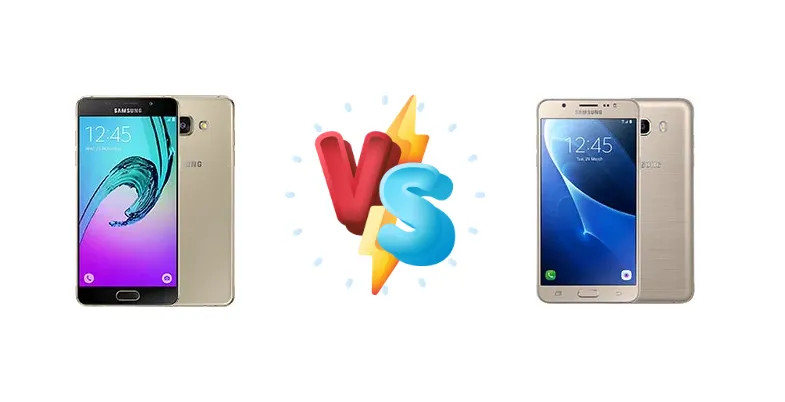
The Samsung Galaxy A5 (2016) and Galaxy J7 (2016) were popular mid-range smartphones, offering a blend of features and affordability. But which one truly reigned supreme? This comprehensive comparison dives deep into their specs, performance, and overall value to help you decide which phone was the better choice.
🏆 Quick Verdict
The Galaxy J7 (2016) edges out the A5 (2016) thanks to its slightly better chipset, marginally superior display in sunlight, and a comparable battery life with a slightly better endurance rating. Both offer solid value, but the J7 provides a bit more performance for the money.
| Network |
|---|
| 2G bands | GSM 850 / 900 / 1800 / 1900 - SIM 1 & SIM 2 (dual-SIM model only) | GSM 850 / 900 / 1800 / 1900 - SIM 1 & SIM 2 (dual-SIM model only) |
| 3G bands | HSDPA 850 / 900 / 1900 / 2100 | HSDPA 850 / 900 / 1900 / 2100 |
| 4G bands | 1, 3, 5, 7, 8, 20, 40 | 1, 3, 5, 7, 8, 20, 40 |
| Speed | HSPA 42.2/5.76 Mbps, LTE Cat6 300/50 Mbps | HSPA, LTE Cat4 150/50 Mbps |
| Technology | GSM / UMTS / HSPA / LTE | GSM / HSPA / LTE |
| | UMTS 2100 | - |
| Launch |
|---|
| Announced | 2015, December. Released 2015, December | 2016, March 29. Released 2016, April |
| Status | Discontinued | Discontinued |
| Body |
|---|
| Build | Glass front (Gorilla Glass 4), glass back (Gorilla Glass 4), aluminum frame | Glass front, plastic back, aluminum frame |
| Dimensions | 144.8 x 71 x 7.3 mm (5.70 x 2.80 x 0.29 in) | 151.7 x 76 x 7.8 mm (5.97 x 2.99 x 0.31 in) |
| SIM | · Nano-SIM· Nano-SIM + Nano-SIM | Single SIM (Micro-SIM) or Dual SIM (Micro-SIM, dual stand-by) |
| Weight | 155 g (5.47 oz) | 170 g (6.00 oz) |
| Display |
|---|
| Protection | Corning Gorilla Glass 4 | - |
| Resolution | 1080 x 1920 pixels, 16:9 ratio (~424 ppi density) | 720 x 1280 pixels, 16:9 ratio (~267 ppi density) |
| Size | 5.2 inches, 74.5 cm2 (~72.5% screen-to-body ratio) | 5.5 inches, 83.4 cm2 (~72.3% screen-to-body ratio) |
| Type | Super AMOLED | Super AMOLED |
| Platform |
|---|
| CPU | Octa-core 1.6 GHz Cortex-A53Octa-core (4x1.2 GHz Cortex-A53 & 4x1.5 GHz Cortex-A53) - China only | Octa-core (4x1.6 GHz Cortex-A53 & 4x1.0 GHz Cortex-A53)Octa-core 1.6 GHz Cortex-A53 |
| Chipset | Exynos 7580 Octa (28 nm)Qualcomm MSM8939 Snapdragon 615 (28 nm) - China only | Qualcomm MSM8952 Snapdragon 617 (28 nm)Exynos 7870 Octa (14 nm) |
| GPU | Mali-T720MP2Adreno 405 - China only | Adreno 405Mali-T830 MP1 |
| OS | Android 5.1.1 (Lollipop), upgradable to 7.0 (Nougat) | Android 6.0.1 (Marshmallow), upgradable to Android 8.1 (Oreo) |
| Memory |
|---|
| Card slot | microSDXC (uses shared SIM slot) - dual SIM model only | microSDXC (dedicated slot) |
| Internal | 16GB 2GB RAM | 16GB 2GB RAM |
| | eMMC 5.0 or eMMC 4.5 | eMMC 5.1 |
| Main Camera |
|---|
| Features | LED flash, panorama, HDR | LED flash, panorama, HDR |
| Quad | 48 MP, (wide), 1/2.0", 0.8µm, PDAF
2 MP, (macro)
2 MP, (depth)
2 MP | - |
| Single | 13 MP, f/1.9, 28mm (wide), AF, OIS | 13 MP, f/1.9, 28mm (wide), AF |
| Video | 1080p@30fps | 1080p@30fps |
| Selfie camera |
|---|
| Features | Dual-LED flash | LED flash |
| Single | 5 MP, f/1.9, 24mm (wide) | 5 MP, f/1.9 |
| Video | 1080p@30fps | - |
| Sound |
|---|
| 3.5mm jack | Yes | Yes |
| 35mm jack | Yes | Yes |
| Loudspeaker | Yes | Yes |
| Comms |
|---|
| Bluetooth | 4.1, A2DP, EDR, LE | 4.1, A2DP |
| NFC | Yes | Yes (market dependent for dual-SIM model) |
| Positioning | GPS, GLONASS | GPS, GLONASS, BDS |
| Radio | FM radio | FM radio, RDS, recording |
| USB | microUSB 2.0, OTG | microUSB 2.0, OTG |
| WLAN | Wi-Fi 802.11 a/b/g/n, dual-band, Wi-Fi Direct, hotspot | Wi-Fi 802.11 b/g/n, Wi-Fi Direct |
| Features |
|---|
| Sensors | Fingerprint (front-mounted), accelerometer, proximity, compass | Accelerometer, proximity |
| | ANT+
Samsung Pay | ANT+ |
| Battery |
|---|
| Charging | 18W wired | - |
| Music play | Up to 75 h | Up to 96 h |
| Talk time | Up to 16 h (3G) | Up to 23 h (3G) |
| Type | Li-Ion 2900 mAh, non-removable | Li-Ion 3300 mAh, removable |
| Misc |
|---|
| Colors | Black, White, Gold, Pink | White, Black, Gold, Rose Gold |
| Models | SM-A5100, SM-A510F, SM-A510M, SM-A510Y, SM-A510FD, SM-A5108, SM-A510S, SM-A510K, SM-A510L, SM-A510 | SM-J710FN, SM-J710F, SM-J710H, SM-J710M, SM-J710GN, SM-J710MN, SM-J710K, SM-J7108, SM-J710FQ |
| Price | About 160 EUR | About 230 EUR |
| SAR | 0.29 W/kg (head) 0.47 W/kg (body) | 1.10 W/kg (head) 1.01 W/kg (body) |
| SAR EU | 0.29 W/kg (head) 0.47 W/kg (body) | 0.35 W/kg (head) 1.39 W/kg (body) |
| Tests |
|---|
| Audio quality |
Noise -93.4dB / Crosstalk -53.0dB |
Noise -92.4dB / Crosstalk -92.3dB |
| Battery life |
Endurance rating 91h
|
Endurance rating 101h
|
| Camera |
Photo / Video |
Photo / Video |
| Display |
Contrast ratio: Infinite (nominal), 3.789 (sunlight)3.789 |
Contrast ratio: Infinite (nominal), 3.902 (sunlight) |
| Loudspeaker |
Voice 65dB / Noise 66dB / Ring 66dB
|
Voice 64dB / Noise 71dB / Ring 68dB
|
| Performance |
Basemark OS II 2.0: 833Basemark X: 4947 |
Basemark OS II 2.0: 1007Basemark X: 11199 |
Samsung Galaxy A5 (2016)
- Premium Design
- Compact Size
- Vibrant Super AMOLED Display
- Slightly Weaker Performance
- Lower Battery Life Compared to J7
- Camera Performance Average
Samsung Galaxy J7 (2016)
- Better Performance (Snapdragon 617/Exynos 7870)
- Longer Battery Life
- Good Sunlight Readability
- Larger Screen
- Less Premium Design
- Potentially Larger Size
- Camera Performance Average
Display Comparison
Both phones feature Super AMOLED displays, known for their vibrant colors and deep blacks. The A5 (2016) boasts a contrast ratio listed as 'Infinite' (likely a marketing term), while the J7 (2016) has a sunlight readability score of 3.902 compared to the A5's 3.789. While both are good, the J7 (2016) performs slightly better in bright conditions.
Camera Comparison
Camera performance was generally comparable between the two. Both phones featured decent cameras for their time, capable of capturing acceptable photos and videos in good lighting conditions. Low-light performance was a weakness for both. Specific camera specs are missing, making a definitive winner difficult to declare.
Performance
The Galaxy J7 (2016) has a clear advantage here. It features either the Snapdragon 617 or the Exynos 7870, both generally offering better performance than the A5 (2016)'s Exynos 7580 or Snapdragon 615 (China only). This translates to smoother multitasking and faster app loading times on the J7.
Battery Life
The Galaxy J7 (2016) takes the lead with an endurance rating of 101 hours, slightly surpassing the A5 (2016)'s 91 hours. This suggests the J7 (2016) offers slightly better battery life, allowing for longer usage between charges.
Buying Guide
The Samsung Galaxy A5 (2016) is a good choice for users prioritizing a more premium design and a slightly more compact form factor. The Galaxy J7 (2016) is ideal for those seeking better performance, a larger screen, and longer battery life without breaking the bank.
Frequently Asked Questions
❓ Which phone is better for gaming?
The Galaxy J7 (2016) is generally better for gaming due to its more powerful chipset.
❓ Is the A5 (2016) still worth buying?
Given their age, both phones are likely difficult to find new. If you find one in good condition at a very low price, the A5 (2016) could be a decent option for basic use, but the J7 (2016) remains the slightly better choice.