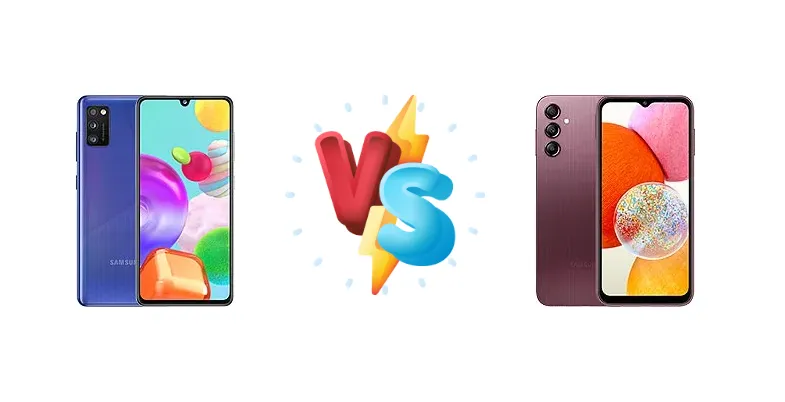
Choosing a budget-friendly Samsung phone can be tricky. The Galaxy A41 and A14 are both solid contenders, but which one offers the best value? This comprehensive comparison dives deep into their specs and features to help you make an informed decision.
🏆 Quick Verdict
The Galaxy A14 generally edges out the A41 thanks to its more modern chipset and potentially improved camera capabilities. While the A41 boasts impressive battery endurance, the A14's overall performance and features make it a more compelling choice for most users.
| Network |
|---|
| 2G bands | GSM 850 / 900 / 1800 / 1900 | GSM 850 / 900 / 1800 / 1900 |
| 3G bands | HSDPA 850 / 900 / 1900 / 2100 | HSDPA 850 / 900 / 2100 |
| 4G bands | 1, 3, 5, 7, 8, 20, 28, 38, 40, 41 | 1, 3, 5, 7, 8, 20, 28, 38, 40, 41 |
| Speed | HSPA, LTE | HSPA, LTE |
| Technology | GSM / HSPA / LTE | GSM / HSPA / LTE |
| Launch |
|---|
| Announced | 2020, March 18. Released 2020, May 22 | 2023, February 28 |
| Status | Discontinued | Available. Released 2023, March 27 |
| Body |
|---|
| Build | Glass front, plastic back, plastic frame | Glass front, plastic back, plastic frame |
| Dimensions | 149.9 x 69.8 x 7.9 mm (5.90 x 2.75 x 0.31 in) | 167.7 x 78 x 9.1 mm (6.60 x 3.07 x 0.36 in) |
| SIM | · Nano-SIM· Nano-SIM + Nano-SIM | · Nano-SIM· Nano-SIM + Nano-SIM |
| Weight | 152 g (5.36 oz) | 201 g (7.09 oz) |
| Display |
|---|
| Resolution | 1080 x 2400 pixels, 20:9 ratio (~431 ppi density) | 1080 x 2408 pixels, 20:9 ratio (~400 ppi density) |
| Size | 6.1 inches, 89.8 cm2 (~85.9% screen-to-body ratio) | 6.6 inches, 104.9 cm2 (~80.2% screen-to-body ratio) |
| Type | Super AMOLED | PLS LCD |
| Platform |
|---|
| CPU | Octa-core (2x2.0 GHz Cortex-A75 & 6x1.7 GHz Cortex-A55) | Octa-core (2x2.0 GHz Cortex-A75 & 6x1.8 GHz Cortex-A55) - Version AOcta-core (4x2.0 GHz Cortex-A55 & 4x2.0 GHz Cortex-A55) - Version B |
| Chipset | Mediatek MT6768 Helio P65 (12 nm) | Mediatek MT6769 Helio G80 (12 nm) - Version AExynos 850 (8 nm) - Version B |
| GPU | Mali-G52 MC2 | Mali-G52 MC2 |
| OS | Android 10, upgradable to Android 12, One UI 4.1 | Android 13, upgradable to Android 15, One UI 7 |
| Memory |
|---|
| Card slot | microSDXC (dedicated slot) | microSDXC (dedicated slot) |
| Internal | 64GB 4GB RAM, 64GB 8GB RAM | 64GB 4GB RAM, 128GB 4GB RAM, 128GB 6GB RAM |
| | eMMC 5.1 | - |
| Main Camera |
|---|
| Features | LED flash, panorama, HDR | LED flash, panorama, HDR |
| Single | - | 13 MP, f/2.0, (wide) |
| Triple | 48 MP, f/2.0, 26mm (wide), 1/2.0", 0.8µm, PDAF
8 MP, f/2.2, 123˚ (ultrawide), 1/4.0", 1.12µm
Auxiliary lens | 50 MP, f/1.8, 26mm (wide), 1/2.75", 0.64µm, PDAF
5 MP, f/2.2, 17mm (ultrawide), 1/5.0", 1.12µm
2 MP (macro) |
| Video | 1080p@30fps | 1080p@30fps |
| Selfie camera |
|---|
| Single | 25 MP, f/2.2, 25mm (wide), 1/2.8", 0.9µm | 13 MP, f/2.0, 26mm (wide), 1/3.1", 1.12µm |
| Video | 1080p@30fps | 1080p@30fps |
| Sound |
|---|
| 3.5mm jack | Yes | Yes |
| 35mm jack | Yes | Yes |
| Loudspeaker | Yes | Yes |
| Comms |
|---|
| Bluetooth | 5.0, A2DP, LE | 5.1 or 5.3, A2DP, LE |
| NFC | Yes | Yes (market/region dependent) |
| Positioning | GPS, GLONASS, GALILEO, BDS | GPS, GALILEO, GLONASS, BDS, QZSS |
| Radio | FM radio, recording | Unspecified |
| USB | USB Type-C 2.0 | USB Type-C 2.0 |
| WLAN | Wi-Fi 802.11 a/b/g/n/ac, dual-band, Wi-Fi Direct | Wi-Fi 802.11 a/b/g/n/ac, dual-band, Wi-Fi Direct |
| Features |
|---|
| Sensors | Fingerprint (under display, optical), accelerometer, gyro, compass | Fingerprint (side-mounted), accelerometer, proximity, compass |
| | Virtual proximity sensing | - |
| Battery |
|---|
| Charging | 15W wired | 15W wired |
| Type | Li-Po 3500 mAh | Li-Po 5000 mAh |
| Misc |
|---|
| Colors | Prism Crush Black, Prism Crush Silver, Prism Crush Blue, Prism Crush Red | Black, Dark Red, Silver, Green |
| Models | SM-A415F/DSN, SM-A415F/DSM, SM-A415F, SM-A415F/DS, SCV48, SC-41A | SM-A145F, SM-A145F/DSN, SM-A145M, SM-A145M/DS, SM-A145P, SM-A145R |
| Price | About 290 EUR | € 85.76 / $ 147.60 / £ 79.95 |
| SAR EU | 0.59 W/kg (head) 1.50 W/kg (body) | 0.46 W/kg (head) 1.37 W/kg (body) |
| Tests |
|---|
| Battery life |
Endurance rating 102h
| - |
| Camera |
Photo / Video | - |
| Display |
Contrast ratio: Infinite (nominal) | - |
| Loudspeaker |
-30.5 LUFS (Below average)
| - |
| Performance |
AnTuTu: 170044 (v8)
GeekBench: 1175 (v5.1)
GFXBench: 6.9fps (ES 3.1 onscreen) | - |
Samsung Galaxy A41
- Exceptional battery life
- Bright Super AMOLED display
- Decent performance for everyday tasks
- Older chipset
- Less powerful than A14
- Potentially lower camera quality
Samsung Galaxy A14
- More modern chipset (Helio G80 or Exynos 850)
- Potentially better camera performance
- Larger display
- More contemporary design
- Battery life not as exceptional as A41
- PLS LCD display (not AMOLED)
Display Comparison
The A41 features a 6.5-inch Super AMOLED display with a measured peak brightness of 624 nits and an infinite contrast ratio, promising vibrant colors and deep blacks. The A14 typically has a 6.6-inch PLS LCD display. While the A14's screen is larger, the A41's AMOLED technology generally provides a superior viewing experience with better color accuracy and contrast.
Camera Comparison
Both phones offer versatile camera setups. The A41 typically features a triple-lens rear camera system (main, ultrawide, depth). The A14 generally has a quad-camera setup (main, ultrawide, macro, depth). While specific megapixel counts vary, the A14's newer chipset and potentially improved image processing algorithms likely result in better image quality, especially in low-light conditions.
Performance
The A41 utilizes a Mediatek Helio P65 chipset, which is adequate for everyday tasks but can struggle with demanding games. The A14 offers two chipset options: a Mediatek Helio G80 or an Exynos 850. The Helio G80 provides a noticeable performance boost over the P65, while the Exynos 850 offers even better performance, making the A14 the clear winner in this category.
Battery Life
The A41 shines in battery life, boasting an impressive endurance rating of 102 hours. The A14's battery life is generally good, but not quite as exceptional as the A41's. However, the A14's more efficient chipset can help offset this difference.
Buying Guide
Who should buy the Samsung Galaxy A41? Users prioritizing exceptional battery life and a bright display on a tight budget. Who should buy the Samsung Galaxy A14? Those seeking a more modern chipset, potentially better camera performance, and a slightly more contemporary design.
Frequently Asked Questions
❓ Is the Samsung Galaxy A41 still worth buying?
If battery life is your absolute top priority and you can find it at a significantly lower price than the A14, it's still a viable option. However, the A14 generally offers a better overall experience.
❓ Which chipset is better in the Samsung Galaxy A14: Helio G80 or Exynos 850?
The Exynos 850 is generally the better chipset, offering noticeably improved performance compared to the Helio G80. It's better suited for multitasking and demanding applications.