
Samsung Galaxy A36 vs Google Pixel 7a: A Deep Dive into Battery, Performance, and Value
| Phones Images | |||||
|---|---|---|---|---|---|
|
🏆 Quick Verdict
For the average user prioritizing longevity and fast refueling, the Samsung Galaxy A36 emerges as the winner. Its remarkable 41:28h battery endurance and 45W charging significantly outperform the Pixel 7a, despite the latter’s more powerful processor. However, the Pixel 7a remains a strong contender for camera enthusiasts.
| PHONES | ||
|---|---|---|
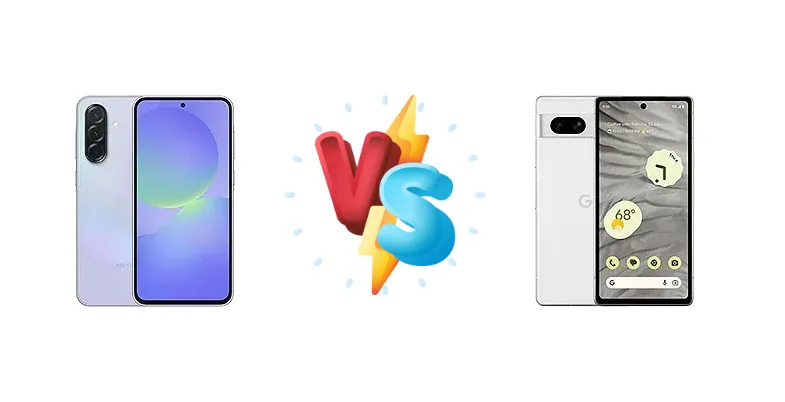
| Phone Names | Samsung Galaxy A36 | Google Pixel 7a |
| Network | ||
|---|---|---|
| 2G bands | GSM 850 / 900 / 1800 / 1900 | GSM 850 / 900 / 1800 / 1900 |
| 3G bands | HSDPA 850 / 900 / 1700(AWS) / 1900 / 2100 | HSDPA 800 / 850 / 900 / 1700(AWS) / 1900 / 2100 |
| 4G bands | 1, 2, 3, 4, 5, 7, 8, 12, 17, 20, 25, 26, 28, 32, 38, 40, 41, 66 | 1, 2, 3, 4, 5, 7, 8, 12, 13, 14, 17, 20, 25, 26, 28, 29, 30, 38, 40, 41, 48, 66, 71 - GWKK3, G0DZQ |
| 5G bands | 1, 3, 5, 7, 8, 20, 28, 38, 40, 41, 66, 77, 78 SA/NSA/Sub6 | 1, 2, 3, 5, 7, 8, 12, 14, 20, 25, 28, 30, 38, 41, 48, 66, 71, 77, 78 SA/NSA/Sub6 - GWKK3 |
| Speed | HSPA, LTE, 5G | HSPA, LTE, 5G |
| Technology | GSM / HSPA / LTE / 5G | GSM / HSPA / LTE / 5G |
| - | 1, 2, 3, 5, 7, 8, 12, 20, 25, 28, 38, 40, 41, 66, 75, 76, 77, 78, 79 SA/NSA/Sub6 - GHL1X, G82U8 | |
| Launch | ||
|---|---|---|
| Announced | 2025, March 02 | 2023, May 10 |
| Status | Available. Released 2025, March 10 | Available. Released 2023, May 10 |
| Body | ||
|---|---|---|
| Build | Glass front (Gorilla Glass Victus+), plastic frame, glass back (Gorilla Glass Victus+) | Glass front (Gorilla Glass 3), aluminum frame, plastic back |
| Dimensions | 162.9 x 78.2 x 7.4 mm (6.41 x 3.08 x 0.29 in) | 152 x 72.9 x 9 mm (5.98 x 2.87 x 0.35 in) |
| SIM | Nano-SIM + Nano-SIM + eSIM + eSIM (max 2 at a time) | Nano-SIM + eSIM |
| Weight | 195 g (6.88 oz) | 193.5 g (6.84 oz) |
| - | IP67 dust/water resistant (up to 1m for 30 min) | |
| Display | ||
|---|---|---|
| Protection | Corning Gorilla Glass Victus+, Mohs level 5 | Corning Gorilla Glass 3 |
| Resolution | 1080 x 2340 pixels, 19.5:9 ratio (~385 ppi density) | 1080 x 2400 pixels, 20:9 ratio (~429 ppi density) |
| Size | 6.7 inches, 110.2 cm2 (~86.5% screen-to-body ratio) | 6.1 inches, 90.7 cm2 (~81.8% screen-to-body ratio) |
| Type | Super AMOLED, 120Hz, 1200 nits (HBM), 1900 nits (peak) | OLED, HDR, 90Hz |
| - | Always-on display | |
| Platform | ||
|---|---|---|
| CPU | Octa-core (4x2.4 GHz Cortex-A78 & 4x1.8 GHz Cortex-A55) | Octa-core (2x2.85 GHz Cortex-X1 & 2x2.35 GHz Cortex-A78 & 4x1.80 GHz Cortex-A55) |
| Chipset | Qualcomm SM6475-AB Snapdragon 6 Gen 3 (4 nm) | Google Tensor G2 (5 nm) |
| GPU | Adreno 710 | Mali-G710 MP7 |
| OS | Android 15, up to 6 major Android upgrades, One UI 7 | Android 13, upgradable to Android 15, up to 5 major Android upgrades |
| Memory | ||
|---|---|---|
| Card slot | No | No |
| Internal | 128GB 6GB RAM, 128GB 8GB RAM, 256GB 6GB RAM, 256GB 8GB RAM, 256GB 12GB RAM | 128GB 8GB RAM |
| - | UFS 3.1 | |
| Main Camera | ||
|---|---|---|
| Dual | - | 64 MP, f/1.9, 26mm (wide), 1/1.73", 0.8µm, dual pixel PDAF, OIS 13 MP, f/2.2, 120˚ (ultrawide), 1.12µm |
| Features | LED flash, panorama, HDR | Dual-LED flash, Pixel Shift, Auto-HDR, panorama |
| Triple | 50 MP, f/1.8, (wide), 1/1.96", PDAF, OIS 8 MP, f/2.2, 123˚, (ultrawide), 1/4.0", 1.12µm 5 MP (macro) | - |
| Video | 4K@30fps, 1080p@30/60fps, gyro-EIS | 4K@30/60fps, 1080p@30/60/120/240fps, OIS |
| Selfie camera | ||
|---|---|---|
| Features | - | HDR, panorama |
| Single | 12 MP, f/2.2, (wide) | 13 MP, f/2.2, 20mm (ultrawide), 1.12µm |
| Video | 4K@30fps, 1080p@30fps, 10-bit HDR | 4K@30fps, 1080p@30fps |
| Sound | ||
|---|---|---|
| 3.5mm jack | - | No |
| 35mm jack | No | No |
| Loudspeaker | Yes, with stereo speakers | Yes, with stereo speakers |
| Comms | ||
|---|---|---|
| Bluetooth | 5.4, A2DP, LE | 5.3, A2DP, LE |
| NFC | Yes (market/region dependent) | Yes |
| Positioning | GPS, GALILEO, GLONASS, BDS, QZSS | GPS, GLONASS, GALILEO, BDS, QZSS, NavIC |
| Radio | No | No |
| USB | USB Type-C 2.0, OTG | USB Type-C 3.2 |
| WLAN | Wi-Fi 802.11 a/b/g/n/ac/6, dual-band, Wi-Fi Direct | Wi-Fi 802.11 a/b/g/n/ac/6e, tri-band |
| Features | ||
|---|---|---|
| Sensors | Fingerprint (under display, optical), accelerometer, gyro, compass | Fingerprint (under display, optical), accelerometer, gyro, proximity, compass, barometer |
| Battery | ||
|---|---|---|
| Charging | 45W wired, 66% in 30 min, 100% in 68 min | 18W wired, PD3.0 7.5W wireless |
| Type | 5000 mAh | Li-Po 4385 mAh |
| Misc | ||
|---|---|---|
| Colors | Lavender, Black, White, Lime | Charcoal, Snow, Sea, Coral |
| Models | SM-A366E, SM-A366E/DS, SM-A366B, SM-A366B/DS, SM-A366U, SM-A366U1, SM-A366W | GWKK3, GHL1X, G0DZQ, G82U8 |
| Price | € 232.99 / $ 243.29 / £ 189.00 / ₹ 28,898 | € 179.90 / $ 150.00 / £ 170.00 / ₹ 25,980 |
| SAR | 1.07 W/kg (head) | - |
| SAR EU | 0.53 W/kg (head) 1.29 W/kg (body) | - |
| EU LABEL | ||
|---|---|---|
| Battery | 41:28h endurance, 2000 cycles | - |
| Energy | Class C | - |
| Free fall | Class C (90 falls) | - |
| Repairability | Class C | - |
Samsung Galaxy A36
- Exceptional battery life (41:28h endurance)
- Ultra-fast 45W charging
- Bright display (1233 nits)
- Less powerful processor than the Pixel 7a
- Camera performance likely trails the Pixel 7a
Google Pixel 7a
- Powerful Tensor G2 chipset
- Excellent camera software and image processing
- Clean Android experience
- Significantly shorter battery life
- Slow 18W charging
Display Comparison
The Samsung Galaxy A36 boasts a brighter display, reaching a measured 1233 nits compared to the Pixel 7a’s 1070 nits. This translates to better visibility outdoors under direct sunlight. While both displays likely utilize AMOLED technology (though not explicitly stated), the A36’s higher peak brightness is a tangible advantage. We lack PWM frequency data for both, but the A36’s brightness advantage may allow for more comfortable viewing at lower brightness levels. Bezels are assumed to be comparable given the market segment, and color accuracy is likely excellent on both, though Samsung historically leans towards more saturated colors.
Camera Comparison
The Pixel 7a’s camera system is a known strength, leveraging Google’s computational photography prowess. While specific sensor details are missing for both devices, the Pixel 7a’s reputation suggests a focus on image processing and dynamic range. The A36’s camera capabilities are less well-defined, but Samsung typically emphasizes vibrant colors and detail. The Pixel 7a’s video capabilities are also likely superior, benefiting from the Tensor G2’s image signal processor. The absence of details on OIS and lens apertures makes a precise comparison difficult, but the Pixel 7a’s software advantage is a significant factor.
Performance
The Google Pixel 7a’s Tensor G2 (5nm) chipset, with its Cortex-X1 prime cores, offers a clear performance advantage over the Samsung Galaxy A36’s Snapdragon 6 Gen 3 (4nm) in CPU-intensive tasks. The Tensor G2’s 2x2.85 GHz Cortex-X1 cores will outperform the A36’s 4x2.4 GHz Cortex-A78 cores. However, the Snapdragon 6 Gen 3’s 4nm process offers improved power efficiency. The A36’s architecture, while less powerful, is optimized for sustained performance, potentially avoiding the thermal throttling that can sometimes affect the Tensor G2 under prolonged load. The Pixel 7a will excel in tasks like video editing and complex gaming, while the A36 will handle everyday tasks and moderate gaming with ease.
Battery Life
The Samsung Galaxy A36 dominates in battery performance. Its impressive 41:28h endurance rating, coupled with 2000 charge cycles, significantly surpasses the Pixel 7a’s older 76h rating. The A36 also boasts 45W wired charging, achieving 66% charge in 30 minutes and 100% in 68 minutes, a substantial improvement over the Pixel 7a’s 18W charging with PD3.0 and 7.5W wireless charging. This means less time tethered to a charger and greater peace of mind for users who rely heavily on their phones.
Buying Guide
Buy the Samsung Galaxy A36 if you need a phone that can reliably last through a full day – and then some – with heavy use, and if minimizing downtime with fast charging is crucial. Buy the Google Pixel 7a if you prioritize computational photography, a clean Android experience, and a more powerful processor for demanding tasks, even at the expense of battery life.