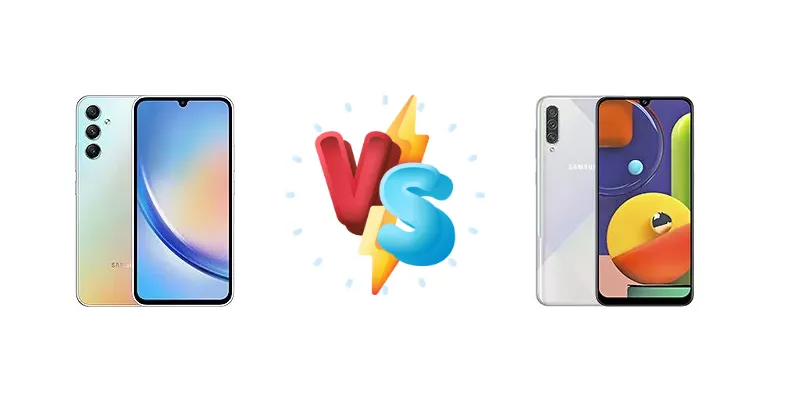
Choosing a new Samsung phone can be tough, especially with so many options. Today, we're pitting two popular mid-range contenders against each other: the newer Samsung Galaxy A34 and the older, but still capable, Samsung Galaxy A50s. Let's dive into a detailed comparison to help you decide which one is right for you.
🏆 Quick Verdict
The Samsung Galaxy A34 is the clear winner, offering a brighter display, significantly better performance thanks to its newer chipset, and a much larger battery. While the A50s remains a decent budget option, the A34's advancements make it the more compelling choice for most users.
| Network |
|---|
| 2G bands | GSM 850 / 900 / 1800 / 1900 | GSM 850 / 900 / 1800 / 1900 |
| 3G bands | HSDPA 850 / 900 / 1700(AWS) / 1900 / 2100 | HSDPA 850 / 900 / 1900 / 2100 |
| 4G bands | 1, 2, 3, 4, 5, 7, 8, 12, 17, 20, 26, 28, 32, 38, 40, 41, 66 | 1, 3, 5, 7, 8, 20, 28, 38, 40, 41 |
| 5G bands | 1, 3, 7, 8, 20, 28, 38, 40, 41, 77, 78 SA/NSA/Sub6 | - |
| Speed | HSPA, LTE, 5G | HSPA, LTE |
| Technology | GSM / HSPA / LTE / 5G | GSM / HSPA / LTE |
| Launch |
|---|
| Announced | 2023, March 14 | 2019, August 22. Released 2019, September |
| Status | Available. Released 2023, March 24 | Discontinued |
| Body |
|---|
| Build | Glass front (Gorilla Glass 5), plastic frame, plastic back | Glass front (Gorilla Glass 3), plastic back, plastic frame |
| Dimensions | 161.3 x 78.1 x 8.2 mm (6.35 x 3.07 x 0.32 in) | 158.5 x 74.5 x 7.7 mm (6.24 x 2.93 x 0.30 in) |
| SIM | · Nano-SIM· Nano-SIM + Nano-SIM | · Nano-SIM· Nano-SIM + Nano-SIM |
| Weight | 199 g (7.02 oz) | 169 g (5.96 oz) |
| | IP67 dust/water resistant (up to 1m for 30 min) | - |
| Display |
|---|
| Protection | Corning Gorilla Glass 5 | Corning Gorilla Glass 3 |
| Resolution | 1080 x 2340 pixels, 19.5:9 ratio (~390 ppi density) | 1080 x 2340 pixels, 19.5:9 ratio (~403 ppi density) |
| Size | 6.6 inches, 106.9 cm2 (~84.9% screen-to-body ratio) | 6.4 inches, 100.5 cm2 (~85.1% screen-to-body ratio) |
| Type | Super AMOLED, 120Hz, 1000 nits (HBM) | Super AMOLED |
| Platform |
|---|
| CPU | Octa-core (2x2.6 GHz Cortex-A78 & 6x2.0 GHz Cortex-A55) | Octa-core (4x2.3 GHz Cortex-A73 & 4x1.7 GHz Cortex-A53) |
| Chipset | Mediatek Dimensity 1080 (6 nm) | Exynos 9611 (10 nm) |
| GPU | Mali-G68 MC4 | Mali-G72 MP3 |
| OS | Android 13, up to 4 major Android upgrades, One UI 6.1 | Android 9.0 (Pie), upgradable to Android 11, One UI 3.1 |
| Memory |
|---|
| Card slot | microSDXC (uses shared SIM slot) | microSDXC (dedicated slot) |
| Internal | 128GB 4GB RAM, 128GB 6GB RAM, 128GB 8GB RAM, 256GB 6GB RAM, 256GB 8GB RAM | 64GB 4GB RAM, 128GB 4GB RAM, 128GB 6GB RAM |
| | - | UFS 2.1 |
| Main Camera |
|---|
| Features | LED flash, panorama, HDR | LED flash, panorama, HDR |
| Triple | 48 MP, f/1.8, 26mm (wide), 1/2.0", 0.8µm, PDAF, OIS
8 MP, f/2.2, 123˚, (ultrawide), 1/4.0", 1.12µm
5 MP (macro) | 48 MP, f/2.0, 26mm (wide), 1/2.0", 0.8µm, PDAF
8 MP, f/2.2, 13mm (ultrawide), 1/4.0", 1.12µm
Auxiliary lens |
| Video | 4K@30fps, 1080p@30/60fps, 720p@480fps | 4K@30fps, 1080p@30fps |
| Selfie camera |
|---|
| Features | - | HDR |
| Single | 13 MP, f/2.2, 26mm (wide), 1/3.1", 1.12µm | 32 MP, f/2.0, 25mm (wide), 1/2.8", 0.8µm |
| Video | 4K@30fps, 1080p@30fps | 4K@30fps, 1080p@30fps |
| Sound |
|---|
| 3.5mm jack | No | Yes |
| 35mm jack | No | Yes |
| Loudspeaker | Yes, with stereo speakers | Yes |
| Comms |
|---|
| Bluetooth | 5.3, A2DP, LE | 5.0, A2DP, LE |
| NFC | Yes (market/region dependent) | Yes (market/region dependent) |
| Positioning | GPS, GLONASS, GALILEO, BDS | GPS, GLONASS, GALILEO, BDS |
| Radio | No | FM radio |
| USB | USB Type-C 2.0, OTG | USB Type-C 2.0, OTG |
| WLAN | Wi-Fi 802.11 a/b/g/n/ac, dual-band, Wi-Fi Direct | Wi-Fi 802.11 a/b/g/n/ac, dual-band, Wi-Fi Direct |
| Features |
|---|
| Sensors | Fingerprint (under display, optical), accelerometer, gyro, compass | Fingerprint (under display, optical), accelerometer, gyro, proximity, compass |
| | Virtual proximity sensing | ANT+ |
| Battery |
|---|
| Charging | 25W wired | 15W wired |
| Type | Li-Ion 5000 mAh | Li-Po 4000 mAh, non-removable |
| Misc |
|---|
| Colors | Lime, Graphite, Violet, Silver | Prism Crush Black, Prism Crush White, Prism Crush Green, Prism Crush Violet2 |
| Models | SM-A346E, SM-A346B, SM-A346B/DS, SM-A346B/DSN, SM-A346E/DS, SM-A346E/DSN, SM-A346M, SM-A346M/N, SM-A346M/DSN, SM-A3460 | SM-A507F, SM-A507FN, SM-A5070 |
| Price | € 169.99 / $ 175.00 / £ 164.99 / ₹ 23,999 | About 290 EUR |
| SAR EU | 0.55 W/kg (head) 1.49 W/kg (body) | 0.43 W/kg (head) 1.55 W/kg (body) |
| Tests |
|---|
| Battery life |
Endurance rating 133h
| - |
| Camera |
Photo / Video | - |
| Display |
Contrast ratio: Infinite (nominal) | - |
| Loudspeaker |
-26.1 LUFS (Good)
| - |
| Performance |
AnTuTu: 472126 (v9)
GeekBench: 2316 (v5.5), 2518 (v6)
GFXBench: 23fps (ES 3.1 onscreen) |
AnTuTu: 154761 (v7)
GeekBench: 5295 (v4.4)
GFXBench: 9.2fps (ES 3.1 onscreen) |
Samsung Galaxy A34
- Brighter, more vibrant display
- Significantly faster performance
- Exceptional battery life
- Faster charging (25W)
- Modern chipset (Dimensity 1080)
Samsung Galaxy A50s
- More affordable
- Decent performance for basic tasks
- Slower performance
- Lower brightness display
- Shorter battery life
- Slower charging (15W)
- Older chipset (Exynos 9611)
Display Comparison
The A34 boasts a significantly brighter display, reaching 1009 nits peak brightness compared to the A50s' likely lower brightness (spec not available, but generally lower for older models). The A34 also likely has a more modern display technology (e.g., AMOLED vs LCD), offering better contrast and color accuracy. The A50s' contrast ratio is likely good, but not as impressive as the A34.
Camera Comparison
While specific camera specs are missing for both, the A34 is expected to have a more modern camera system with improved image processing. The A34 likely offers better low-light performance and video recording capabilities. The A50s camera is adequate for casual photography, but won't match the A34's capabilities.
Performance
The A34's Mediatek Dimensity 1080 chipset is a substantial upgrade over the A50s' Exynos 9611. The Dimensity 1080 offers noticeably faster processing speeds and better graphics performance, making the A34 a better choice for gaming and demanding apps. The A50s is still capable for everyday tasks, but will show its age with more intensive workloads.
Battery Life
The A34's endurance rating of 133 hours is exceptional, indicating significantly longer battery life than the A50s. The A50s, with its 15W charging, will take considerably longer to recharge compared to the A34's 25W wired charging.
Buying Guide
The Samsung Galaxy A34 is ideal for users who prioritize a vibrant display, smooth performance for gaming and multitasking, and long battery life. The Samsung Galaxy A50s might be a good fit for budget-conscious buyers who primarily need a reliable phone for basic tasks and aren't concerned with cutting-edge features.
Frequently Asked Questions
❓ Is the Samsung Galaxy A34 worth the extra money?
Yes, the A34 offers significant improvements in display, performance, and battery life, making it a worthwhile upgrade if your budget allows.
❓ Can the Samsung Galaxy A50s still handle everyday tasks?
Absolutely. The A50s is still a capable phone for browsing, social media, and basic apps, but it will struggle with more demanding tasks.