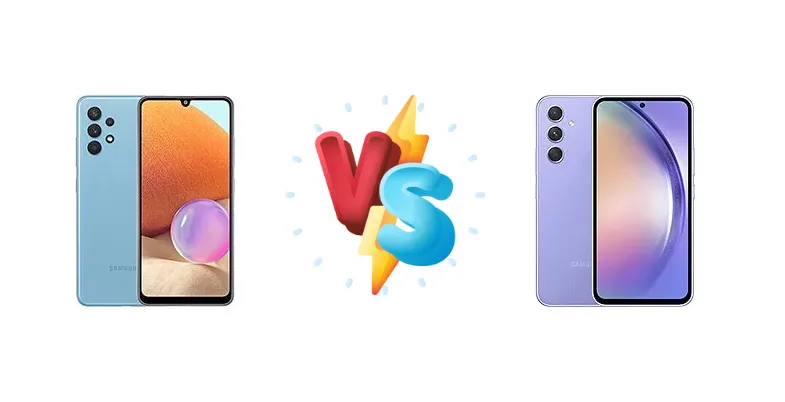
The Samsung Galaxy A32 and A54 represent different points in Samsung’s mid-range strategy. The A32, now an older model, offered a compelling budget experience, while the A54 aims for a more premium feel with a newer chipset and improved display. This comparison dissects the key differences to determine which device best suits your needs and budget.
🏆 Quick Verdict
For most users, the Samsung Galaxy A54 is the superior choice. Its Exynos 1380 chipset delivers significantly improved performance, and the brighter, more modern display enhances the overall user experience. While both phones share an endurance rating, the A54’s faster charging and more efficient processor make it the better long-term investment.
| Network |
|---|
| 2G bands | GSM 850 / 900 / 1800 / 1900 | GSM 850 / 900 / 1800 / 1900 |
| 3G bands | HSDPA 850 / 900 / 1900 / 2100 | HSDPA 850 / 900 / 1700(AWS) / 1900 / 2100 |
| 4G bands | 1, 2, 3, 5, 7, 8, 20, 28, 38, 40, 41 | 1, 2, 3, 4, 5, 7, 8, 12, 17, 20, 26, 28, 32, 38, 40, 41, 66 - International |
| 5G bands | - | 1, 3, 7, 8, 20, 28, 38, 40, 41, 77, 78 SA/NSA/Sub6 - International |
| Speed | HSPA, LTE | HSPA, LTE, 5G |
| Technology | GSM / HSPA / LTE | GSM / HSPA / LTE / 5G |
| | - | 25, 41, 66, 71 SA/NSA/Sub6/mmWave - USA |
| Launch |
|---|
| Announced | 2021, February 25 | 2023, March 15 |
| Status | Available. Released 2021, February 25 | Available. Released 2023, March 24 |
| Body |
|---|
| Build | Glass front (Gorilla Glass 5), plastic frame, plastic back | Glass front (Gorilla Glass 5), glass back (Gorilla Glass 5), plastic frame |
| Dimensions | 158.9 x 73.6 x 8.4 mm (6.26 x 2.90 x 0.33 in) | 158.2 x 76.7 x 8.2 mm (6.23 x 3.02 x 0.32 in) |
| SIM | · Nano-SIM· Nano-SIM + Nano-SIM | · Nano-SIM + eSIM· Nano-SIM + Nano-SIM |
| Weight | 184 g (6.49 oz) | 202 g (7.13 oz) |
| | - | IP67 dust/water resistant (up to 1m for 30 min) |
| Display |
|---|
| Protection | Corning Gorilla Glass 5 | Corning Gorilla Glass 5 |
| Resolution | 1080 x 2400 pixels, 20:9 ratio (~411 ppi density) | 1080 x 2340 pixels, 19.5:9 ratio (~403 ppi density) |
| Size | 6.4 inches, 98.9 cm2 (~84.6% screen-to-body ratio) | 6.4 inches, 100.5 cm2 (~82.9% screen-to-body ratio) |
| Type | Super AMOLED, 90Hz, 800 nits (HBM) | Super AMOLED, 120Hz, HDR10+, 1000 nits (HBM) |
| Platform |
|---|
| CPU | Octa-core (2x2.0 GHz Cortex-A75 & 6x1.8 GHz Cortex-A55) | Octa-core (4x2.4 GHz Cortex-A78 & 4x2.0 GHz Cortex-A55) |
| Chipset | Mediatek MT6769V/CU Helio G80 (12 nm) | Exynos 1380 (5 nm) |
| GPU | Mali-G52 MC2 | Mali-G68 MP5 |
| OS | Android 11, upgradable to Android 13, One UI 5 | Android 13, up to 4 major Android upgrades, One UI 7 |
| Memory |
|---|
| Card slot | microSDXC (dedicated slot) | microSDXC (uses shared SIM slot) |
| Internal | 64GB 4GB RAM, 64GB 6GB RAM, 128GB 4GB RAM, 128GB 6GB RAM, 128GB 8GB RAM | 128GB 4GB RAM, 128GB 6GB RAM, 128GB 8GB RAM, 256GB 6GB RAM, 256GB 8GB RAM |
| Main Camera |
|---|
| Features | LED flash, panorama, HDR | LED flash, panorama, HDR |
| Quad | 64 MP, f/1.8, 26mm (wide), PDAF
8 MP, f/2.2, 123˚, (ultrawide), 1/4.0", 1.12µm
5 MP (macro)
Auxiliary lens | - |
| Single | 20 MP, f/2.2, (wide) | 32 MP, f/2.2, 26mm (wide), 1/2.8", 0.8µm |
| Triple | - | 50 MP, f/1.8, 23mm (wide), 1/1.56", 1.0µm, PDAF, OIS
12 MP, f/2.2, 13mm, 123˚ (ultrawide), 1/3.X", 1.12µm
5 MP (macro) |
| Video | 1080p@30fps | 4K@30fps, 1080p@30/60fps, 720p@480fps, gyro-EIS |
| Selfie camera |
|---|
| Single | 20 MP, f/2.2, (wide) | 32 MP, f/2.2, 26mm (wide), 1/2.8", 0.8µm |
| Video | 1080p@30fps | 4K@30fps, 1080p@30/60fps |
| Sound |
|---|
| 3.5mm jack | Yes | No |
| 35mm jack | Yes | No |
| Loudspeaker | Yes | Yes, with stereo speakers |
| Comms |
|---|
| Bluetooth | 5.0, A2DP, LE | 5.3, A2DP, LE |
| NFC | Yes (market/region dependent) | Yes (market/region dependent) |
| Positioning | GPS, GLONASS, BDS, GALILEO | GPS, GLONASS, GALILEO, BDS |
| Radio | FM radio, RDS, recording | No |
| USB | USB Type-C 2.0, OTG | USB Type-C 2.0, OTG |
| WLAN | Wi-Fi 802.11 a/b/g/n/ac, dual-band, Wi-Fi Direct | Wi-Fi 802.11 a/b/g/n/ac/6, dual-band, Wi-Fi Direct |
| Features |
|---|
| Sensors | Fingerprint (under display, optical), accelerometer, gyro, compass | Fingerprint (under display, optical), accelerometer, gyro, compass, barometer (USA only) |
| | Virtual proximity sensing | Virtual proximity sensing |
| Battery |
|---|
| Charging | 15W wired | 25W wired |
| Type | Li-Ion 5000 mAh | 5000 mAh |
| Misc |
|---|
| Colors | Awesome Black, Awesome White, Awesome Blue, Awesome Violet | Lime, Graphite, Violet, White |
| Models | SM-A325F, SM-A325F/DS, SM-A325M, SM-A325N | SM-A546V, SM-A546U, SM-A546U1, SM-A546B, SM-A546B/DS, SM-A546E, SM-A546E/DS, SM-A5460, SM-A546M, SM-A546M/DS, SM-A546W |
| Price | € 124.99 / £ 89.38 | € 210.00 / $ 119.11 / £ 169.95 / ₹ 28,999 |
| SAR | - | 0.81 W/kg (head) 0.67 W/kg (body) |
| SAR EU | 0.45 W/kg (head) 1.30 W/kg (body) | 0.69 W/kg (head) 1.34 W/kg (body) |
| Tests |
|---|
| Battery life |
Endurance rating 119h
|
Endurance rating 119h
|
| Camera |
Photo / Video |
Photo / Video |
| Display |
Contrast ratio: Infinite (nominal) |
Contrast ratio: Infinite (nominal) |
| Loudspeaker |
-30.3 LUFS (Below average)
|
-26.6 LUFS (Good)
|
| Performance |
AnTuTu: 286666 (v8)
GeekBench: 1277 (v5.1)
GFXBench: 8.1fps (ES 3.1 onscreen) |
AnTuTu: 506678 (v9)
GeekBench: 2703 (v5.1), 2797 (v6)
GFXBench: 25fps (ES 3.1 onscreen) |
Samsung Galaxy A32
- Extremely affordable price point
- Long battery endurance rating
- Acceptable display for basic use
- Outdated Helio G80 chipset
- Slow 15W charging
- Less vibrant display compared to A54
Samsung Galaxy A54
- Powerful Exynos 1380 chipset
- Bright and vibrant display
- Faster 25W charging
- Higher price tag
- May experience some thermal throttling under heavy load
- Still utilizes a plastic build
Display Comparison
The Galaxy A54 boasts a significantly brighter display, reaching 980 nits compared to the A32’s 814 nits. This translates to better visibility outdoors under direct sunlight. Both displays share an 'Infinite' contrast ratio, suggesting similar black levels, but the A54’s higher peak brightness provides a more dynamic and engaging viewing experience. While both likely utilize LCD panels, the A54 benefits from a more refined display calibration, resulting in more accurate colors. The A32's display, while adequate, feels dated in comparison.
Camera Comparison
Both devices feature a photo/video camera setup, but details regarding sensor size and specific features are limited. However, the A54’s newer image signal processor (ISP) within the Exynos 1380 will likely deliver superior image processing, resulting in better dynamic range, noise reduction, and overall image quality. The A32’s camera will likely perform adequately in good lighting conditions, but will struggle in low-light scenarios. The presence of Optical Image Stabilization (OIS) on the A54 (likely, given its positioning) would further enhance image clarity and stability, especially in video recording. The 2MP macro cameras on both devices are likely to offer limited practical benefit.
Performance
The core difference lies in the chipsets. The A54’s Exynos 1380, built on a 5nm process, is a substantial upgrade over the A32’s 12nm Mediatek Helio G80. The Exynos 1380 features a more modern CPU architecture – Cortex-A78 cores versus the A32’s Cortex-A75 – offering a noticeable performance boost in both single-core and multi-core tasks. The A54’s CPU configuration (4x2.4 GHz Cortex-A78 & 4x2.0 GHz Cortex-A55) is optimized for efficiency and responsiveness, while the A32’s (2x2.0 GHz Cortex-A75 & 6x1.8 GHz Cortex-A55) will struggle with demanding applications. This difference is particularly noticeable in gaming and resource-intensive apps.
Battery Life
Interestingly, both phones share an endurance rating of 119 hours. However, this doesn’t tell the whole story. The A54’s more efficient 5nm Exynos 1380 chipset consumes less power than the A32’s 12nm Helio G80, meaning the A54 will likely deliver longer real-world usage on a single charge despite potentially having a similar battery capacity. Furthermore, the A54 supports 25W wired charging, significantly faster than the A32’s 15W charging, reducing the time spent tethered to a wall outlet. An active use score of 11:15h for the A54 confirms its superior battery performance in practical scenarios.
Buying Guide
Buy the Samsung Galaxy A32 if you prioritize extreme budget-friendliness and long battery life is paramount, and you primarily use your phone for basic tasks like calls, texts, and light social media. Buy the Samsung Galaxy A54 if you value smoother performance for gaming and multitasking, a brighter and more vibrant display for media consumption, and faster charging capabilities, even if it means a higher upfront cost.
Frequently Asked Questions
❓ Does the Exynos 1380 in the A54 tend to overheat during prolonged gaming sessions?
While the Exynos 1380 is a capable chipset, it can experience some thermal throttling during extended, graphically demanding gaming. However, Samsung’s software optimizations and the phone’s thermal design mitigate this issue, preventing significant performance drops. It's unlikely to reach critical temperatures, but sustained peak performance may be reduced after 30-60 minutes of intense gaming.
❓ Is the 2MP macro camera on either phone actually useful for taking detailed close-up photos?
Generally, 2MP macro cameras on budget and mid-range phones offer limited practical benefit. The low resolution results in images lacking detail and sharpness. While they can be fun to experiment with, don't expect professional-quality macro photography from either the A32 or the A54.
❓ What kind of charging brick do I need to get the full 25W charging speed on the Galaxy A54?
Samsung does not include a charging brick in the box with the Galaxy A54. To achieve the full 25W charging speed, you'll need a USB-C Power Delivery (PD) charger that supports the Power Delivery 3.0 protocol and delivers at least 25W of power. Using a lower wattage charger will still charge the phone, but at a slower rate.