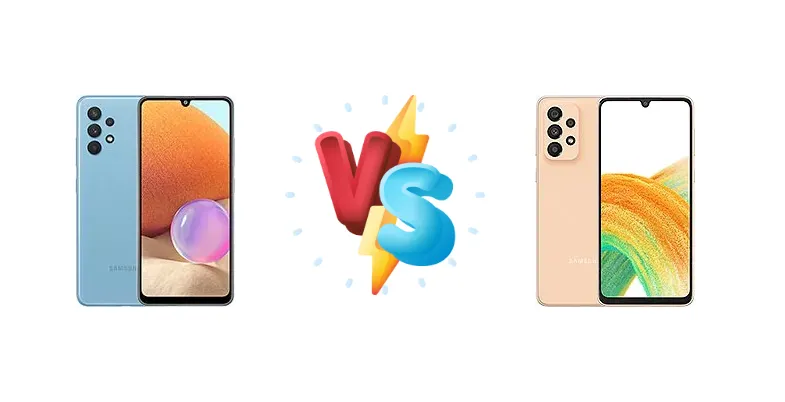
The Samsung Galaxy A32 and A33 5G represent Samsung's approach to accessible smartphones. While both aim for the mid-range market, they diverge significantly in core components. The A33 5G introduces 5G connectivity and a newer Exynos chipset, but at the cost of some battery endurance. This comparison dissects these differences to help you determine which device best suits your needs.
🏆 Quick Verdict
For most users, the Samsung Galaxy A33 5G is the superior choice. The Exynos 1280 chipset delivers a noticeable performance boost over the Helio G80 in the A32, making it better suited for multitasking and gaming. The faster 25W charging partially offsets the slightly reduced battery life, and the 5G connectivity offers future-proofing.
| Network |
|---|
| 2G bands | GSM 850 / 900 / 1800 / 1900 | GSM 850 / 900 / 1800 / 1900 |
| 3G bands | HSDPA 850 / 900 / 1900 / 2100 | HSDPA 850 / 900 / 1700(AWS) / 1900 / 2100 |
| 4G bands | 1, 2, 3, 5, 7, 8, 20, 28, 38, 40, 41 | 1, 2, 3, 4, 5, 7, 8, 12, 17, 20, 26, 28, 32, 38, 40, 41, 66 |
| 5G bands | - | 1, 3, 5, 7, 8, 20, 28, 38, 40, 41, 66, 78 SA/NSA/Sub6 |
| Speed | HSPA, LTE | HSPA, LTE, 5G |
| Technology | GSM / HSPA / LTE | GSM / HSPA / LTE / 5G |
| Launch |
|---|
| Announced | 2021, February 25 | 2022, March 17 |
| Status | Available. Released 2021, February 25 | Available. Released 2022, April 20 |
| Body |
|---|
| Build | Glass front (Gorilla Glass 5), plastic frame, plastic back | Glass front (Gorilla Glass 5), plastic frame, plastic back |
| Dimensions | 158.9 x 73.6 x 8.4 mm (6.26 x 2.90 x 0.33 in) | 159.7 x 74 x 8.1 mm (6.29 x 2.91 x 0.32 in) |
| SIM | · Nano-SIM· Nano-SIM + Nano-SIM | · Nano-SIM· Nano-SIM + Nano-SIM |
| Weight | 184 g (6.49 oz) | 186 g (6.56 oz) |
| | - | IP67 dust/water resistant (up to 1m for 30 min) |
| Display |
|---|
| Protection | Corning Gorilla Glass 5 | Corning Gorilla Glass 5 |
| Resolution | 1080 x 2400 pixels, 20:9 ratio (~411 ppi density) | 1080 x 2400 pixels, 20:9 ratio (~411 ppi density) |
| Size | 6.4 inches, 98.9 cm2 (~84.6% screen-to-body ratio) | 6.4 inches, 98.9 cm2 (~83.7% screen-to-body ratio) |
| Type | Super AMOLED, 90Hz, 800 nits (HBM) | Super AMOLED, 90Hz |
| Platform |
|---|
| CPU | Octa-core (2x2.0 GHz Cortex-A75 & 6x1.8 GHz Cortex-A55) | Octa-core (2x2.4 GHz Cortex-A78 & 6x2.0 GHz Cortex-A55) |
| Chipset | Mediatek MT6769V/CU Helio G80 (12 nm) | Exynos 1280 (5 nm) |
| GPU | Mali-G52 MC2 | Mali-G68 |
| OS | Android 11, upgradable to Android 13, One UI 5 | Android 12, up to 4 major Android upgrades, One UI 8 |
| Memory |
|---|
| Card slot | microSDXC (dedicated slot) | microSDXC (uses shared SIM slot) |
| Internal | 64GB 4GB RAM, 64GB 6GB RAM, 128GB 4GB RAM, 128GB 6GB RAM, 128GB 8GB RAM | 128GB 4GB RAM, 128GB 6GB RAM, 128GB 8GB RAM, 256GB 8GB RAM |
| Main Camera |
|---|
| Features | LED flash, panorama, HDR | LED flash, panorama, HDR |
| Quad | 64 MP, f/1.8, 26mm (wide), PDAF
8 MP, f/2.2, 123˚, (ultrawide), 1/4.0", 1.12µm
5 MP (macro)
Auxiliary lens | 48 MP, f/1.8, 26mm (wide), 1/2.0", 0.8µm, PDAF, OIS
8 MP, f/2.2, 123˚, (ultrawide), 1/4.0", 1.12µm
5 MP (macro)
Auxiliary lens |
| Single | 20 MP, f/2.2, (wide) | 13 MP, f/2.2, (wide), 1/3.1", 1.12µm |
| Video | 1080p@30fps | 4K@30fps, 1080p@30/60fps |
| Selfie camera |
|---|
| Single | 20 MP, f/2.2, (wide) | 13 MP, f/2.2, (wide), 1/3.1", 1.12µm |
| Video | 1080p@30fps | 4K@30fps, 1080p@30fps |
| Sound |
|---|
| 3.5mm jack | Yes | No |
| 35mm jack | Yes | No |
| Loudspeaker | Yes | Yes, with stereo speakers |
| Comms |
|---|
| Bluetooth | 5.0, A2DP, LE | 5.1, A2DP, LE |
| NFC | Yes (market/region dependent) | Yes (market/region dependent) |
| Positioning | GPS, GLONASS, BDS, GALILEO | GPS, GLONASS, GALILEO, BDS |
| Radio | FM radio, RDS, recording | No |
| USB | USB Type-C 2.0, OTG | USB Type-C 2.0, OTG |
| WLAN | Wi-Fi 802.11 a/b/g/n/ac, dual-band, Wi-Fi Direct | Wi-Fi 802.11 a/b/g/n/ac, dual-band, Wi-Fi Direct |
| Features |
|---|
| Sensors | Fingerprint (under display, optical), accelerometer, gyro, compass | Fingerprint (under display, optical), accelerometer, gyro, compass |
| | Virtual proximity sensing | Virtual proximity sensing |
| Battery |
|---|
| Charging | 15W wired | 25W wired |
| Type | Li-Ion 5000 mAh | Li-Po 5000 mAh |
| Misc |
|---|
| Colors | Awesome Black, Awesome White, Awesome Blue, Awesome Violet | Black, White, Blue, Peach |
| Models | SM-A325F, SM-A325F/DS, SM-A325M, SM-A325N | SM-A336E, SM-A336B, SM-A336B/DS, SM-A336B/DSN, SM-A336E/DS, SM-A336M, SM-A3360 |
| Price | € 124.99 / £ 89.38 | £ 174.99 / € 187.50 / ₹ 21,999 |
| SAR | - | 0.35 W/kg (head) |
| SAR EU | 0.45 W/kg (head) 1.30 W/kg (body) | 0.57 W/kg (head) 1.59 W/kg (body) |
| Tests |
|---|
| Battery life |
Endurance rating 119h
|
Endurance rating 104h
|
| Camera |
Photo / Video |
Photo / Video |
| Display |
Contrast ratio: Infinite (nominal) |
Contrast ratio: Infinite (nominal) |
| Loudspeaker |
-30.3 LUFS (Below average)
|
-26.5 LUFS (Good)
|
| Performance |
AnTuTu: 286666 (v8)
GeekBench: 1277 (v5.1)
GFXBench: 8.1fps (ES 3.1 onscreen) |
AnTuTu: 354420 (v8), 394918 (v9)
GeekBench: 1900 (v5.1)
GFXBench: 20fps (ES 3.1 onscreen) |
Samsung Galaxy A32
- Longer battery life (119h endurance)
- Brighter display (814 nits)
- More affordable price point (likely)
- Less powerful processor (Helio G80)
- Slower charging (15W)
- No 5G connectivity
Samsung Galaxy A33 5G
- Faster processor (Exynos 1280)
- Faster charging (25W)
- 5G connectivity
- Potentially better image processing
- Shorter battery life (104h endurance)
- Dimmer display (728 nits)
- Potentially higher price
Display Comparison
Both the A32 and A33 5G feature displays with an 'Infinite' contrast ratio, typical of Samsung's AMOLED panels. However, the A32 boasts a significantly brighter peak brightness of 814 nits compared to the A33 5G’s 728 nits. This means the A32 will be more visible outdoors in direct sunlight. While both likely use similar OLED technology, the A32’s higher brightness is a tangible advantage for outdoor usability. The lack of high refresh rate information for either device suggests a standard 60Hz panel, limiting smoothness in scrolling and animations.
Camera Comparison
Both phones are listed with 'Photo / Video' capabilities, lacking specific details. However, the A33 5G’s newer chipset likely includes an improved image signal processor (ISP), potentially leading to better image processing and low-light performance. Without sensor size or aperture information, it’s difficult to make a definitive judgment. The inclusion of a 2MP macro camera on both devices is likely a marketing feature with limited practical benefit, given the small sensor size and fixed focus. The A33 5G’s processing power may allow for more advanced computational photography features.
Performance
The core difference lies in the chipsets. The A33 5G’s Exynos 1280, fabricated on a 5nm process, represents a substantial upgrade over the A32’s 12nm Mediatek Helio G80. The Exynos 1280’s octa-core configuration, featuring 2x2.4 GHz Cortex-A78 cores, provides a significant CPU performance advantage over the A32’s 2x2.0 GHz Cortex-A75 cores. This translates to faster app loading times, smoother multitasking, and improved gaming performance. The 5nm process also contributes to better thermal efficiency, potentially reducing throttling during sustained workloads. While RAM specifications aren't provided, the A33 5G's superior chipset will be the primary performance driver.
Battery Life
The A32 holds a clear advantage in endurance rating, achieving 119 hours compared to the A33 5G’s 104 hours. This suggests the Helio G80 is more power-efficient than the Exynos 1280. However, the A33 5G compensates with significantly faster 25W wired charging, compared to the A32’s 15W charging. While the A33 5G’s battery life is shorter, the faster charging can mitigate this, allowing for quicker top-ups throughout the day. A full charge on the A33 5G will be considerably faster than on the A32.
Buying Guide
Buy the Samsung Galaxy A32 if you prioritize maximum battery life and are less concerned with demanding applications or 5G connectivity. It’s ideal for users who primarily browse, text, and make calls. Buy the Samsung Galaxy A33 5G if you value performance, faster charging, and the benefits of 5G, even if it means slightly less time between charges. This phone is better for gamers, social media enthusiasts, and those who want a phone that will remain relevant for longer.
Frequently Asked Questions
❓ Does the Exynos 1280 in the A33 5G tend to overheat during prolonged gaming sessions?
The Exynos 1280, built on a 5nm process, is generally more thermally efficient than the Helio G80. While it can get warm during intensive tasks like gaming, the 5nm node and Samsung's thermal management should prevent significant throttling, offering a more consistent gaming experience compared to the A32.
❓ Is the 2MP macro camera on either phone actually useful for taking detailed close-up photos?
Unfortunately, the 2MP macro cameras on both the A32 and A33 5G are largely marketing features. The small sensor size and fixed focus result in images that lack detail and sharpness. They are unlikely to provide a significant improvement over using the main camera in close-up mode.
❓ Can the Samsung Galaxy A33 5G reliably maintain 60fps in popular games like PUBG Mobile?
The Exynos 1280 should be capable of maintaining 60fps in PUBG Mobile at medium to high graphics settings. However, achieving consistently smooth performance will depend on the specific game optimization and background processes running on the device. The A32's Helio G80 will likely struggle to maintain a stable 60fps at similar settings.
❓ How long does it realistically take to fully charge the Samsung Galaxy A33 5G from 0% to 100% with the 25W charger?
With the 25W charger, the Samsung Galaxy A33 5G should fully charge from 0% to 100% in approximately 1 hour and 15 minutes to 1 hour and 30 minutes. This is significantly faster than the A32's 15W charging, which would likely take over 2 hours for a full charge.