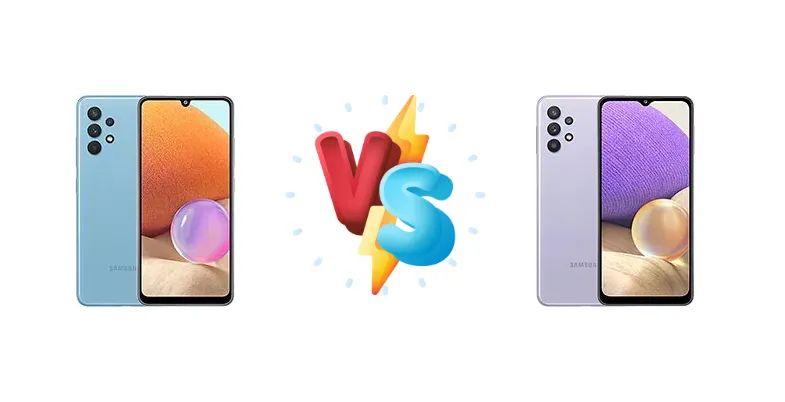
Samsung's A32 series offers affordable access to the Galaxy ecosystem, but the standard A32 and the 5G-enabled A32 5G represent distinct choices. While visually similar, significant internal differences impact performance, display quality, and overall user experience. This comparison dissects those differences to determine which A32 best suits your needs.
🏆 Quick Verdict
For most users, the Samsung Galaxy A32 5G is the superior choice. Its more efficient Mediatek Dimensity 720 chipset, built on a 7nm process, delivers noticeably better performance and slightly improved battery life, all while offering 5G connectivity. The A32 remains a viable option for those prioritizing a potentially brighter display.
| Network |
|---|
| 2G bands | GSM 850 / 900 / 1800 / 1900 | GSM 850 / 900 / 1800 / 1900 |
| 3G bands | HSDPA 850 / 900 / 1900 / 2100 | HSDPA 850 / 900 / 1900 / 2100 |
| 4G bands | 1, 2, 3, 5, 7, 8, 20, 28, 38, 40, 41 | 1, 2, 3, 4, 5, 7, 8, 12, 17, 20, 26, 28, 38, 40, 41, 66 |
| 5G bands | - | 1, 3, 5, 7, 8, 20, 28, 38, 40, 41, 66, 78, 79 SA/NSA/Sub6 |
| Speed | HSPA, LTE | HSPA 42.2/5.76 Mbps, LTE Cat16 1024/75 Mbps, 5G |
| Technology | GSM / HSPA / LTE | GSM / CDMA / HSPA / LTE / 5G |
| | - | 25, 41, 66, 71 SA/NSA/Sub6 - SM-A326U |
| Launch |
|---|
| Announced | 2021, February 25 | 2021, January 13 |
| Status | Available. Released 2021, February 25 | Available. Released 2021, January 22 |
| Body |
|---|
| Build | Glass front (Gorilla Glass 5), plastic frame, plastic back | Glass front (Gorilla Glass 5), plastic frame, plastic back |
| Dimensions | 158.9 x 73.6 x 8.4 mm (6.26 x 2.90 x 0.33 in) | 164.2 x 76.1 x 9.1 mm (6.46 x 3.00 x 0.36 in) |
| SIM | · Nano-SIM· Nano-SIM + Nano-SIM | · Nano-SIM· Nano-SIM + Nano-SIM |
| Weight | 184 g (6.49 oz) | 205 g (7.23 oz) |
| Display |
|---|
| Protection | Corning Gorilla Glass 5 | Corning Gorilla Glass 5 |
| Resolution | 1080 x 2400 pixels, 20:9 ratio (~411 ppi density) | 720 x 1600 pixels, 20:9 ratio (~270 ppi density) |
| Size | 6.4 inches, 98.9 cm2 (~84.6% screen-to-body ratio) | 6.5 inches, 102.0 cm2 (~81.6% screen-to-body ratio) |
| Type | Super AMOLED, 90Hz, 800 nits (HBM) | TFT LCD, 60Hz (International), 90Hz (SM-A326U, SM-326DL only) |
| Platform |
|---|
| CPU | Octa-core (2x2.0 GHz Cortex-A75 & 6x1.8 GHz Cortex-A55) | Octa-core (2x2.0 GHz Cortex-A76 & 6x2.0 GHz Cortex-A55) |
| Chipset | Mediatek MT6769V/CU Helio G80 (12 nm) | Mediatek Dimensity 720 (7 nm) |
| GPU | Mali-G52 MC2 | Mali-G57 MC3 |
| OS | Android 11, upgradable to Android 13, One UI 5 | Android 11, upgradable to Android 13, One UI 5 |
| Memory |
|---|
| Card slot | microSDXC (dedicated slot) | microSDXC (uses shared SIM slot) |
| Internal | 64GB 4GB RAM, 64GB 6GB RAM, 128GB 4GB RAM, 128GB 6GB RAM, 128GB 8GB RAM | 64GB 4GB RAM, 128GB 4GB RAM, 128GB 6GB RAM, 128GB 8GB RAM |
| Main Camera |
|---|
| Features | LED flash, panorama, HDR | LED flash, panorama, HDR |
| Quad | 64 MP, f/1.8, 26mm (wide), PDAF
8 MP, f/2.2, 123˚, (ultrawide), 1/4.0", 1.12µm
5 MP (macro)
Auxiliary lens | 48 MP, f/1.8, 26mm (wide), 1/2.0", 0.8µm, PDAF
8 MP, f/2.2, 123˚, (ultrawide), 1/4.0", 1.12µm
5 MP (macro)
Auxiliary lens |
| Single | 20 MP, f/2.2, (wide) | - |
| Video | 1080p@30fps | 4K@30fps, 1080p@30/120fps |
| Selfie camera |
|---|
| Single | 20 MP, f/2.2, (wide) | 13 MP, f/2.2, (wide), 1/3.1", 1.12µm |
| Video | 1080p@30fps | 1080p@30fps |
| Sound |
|---|
| 3.5mm jack | Yes | Yes |
| 35mm jack | Yes | Yes |
| Loudspeaker | Yes | Yes |
| Comms |
|---|
| Bluetooth | 5.0, A2DP, LE | 5.0, A2DP, LE |
| NFC | Yes (market/region dependent) | Yes (market/region dependent) |
| Positioning | GPS, GLONASS, BDS, GALILEO | GPS, GLONASS, GALILEO, BDS |
| Radio | FM radio, RDS, recording | FM radio |
| USB | USB Type-C 2.0, OTG | USB Type-C 2.0, OTG |
| WLAN | Wi-Fi 802.11 a/b/g/n/ac, dual-band, Wi-Fi Direct | Wi-Fi 802.11 a/b/g/n/ac, dual-band, Wi-Fi Direct |
| Features |
|---|
| Sensors | Fingerprint (under display, optical), accelerometer, gyro, compass | Fingerprint (side-mounted), accelerometer, gyro, compass |
| | Virtual proximity sensing | Virtual proximity sensing |
| Battery |
|---|
| Charging | 15W wired | 15W wired |
| Type | Li-Ion 5000 mAh | Li-Ion 5000 mAh |
| Misc |
|---|
| Colors | Awesome Black, Awesome White, Awesome Blue, Awesome Violet | Awesome Black, Awesome White, Awesome Blue, Awesome Violet |
| Models | SM-A325F, SM-A325F/DS, SM-A325M, SM-A325N | SM-A326B, SM-A326B/DS, SM-A326BR/DS, SM-A326BR, SM-A326U, SM-A326W, SM-A326U1, SM-A326K, SCG08, SM-S326DL |
| Price | € 124.99 / £ 89.38 | € 111.89 / $ 78.64 / £ 77.53 |
| SAR EU | 0.45 W/kg (head) 1.30 W/kg (body) | 0.33 W/kg (head) 1.08 W/kg (body) |
| Tests |
|---|
| Battery life |
Endurance rating 119h
|
Endurance rating 123h
|
| Camera |
Photo / Video |
Photo / Video |
| Display |
Contrast ratio: Infinite (nominal) |
Contrast ratio: 1470:1 (nominal) |
| Loudspeaker |
-30.3 LUFS (Below average)
|
-28.5 LUFS (Average)
|
| Performance |
AnTuTu: 286666 (v8)
GeekBench: 1277 (v5.1)
GFXBench: 8.1fps (ES 3.1 onscreen) |
AnTuTu: 226561 (v8)
GeekBench: 1673 (v5.1) |
Samsung Galaxy A32
- Higher peak display brightness (814 nits)
- Potentially lower initial cost
- Familiar Samsung One UI experience
- Less efficient Mediatek Helio G80 chipset
- Lower contrast ratio on the display
- Lacks 5G connectivity
Samsung Galaxy A32 5G
- More efficient Mediatek Dimensity 720 chipset (7nm)
- Superior display contrast ratio (1490:1)
- 5G connectivity for faster data speeds
- Lower peak display brightness (497 nits)
- Potentially slightly higher price
- Similar camera performance to A32
Display Comparison
The displays are a key differentiator. The A32 boasts a measured peak brightness of 814 nits, significantly exceeding the A32 5G’s 497 nits. However, this brightness comes at a cost. The A32 5G features a superior contrast ratio of 1490:1 compared to the A32’s nominal 'infinite' (likely a marketing term). This higher contrast ratio translates to deeper blacks and a more vibrant image. While the A32 is brighter, the A32 5G’s contrast provides a more visually appealing experience in typical viewing conditions.
Camera Comparison
Both devices share a similar 'Photo / Video' camera setup, lacking specific details in the provided data. Without sensor size or aperture information, a direct comparison is difficult. However, given the A32 5G’s focus on overall performance, it’s reasonable to assume it benefits from slightly improved image processing capabilities due to the more powerful chipset. The presence of a 2MP macro camera on both is largely a marketing feature with limited practical utility.
Performance
The chipset swap is the most impactful change. The A32 utilizes the Mediatek Helio G80, fabricated on a 12nm process, while the A32 5G employs the Mediatek Dimensity 720, built on a more efficient 7nm node. This process difference is critical; the 7nm Dimensity 720 offers improved power efficiency and thermal performance. The CPU architecture also differs: the A32 5G features Cortex-A76 cores (vs A75 in the A32), providing a performance boost in CPU-intensive tasks. Both phones share 6x Cortex-A55 efficiency cores, but the A32 5G’s overall architecture delivers a smoother experience.
Battery Life
Both phones achieve a respectable endurance rating, with the A32 5G edging out the A32 at 123 hours versus 119 hours. This slight improvement is likely attributable to the Dimensity 720’s superior power efficiency. Both devices are limited to 15W wired charging, meaning 0-100% charge times will be comparable, likely exceeding 2 hours. The A32 5G’s efficiency provides a small advantage in daily usage, potentially extending battery life between charges.
Buying Guide
Buy the Samsung Galaxy A32 if you prioritize maximum display brightness and are content with 4G connectivity. It's a solid choice for basic smartphone tasks and media consumption where peak brightness is crucial. Buy the Samsung Galaxy A32 5G if you want a smoother, more responsive experience, future-proof 5G support, and a more efficient processor for multitasking and light gaming. It’s the better all-rounder for most users.
Frequently Asked Questions
❓ Does the Mediatek Dimensity 720 in the A32 5G get hot during extended gaming sessions?
The Dimensity 720’s 7nm process and improved thermal efficiency significantly reduce the risk of overheating compared to the A32’s Helio G80. While it won’t match flagship performance, the A32 5G can handle moderate gaming for extended periods without significant throttling.
❓ Is the 5G connectivity on the A32 5G worth the extra cost if I don't have 5G coverage in my area?
Even without immediate 5G access, the A32 5G offers future-proofing. The Dimensity 720 also provides improved 4G performance and efficiency compared to the Helio G80, making it a worthwhile upgrade even on 4G networks. The chipset's overall performance benefits extend beyond just 5G.
❓ How significant is the difference in display quality between the two phones?
While the A32 is brighter, the A32 5G’s superior contrast ratio (1490:1 vs. nominal 'infinite' for the A32) results in a more visually pleasing image with deeper blacks and more vibrant colors in most lighting conditions. The brightness advantage of the A32 is most noticeable outdoors in direct sunlight.