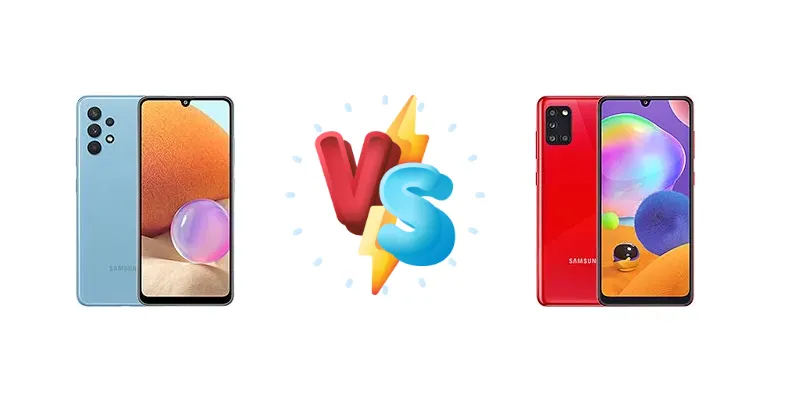
The Samsung Galaxy A32 and A31 represent Samsung’s continued push in the affordable smartphone segment. While both devices share a similar design language and target price point, the A32 introduces incremental improvements, primarily in display technology and processing power. This comparison dissects these differences to determine which device offers the best value for budget-conscious consumers.
🏆 Quick Verdict
For most users, the Samsung Galaxy A32 is the better choice. Its significantly brighter display (814 nits vs 635 nits) enhances outdoor visibility, and the Helio G80 chipset provides a modest performance uplift. However, the A31 retains a slight edge in battery endurance, offering 5 more hours of use.
| Network |
|---|
| 2G bands | GSM 850 / 900 / 1800 / 1900 | GSM 850 / 900 / 1800 / 1900 |
| 3G bands | HSDPA 850 / 900 / 1900 / 2100 | HSDPA 850 / 900 / 1900 / 2100 - SM-A315F |
| 4G bands | 1, 2, 3, 5, 7, 8, 20, 28, 38, 40, 41 | 1, 2, 3, 5, 7, 8, 20, 38, 40, 41 - SM-A315F |
| Speed | HSPA, LTE | HSPA, LTE |
| Technology | GSM / HSPA / LTE | GSM / HSPA / LTE |
| Launch |
|---|
| Announced | 2021, February 25 | 2020, March 24. Released 2020, April 27 |
| Status | Available. Released 2021, February 25 | Discontinued |
| Body |
|---|
| Build | Glass front (Gorilla Glass 5), plastic frame, plastic back | - |
| Dimensions | 158.9 x 73.6 x 8.4 mm (6.26 x 2.90 x 0.33 in) | 159.3 x 73.1 x 8.6 mm (6.27 x 2.88 x 0.34 in) |
| SIM | · Nano-SIM· Nano-SIM + Nano-SIM | · Nano-SIM· Nano-SIM + Nano-SIM |
| Weight | 184 g (6.49 oz) | 185 g (6.53 oz) |
| Display |
|---|
| Protection | Corning Gorilla Glass 5 | - |
| Resolution | 1080 x 2400 pixels, 20:9 ratio (~411 ppi density) | 1080 x 2400 pixels, 20:9 ratio (~411 ppi density) |
| Size | 6.4 inches, 98.9 cm2 (~84.6% screen-to-body ratio) | 6.4 inches, 98.9 cm2 (~84.9% screen-to-body ratio) |
| Type | Super AMOLED, 90Hz, 800 nits (HBM) | Super AMOLED |
| Platform |
|---|
| CPU | Octa-core (2x2.0 GHz Cortex-A75 & 6x1.8 GHz Cortex-A55) | Octa-core (2x2.0 GHz Cortex-A75 & 6x1.7 GHz Cortex-A55) |
| Chipset | Mediatek MT6769V/CU Helio G80 (12 nm) | Mediatek MT6768 Helio P65 (12 nm) |
| GPU | Mali-G52 MC2 | Mali-G52 MC2 |
| OS | Android 11, upgradable to Android 13, One UI 5 | Android 10, upgradable to Android 12, One UI 4.1 |
| Memory |
|---|
| Card slot | microSDXC (dedicated slot) | microSDXC (dedicated slot) |
| Internal | 64GB 4GB RAM, 64GB 6GB RAM, 128GB 4GB RAM, 128GB 6GB RAM, 128GB 8GB RAM | 64GB 4GB RAM, 128GB 4GB RAM, 128GB 6GB RAM, 128GB 8GB RAM |
| Main Camera |
|---|
| Features | LED flash, panorama, HDR | LED flash, panorama, HDR |
| Quad | 64 MP, f/1.8, 26mm (wide), PDAF
8 MP, f/2.2, 123˚, (ultrawide), 1/4.0", 1.12µm
5 MP (macro)
Auxiliary lens | 48 MP, f/2.0, 26mm (wide), 1/2.0", 0.8µm, PDAF
8 MP, f/2.2, 123˚, (ultrawide), 1/4.0", 1.12µm
5 MP (macro)
Auxiliary lens |
| Single | 20 MP, f/2.2, (wide) | - |
| Video | 1080p@30fps | 1080p@30fps |
| Selfie camera |
|---|
| Single | 20 MP, f/2.2, (wide) | 20 MP, f/2.2, (wide) |
| Video | 1080p@30fps | 1080p@30fps |
| Sound |
|---|
| 3.5mm jack | Yes | Yes |
| 35mm jack | Yes | Yes |
| Loudspeaker | Yes | Yes |
| Comms |
|---|
| Bluetooth | 5.0, A2DP, LE | 5.0, A2DP, LE |
| NFC | Yes (market/region dependent) | Yes (market/region dependent) |
| Positioning | GPS, GLONASS, BDS, GALILEO | GPS, GLONASS, GALILEO, BDS |
| Radio | FM radio, RDS, recording | FM radio, RDS, recording |
| USB | USB Type-C 2.0, OTG | USB Type-C 2.0, OTG |
| WLAN | Wi-Fi 802.11 a/b/g/n/ac, dual-band, Wi-Fi Direct | Wi-Fi 802.11 a/b/g/n/ac, dual-band, Wi-Fi Direct |
| Features |
|---|
| Sensors | Fingerprint (under display, optical), accelerometer, gyro, compass | Fingerprint (under display, optical), accelerometer, gyro, compass |
| | Virtual proximity sensing | - |
| Battery |
|---|
| Charging | 15W wired | 15W wired |
| Type | Li-Ion 5000 mAh | Li-Po 5000 mAh |
| Misc |
|---|
| Colors | Awesome Black, Awesome White, Awesome Blue, Awesome Violet | Prism Crush Black, Prism Crush Blue, Prism Crush Red, Prism Crush White |
| Models | SM-A325F, SM-A325F/DS, SM-A325M, SM-A325N | SM-A315F, SM-A315F/DS, SM-A315G/DS, SM-A315G, SM-A315N |
| Price | € 124.99 / £ 89.38 | £ 139.00 / € 138.27 |
| SAR EU | 0.45 W/kg (head) 1.30 W/kg (body) | 0.49 W/kg (head) 1.68 W/kg (body) |
| Tests |
|---|
| Battery life |
Endurance rating 119h
| Endurance rating 124h |
| Camera |
Photo / Video |
Photo / Video |
| Display |
Contrast ratio: Infinite (nominal) |
Contrast ratio: Infinite (nominal) |
| Loudspeaker |
-30.3 LUFS (Below average)
|
-30.9 LUFS (Below average) |
| Performance |
AnTuTu: 286666 (v8)
GeekBench: 1277 (v5.1)
GFXBench: 8.1fps (ES 3.1 onscreen) |
AnTuTu: 151815 (v8)
GeekBench: 5096 (v4.4), 1216 (v5.1)
GFXBench: 7fps (ES 3.1 onscreen) |
Samsung Galaxy A32
- Brighter display for better outdoor visibility
- Slightly improved processor performance
- More modern chipset architecture
- Slightly shorter battery life
- Similar camera system to the A31
Samsung Galaxy A31
- Longer battery life for all-day use
- Comparable performance for basic tasks
- Often available at a lower price point
- Dimmer display, less ideal for outdoor use
- Older chipset with less graphical power
Display Comparison
The most immediately noticeable difference lies in the displays. The Galaxy A32 boasts a peak brightness of 814 nits, a substantial improvement over the A31’s 635 nits. This translates to significantly better visibility in direct sunlight. Both phones share an 'Infinite' contrast ratio (Samsung’s marketing term for a high contrast ratio typical of AMOLED panels), but the A32’s higher brightness makes colors appear more vivid and punchy. While both utilize similar panel technology, the A32’s increased luminance is a clear advantage for outdoor users.
Camera Comparison
Both the A32 and A31 feature a multi-camera setup, but detailed sensor information is limited in the provided data. Both are advertised as having Photo/Video capabilities. Given the market segment, it’s likely both phones rely on software processing to enhance image quality. Without specific sensor size or aperture details, it’s difficult to definitively declare a camera winner. The presence of a 2MP macro lens on both devices is largely a marketing feature with limited practical utility.
Performance
Under the hood, the A32 features the Mediatek Helio G80, while the A31 utilizes the Helio P65. Both are 12nm chips with an octa-core configuration featuring two Cortex-A75 cores clocked at 2.0 GHz and six Cortex-A55 cores. However, the G80 in the A32 has a slightly higher clock speed on the efficiency cores (1.8 GHz vs 1.7 GHz) and a more modern GPU. This results in a modest performance increase in the A32, particularly in graphics-intensive tasks. While neither chipset is a powerhouse, the A32 offers a smoother experience for casual gaming and multitasking.
Battery Life
Battery life is a close contest. The A31 holds a slight advantage with an endurance rating of 124 hours, compared to the A32’s 119 hours. This difference of 5 hours, while not massive, could be noticeable for heavy users. Both phones support 15W wired charging, meaning charging times will be comparable – approximately 2-3 hours for a full charge. The A31’s slightly larger battery capacity contributes to its longer endurance, making it a better choice for users who prioritize all-day battery life.
Buying Guide
Buy the Samsung Galaxy A32 if you prioritize a brighter, more vibrant display for media consumption and gaming, and appreciate a small performance boost for smoother multitasking. Buy the Samsung Galaxy A31 if maximizing battery life is your primary concern, and you’re content with a less bright screen. Both phones are excellent options for users seeking a reliable Samsung experience without breaking the bank.
Frequently Asked Questions
❓ Will I notice a significant performance difference between the Helio G80 and Helio P65 in everyday use?
For typical tasks like browsing, social media, and messaging, the performance difference will be minimal. The Helio G80 in the A32 offers a slight edge in graphics performance, which may be noticeable in less demanding games, but both chips are designed for efficient, everyday use rather than intensive gaming.
❓ Is the display on the A32 worth the upgrade if I primarily use my phone indoors?
If you primarily use your phone indoors, the A32’s brighter display is still beneficial. It results in more vibrant colors and a more engaging viewing experience, even in controlled lighting conditions. However, the difference won’t be as dramatic as it would be outdoors.
❓ How much faster will the A32 charge compared to the A31, given they both support 15W charging?
Both phones support the same 15W charging standard, so the charging speed will be virtually identical. Expect approximately 2-3 hours to fully charge from 0% to 100% in both cases.