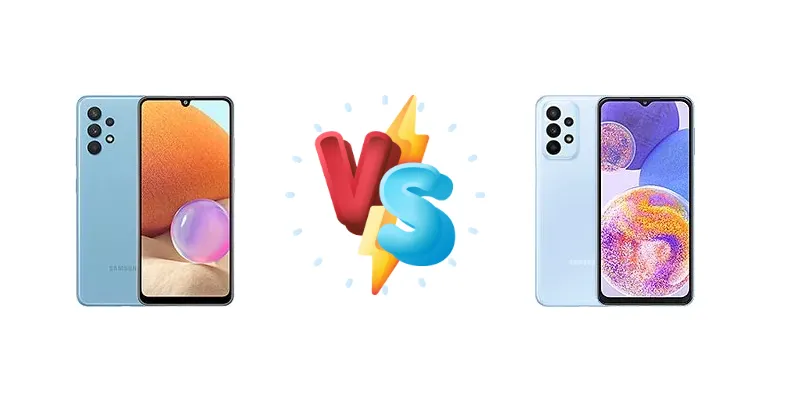
The Samsung Galaxy A32 and A23 represent Samsung's continued commitment to the affordable smartphone market. While both aim to deliver a solid experience without breaking the bank, they differ significantly in core components, impacting performance, battery life, and overall usability. This comparison dives deep into these differences to help you determine which device best suits your needs.
🏆 Quick Verdict
For most users, the Samsung Galaxy A23 emerges as the better choice. Its more efficient Snapdragon 680 chipset, coupled with a larger battery and faster 25W charging, provides a noticeable improvement in battery life and overall responsiveness compared to the A32's Helio G80. While the A32 boasts a brighter display, the A23's gains in efficiency are more impactful for daily use.
| Network |
|---|
| 2G bands | GSM 850 / 900 / 1800 / 1900 | GSM 850 / 900 / 1800 / 1900 |
| 3G bands | HSDPA 850 / 900 / 1900 / 2100 | HSDPA 850 / 900 / 2100 |
| 4G bands | 1, 2, 3, 5, 7, 8, 20, 28, 38, 40, 41 | 1, 3, 5, 7, 8, 20, 28, 38, 40, 41 |
| Speed | HSPA, LTE | HSPA, LTE |
| Technology | GSM / HSPA / LTE | GSM / HSPA / LTE |
| Launch |
|---|
| Announced | 2021, February 25 | 2022, March 04 |
| Status | Available. Released 2021, February 25 | Available. Released 2022, March 25 |
| Body |
|---|
| Build | Glass front (Gorilla Glass 5), plastic frame, plastic back | Glass front (Gorilla Glass 5), plastic frame, plastic back |
| Dimensions | 158.9 x 73.6 x 8.4 mm (6.26 x 2.90 x 0.33 in) | 165.4 x 76.9 x 8.4 mm (6.51 x 3.03 x 0.33 in) |
| SIM | · Nano-SIM· Nano-SIM + Nano-SIM | · Nano-SIM· Nano-SIM + Nano-SIM |
| Weight | 184 g (6.49 oz) | 195 g (6.88 oz) |
| Display |
|---|
| Protection | Corning Gorilla Glass 5 | Corning Gorilla Glass 5 |
| Resolution | 1080 x 2400 pixels, 20:9 ratio (~411 ppi density) | 1080 x 2408 pixels, 20:9 ratio (~400 ppi density) |
| Size | 6.4 inches, 98.9 cm2 (~84.6% screen-to-body ratio) | 6.6 inches, 104.9 cm2 (~82.5% screen-to-body ratio) |
| Type | Super AMOLED, 90Hz, 800 nits (HBM) | PLS LCD, 90Hz |
| Platform |
|---|
| CPU | Octa-core (2x2.0 GHz Cortex-A75 & 6x1.8 GHz Cortex-A55) | Octa-core (4x2.4 GHz Kryo 265 Gold & 4x1.9 GHz Kryo 265 Silver) |
| Chipset | Mediatek MT6769V/CU Helio G80 (12 nm) | Qualcomm SM6225 Snapdragon 680 4G (6 nm) |
| GPU | Mali-G52 MC2 | Adreno 610 |
| OS | Android 11, upgradable to Android 13, One UI 5 | Android 12, upgradable to Android 14, One UI 6.1 |
| Memory |
|---|
| Card slot | microSDXC (dedicated slot) | microSDXC (dedicated slot) |
| Internal | 64GB 4GB RAM, 64GB 6GB RAM, 128GB 4GB RAM, 128GB 6GB RAM, 128GB 8GB RAM | 64GB 4GB RAM, 64GB 6GB RAM, 128GB 4GB RAM, 128GB 6GB RAM, 128GB 8GB RAM |
| | - | eMMC 5.1 |
| Main Camera |
|---|
| Features | LED flash, panorama, HDR | LED flash, panorama, HDR |
| Quad | 64 MP, f/1.8, 26mm (wide), PDAF
8 MP, f/2.2, 123˚, (ultrawide), 1/4.0", 1.12µm
5 MP (macro)
Auxiliary lens | 50 MP, f/1.8, (wide), PDAF, OIS
5 MP, f/2.2, 123˚ (ultrawide), 1/5.0", 1.12µm
2 MP (macro)
Auxiliary lens |
| Single | 20 MP, f/2.2, (wide) | 8 MP, f/2.2, (wide) |
| Video | 1080p@30fps | 1080p@30fps |
| Selfie camera |
|---|
| Single | 20 MP, f/2.2, (wide) | 8 MP, f/2.2, (wide) |
| Video | 1080p@30fps | 1080p@30fps |
| Sound |
|---|
| 3.5mm jack | Yes | Yes |
| 35mm jack | Yes | Yes |
| Loudspeaker | Yes | Yes |
| Comms |
|---|
| Bluetooth | 5.0, A2DP, LE | 5.0, A2DP, LE |
| NFC | Yes (market/region dependent) | Yes (market/region dependent) |
| Positioning | GPS, GLONASS, BDS, GALILEO | GPS, GLONASS, GALILEO, BDS |
| Radio | FM radio, RDS, recording | FM radio |
| USB | USB Type-C 2.0, OTG | USB Type-C 2.0 |
| WLAN | Wi-Fi 802.11 a/b/g/n/ac, dual-band, Wi-Fi Direct | Wi-Fi 802.11 a/b/g/n/ac, dual-band, Wi-Fi Direct |
| Features |
|---|
| Sensors | Fingerprint (under display, optical), accelerometer, gyro, compass | Fingerprint (side-mounted), accelerometer, gyro, compass |
| | Virtual proximity sensing | Virtual proximity sensing |
| Battery |
|---|
| Charging | 15W wired | 25W wired |
| Type | Li-Ion 5000 mAh | Li-Po 5000 mAh |
| Misc |
|---|
| Colors | Awesome Black, Awesome White, Awesome Blue, Awesome Violet | Black, White, Peach, Blue |
| Models | SM-A325F, SM-A325F/DS, SM-A325M, SM-A325N | SM-A235F, SM-A235F/DS, SM-A235F/DSN, SM-A235M, SM-A235M/DS, SM-A235N |
| Price | € 124.99 / £ 89.38 | £ 99.00 / ₹ 14,999 |
| SAR | - | 0.48 W/kg (head) |
| SAR EU | 0.45 W/kg (head) 1.30 W/kg (body) | 0.36 W/kg (head) 0.96 W/kg (body) |
| Tests |
|---|
| Battery life |
Endurance rating 119h
|
Endurance rating 130h
|
| Camera |
Photo / Video |
Photo / Video |
| Display |
Contrast ratio: Infinite (nominal) |
Contrast ratio: 1241:1 |
| Loudspeaker |
-30.3 LUFS (Below average)
|
-27.6 LUFS (Good)
|
| Performance |
AnTuTu: 286666 (v8)
GeekBench: 1277 (v5.1)
GFXBench: 8.1fps (ES 3.1 onscreen) |
AnTuTu: 273554 (v9)
GeekBench: 1632 (v5.1)
GFXBench: 6.7fps (ES 3.1 onscreen) |
Samsung Galaxy A32
- Brighter display for outdoor use
- Potentially lower price point
- Familiar Samsung One UI experience
- Less efficient processor
- Slower charging speed
- Shorter battery life
Samsung Galaxy A23
- More efficient Snapdragon 680 chipset
- Faster 25W charging
- Longer battery life
- Improved sustained performance
- Dimmer display in direct sunlight
- Potentially higher price
Display Comparison
The Samsung Galaxy A32 features a display capable of reaching 814 nits of peak brightness, making it significantly more visible in direct sunlight than the A23’s 464 nits. However, the A23 counters with a 1241:1 contrast ratio, suggesting deeper blacks and a more vibrant image, though this is less noticeable in typical use. Both displays share an 'infinite' (nominal) contrast ratio, indicating they are likely LCD panels. The A32’s higher brightness is a clear advantage for outdoor users, but the A23’s contrast ratio offers a more refined viewing experience indoors.
Camera Comparison
Both phones feature a 'Photo / Video' camera setup, but detailed sensor information is lacking. Without specifics on sensor size or aperture, it’s difficult to make a definitive judgment. However, given the A23’s more modern chipset and image signal processor (ISP), it’s likely to offer improved image processing capabilities, resulting in better dynamic range and low-light performance. The presence of a dedicated ISP within the Snapdragon 680 is a significant advantage. We can assume both phones include standard features like scene optimization and portrait mode, but the A23 is likely to deliver more consistent results.
Performance
The core difference lies in the chipsets. The Galaxy A32 utilizes the Mediatek Helio G80, a 12nm process chip with a Cortex-A75/A55 CPU configuration. The A23, however, is powered by the Qualcomm Snapdragon 680, built on a more efficient 6nm process. This process node advantage translates to better power efficiency and reduced heat generation. While the A32’s CPU has a slightly higher clock speed on its prime cores (2.0 GHz vs 2.4 GHz on the A23), the Snapdragon 680’s architecture and efficiency gains provide a smoother, more responsive experience, especially during sustained tasks. The A23’s Kryo cores are designed for better sustained performance than the A32’s Cortex cores.
Battery Life
The Galaxy A23 boasts a 130-hour endurance rating, a 10-hour improvement over the A32’s 119-hour rating. This difference is largely attributable to the Snapdragon 680’s superior power efficiency. Furthermore, the A23 supports 25W wired charging, a substantial upgrade from the A32’s 15W charging. This means the A23 will charge significantly faster, reducing downtime. While both phones offer all-day battery life for moderate users, the A23 provides greater peace of mind and quicker top-ups.
Buying Guide
Buy the Samsung Galaxy A32 if you prioritize a brighter display for outdoor visibility and are looking for the absolute lowest price point. It's a viable option for basic smartphone tasks. Buy the Samsung Galaxy A23 if you value longer battery life, faster charging, and a more modern, efficient processor for smoother multitasking and improved app performance. It's the better all-around choice for most users.
Frequently Asked Questions
❓ Does the Snapdragon 680 in the A23 get hot during extended gaming sessions?
The Snapdragon 680’s 6nm process and efficient architecture are designed to minimize heat generation. While it won’t match the performance of flagship chips, it’s significantly better at thermal management than the Helio G80 in the A32, allowing for longer gaming sessions with less throttling.
❓ Is the 25W charging on the A23 a significant improvement over the A32’s 15W charging in real-world use?
Yes, the 25W charging on the A23 noticeably reduces charging times. Expect a significantly faster 0-100% charge compared to the A32, potentially shaving off 30-60 minutes depending on usage patterns. This is particularly beneficial for users who frequently need to top up their battery quickly.
❓ Will I notice a significant performance difference between the Helio G80 and the Snapdragon 680 for everyday tasks like browsing and social media?
While both chips can handle everyday tasks, the Snapdragon 680 in the A23 provides a smoother and more responsive experience. The A23 will exhibit less lag when switching between apps and loading web pages, thanks to its more efficient architecture and improved memory management.
❓ How does the display quality compare for watching videos on both devices?
The A32’s brighter display will be preferable in well-lit environments. However, the A23’s higher contrast ratio will deliver deeper blacks and a more immersive viewing experience in darker rooms. The overall difference in video quality will be subtle, but the A23 has a slight edge in contrast.