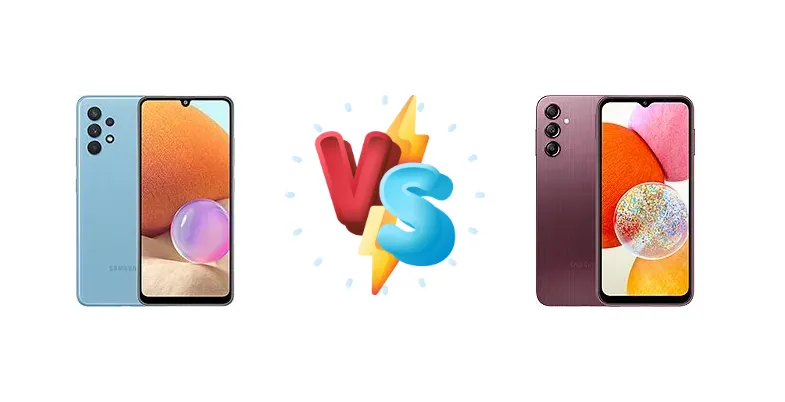
The Samsung Galaxy A32 and A14 represent Samsung’s commitment to providing capable smartphones at accessible price points. While both aim to deliver a solid experience without breaking the bank, they differ in key areas, particularly in chipset options and display quality. This comparison dissects these differences to determine which device offers the best value for your money.
🏆 Quick Verdict
For most users, the Samsung Galaxy A32 emerges as the better choice. Its significantly brighter 814-nit display and proven endurance rating of 119 hours offer a more enjoyable and reliable experience, despite the A14’s potential Exynos variant.
| Network |
|---|
| 2G bands | GSM 850 / 900 / 1800 / 1900 | GSM 850 / 900 / 1800 / 1900 |
| 3G bands | HSDPA 850 / 900 / 1900 / 2100 | HSDPA 850 / 900 / 2100 |
| 4G bands | 1, 2, 3, 5, 7, 8, 20, 28, 38, 40, 41 | 1, 3, 5, 7, 8, 20, 28, 38, 40, 41 |
| Speed | HSPA, LTE | HSPA, LTE |
| Technology | GSM / HSPA / LTE | GSM / HSPA / LTE |
| Launch |
|---|
| Announced | 2021, February 25 | 2023, February 28 |
| Status | Available. Released 2021, February 25 | Available. Released 2023, March 27 |
| Body |
|---|
| Build | Glass front (Gorilla Glass 5), plastic frame, plastic back | Glass front, plastic back, plastic frame |
| Dimensions | 158.9 x 73.6 x 8.4 mm (6.26 x 2.90 x 0.33 in) | 167.7 x 78 x 9.1 mm (6.60 x 3.07 x 0.36 in) |
| SIM | · Nano-SIM· Nano-SIM + Nano-SIM | · Nano-SIM· Nano-SIM + Nano-SIM |
| Weight | 184 g (6.49 oz) | 201 g (7.09 oz) |
| Display |
|---|
| Protection | Corning Gorilla Glass 5 | - |
| Resolution | 1080 x 2400 pixels, 20:9 ratio (~411 ppi density) | 1080 x 2408 pixels, 20:9 ratio (~400 ppi density) |
| Size | 6.4 inches, 98.9 cm2 (~84.6% screen-to-body ratio) | 6.6 inches, 104.9 cm2 (~80.2% screen-to-body ratio) |
| Type | Super AMOLED, 90Hz, 800 nits (HBM) | PLS LCD |
| Platform |
|---|
| CPU | Octa-core (2x2.0 GHz Cortex-A75 & 6x1.8 GHz Cortex-A55) | Octa-core (2x2.0 GHz Cortex-A75 & 6x1.8 GHz Cortex-A55) - Version AOcta-core (4x2.0 GHz Cortex-A55 & 4x2.0 GHz Cortex-A55) - Version B |
| Chipset | Mediatek MT6769V/CU Helio G80 (12 nm) | Mediatek MT6769 Helio G80 (12 nm) - Version AExynos 850 (8 nm) - Version B |
| GPU | Mali-G52 MC2 | Mali-G52 MC2 |
| OS | Android 11, upgradable to Android 13, One UI 5 | Android 13, upgradable to Android 15, One UI 7 |
| Memory |
|---|
| Card slot | microSDXC (dedicated slot) | microSDXC (dedicated slot) |
| Internal | 64GB 4GB RAM, 64GB 6GB RAM, 128GB 4GB RAM, 128GB 6GB RAM, 128GB 8GB RAM | 64GB 4GB RAM, 128GB 4GB RAM, 128GB 6GB RAM |
| Main Camera |
|---|
| Features | LED flash, panorama, HDR | LED flash, panorama, HDR |
| Quad | 64 MP, f/1.8, 26mm (wide), PDAF
8 MP, f/2.2, 123˚, (ultrawide), 1/4.0", 1.12µm
5 MP (macro)
Auxiliary lens | - |
| Single | 20 MP, f/2.2, (wide) | 13 MP, f/2.0, (wide) |
| Triple | - | 50 MP, f/1.8, 26mm (wide), 1/2.75", 0.64µm, PDAF
5 MP, f/2.2, 17mm (ultrawide), 1/5.0", 1.12µm
2 MP (macro) |
| Video | 1080p@30fps | 1080p@30fps |
| Selfie camera |
|---|
| Single | 20 MP, f/2.2, (wide) | 13 MP, f/2.0, 26mm (wide), 1/3.1", 1.12µm |
| Video | 1080p@30fps | 1080p@30fps |
| Sound |
|---|
| 3.5mm jack | Yes | Yes |
| 35mm jack | Yes | Yes |
| Loudspeaker | Yes | Yes |
| Comms |
|---|
| Bluetooth | 5.0, A2DP, LE | 5.1 or 5.3, A2DP, LE |
| NFC | Yes (market/region dependent) | Yes (market/region dependent) |
| Positioning | GPS, GLONASS, BDS, GALILEO | GPS, GALILEO, GLONASS, BDS, QZSS |
| Radio | FM radio, RDS, recording | Unspecified |
| USB | USB Type-C 2.0, OTG | USB Type-C 2.0 |
| WLAN | Wi-Fi 802.11 a/b/g/n/ac, dual-band, Wi-Fi Direct | Wi-Fi 802.11 a/b/g/n/ac, dual-band, Wi-Fi Direct |
| Features |
|---|
| Sensors | Fingerprint (under display, optical), accelerometer, gyro, compass | Fingerprint (side-mounted), accelerometer, proximity, compass |
| | Virtual proximity sensing | - |
| Battery |
|---|
| Charging | 15W wired | 15W wired |
| Type | Li-Ion 5000 mAh | Li-Po 5000 mAh |
| Misc |
|---|
| Colors | Awesome Black, Awesome White, Awesome Blue, Awesome Violet | Black, Dark Red, Silver, Green |
| Models | SM-A325F, SM-A325F/DS, SM-A325M, SM-A325N | SM-A145F, SM-A145F/DSN, SM-A145M, SM-A145M/DS, SM-A145P, SM-A145R |
| Price | € 124.99 / £ 89.38 | € 85.76 / $ 147.60 / £ 79.95 |
| SAR EU | 0.45 W/kg (head) 1.30 W/kg (body) | 0.46 W/kg (head) 1.37 W/kg (body) |
| Tests |
|---|
| Battery life |
Endurance rating 119h
| - |
| Camera |
Photo / Video | - |
| Display |
Contrast ratio: Infinite (nominal) | - |
| Loudspeaker |
-30.3 LUFS (Below average)
| - |
| Performance |
AnTuTu: 286666 (v8)
GeekBench: 1277 (v5.1)
GFXBench: 8.1fps (ES 3.1 onscreen) | - |
Samsung Galaxy A32
- Brighter display for better outdoor visibility
- Superior battery endurance (119h)
- Potentially better CPU performance with Cortex-A75 cores
- 15W charging is relatively slow
- Camera details are lacking, potentially average performance
Samsung Galaxy A14
- Potentially lower price point
- Exynos 850 variant may offer improved efficiency
- Similar chipset options for basic tasks
- Likely dimmer display
- Exynos variant may have lower peak performance
- Battery life is unknown, potentially lower than A32
Display Comparison
The Samsung Galaxy A32 boasts a clear advantage in display quality, achieving a measured peak brightness of 814 nits. This is a substantial improvement over what is typically found in this price bracket, making it far more usable in direct sunlight. While both phones share an 'Infinite' (nominal) contrast ratio, the A32’s higher brightness translates to a more vibrant and engaging viewing experience. The A14’s display specifications are not provided, suggesting a potentially lower peak brightness, which could result in washed-out visuals outdoors.
Camera Comparison
Both devices are listed with 'Photo / Video' capabilities, lacking specific details. This suggests a similar approach to camera functionality, likely focusing on everyday photography. Without sensor size or aperture information, it’s difficult to assess image quality differences. The inclusion of a 2MP macro camera on both devices is likely a marketing feature with limited practical benefit due to the small sensor size and lack of optical image stabilization (OIS).
Performance
Both the A32 and A14 utilize the Mediatek Helio G80 chipset, but the A14 introduces a variant with the Exynos 850. The Helio G80 in the A32 features an octa-core configuration with 2x2.0 GHz Cortex-A75 and 6x1.8 GHz Cortex-A55 cores. The A14’s Helio G80 version mirrors this. However, the Exynos 850 variant in the A14 uses an octa-core configuration of 4x2.0 GHz Cortex-A55 and 4x2.0 GHz Cortex-A55 cores. This suggests a shift towards efficiency over raw performance with the Exynos version, potentially impacting demanding tasks. The A32’s Cortex-A75 cores offer a performance edge in CPU-intensive applications.
Battery Life
The Samsung Galaxy A32 holds a significant advantage in battery endurance, achieving a measured 119-hour rating. This indicates a well-optimized combination of battery capacity and power efficiency. The A14’s battery capacity and efficiency are unknown, but with a 15W wired charging speed matching the A32, the A32’s superior endurance is likely due to a larger battery or more efficient chipset/software combination. The 15W charging speed on both devices is relatively slow compared to modern standards, meaning a full charge will take a considerable amount of time.
Buying Guide
Buy the Samsung Galaxy A32 if you prioritize a brighter, more visible display for outdoor use and longer battery life between charges. It’s ideal for media consumers and users who frequently rely on their phone throughout the day. Buy the Samsung Galaxy A14 if you are looking for the absolute lowest price point and are willing to compromise on display brightness and potentially performance, especially if you find a version equipped with the Exynos 850.
Frequently Asked Questions
❓ Does the Exynos 850 in the Galaxy A14 tend to overheat during prolonged gaming sessions?
The Exynos 850 is generally known for its efficiency, which helps to mitigate overheating. However, the A14’s thermal design is unknown. While it’s unlikely to experience severe throttling, sustained gaming may lead to some performance reduction over time. The A32’s Helio G80, while not as efficient, also benefits from a potentially better-optimized thermal profile.
❓ Is the 2MP macro camera on either phone actually useful for taking detailed close-up photos?
Unfortunately, the 2MP macro cameras on both the A32 and A14 are largely marketing features. The small sensor size and lack of autofocus result in images that are often soft, lacking in detail, and generally inferior to photos taken with the main camera in good lighting conditions. Don't expect professional-quality macro photography from either device.
❓ Can the Galaxy A14 handle graphically demanding games like PUBG Mobile at 60fps with high settings?
The Helio G80 chipset in both the A32 and A14 can run PUBG Mobile, but achieving a consistent 60fps with high settings is unlikely. You’ll likely need to lower the graphics settings to medium or even low to maintain a smooth frame rate, especially on the A14’s Exynos variant which prioritizes efficiency over raw power.