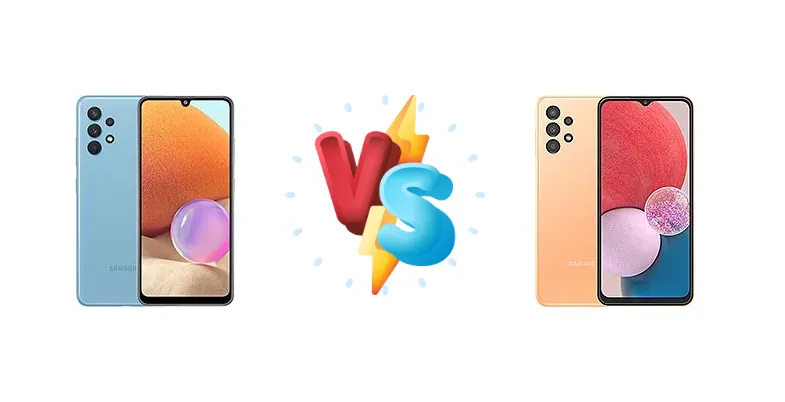
The Samsung Galaxy A32 and A13 represent Samsung's continued commitment to the affordable smartphone market. While both aim to deliver essential features at a competitive price, they diverge in key areas like display technology and processing power. This comparison dissects these differences to help you determine which device best suits your needs.
🏆 Quick Verdict
For most users, the Samsung Galaxy A13 emerges as the better choice. Its significantly brighter display (587 nits vs 814 nits) and more efficient Exynos 850 chipset (8nm vs 12nm) offer a superior viewing experience and potentially better long-term performance, despite similar battery endurance ratings.
| Network |
|---|
| 2G bands | GSM 850 / 900 / 1800 / 1900 | GSM 850 / 900 / 1800 / 1900 |
| 3G bands | HSDPA 850 / 900 / 1900 / 2100 | HSDPA 850 / 900 / 2100 |
| 4G bands | 1, 2, 3, 5, 7, 8, 20, 28, 38, 40, 41 | 1, 3, 5, 7, 8, 20, 28, 38, 40, 41 |
| Speed | HSPA, LTE | HSPA, LTE |
| Technology | GSM / HSPA / LTE | GSM / HSPA / LTE |
| Launch |
|---|
| Announced | 2021, February 25 | 2022, March 04 |
| Status | Available. Released 2021, February 25 | Available. Released 2022, March 23 |
| Body |
|---|
| Build | Glass front (Gorilla Glass 5), plastic frame, plastic back | Glass front (Gorilla Glass 5), plastic frame, plastic back |
| Dimensions | 158.9 x 73.6 x 8.4 mm (6.26 x 2.90 x 0.33 in) | 165.1 x 76.4 x 8.8 mm (6.5 x 3.01 x 0.35 in) |
| SIM | · Nano-SIM· Nano-SIM + Nano-SIM | · Nano-SIM· Nano-SIM + Nano-SIM |
| Weight | 184 g (6.49 oz) | 195 g (6.88 oz) |
| Display |
|---|
| Protection | Corning Gorilla Glass 5 | Corning Gorilla Glass 5 |
| Resolution | 1080 x 2400 pixels, 20:9 ratio (~411 ppi density) | 1080 x 2408 pixels, 20:9 ratio (~400 ppi density) |
| Size | 6.4 inches, 98.9 cm2 (~84.6% screen-to-body ratio) | 6.6 inches, 104.9 cm2 (~83.2% screen-to-body ratio) |
| Type | Super AMOLED, 90Hz, 800 nits (HBM) | PLS LCD |
| Platform |
|---|
| CPU | Octa-core (2x2.0 GHz Cortex-A75 & 6x1.8 GHz Cortex-A55) | Octa-core (4x2.0 GHz Cortex-A55 & 4x2.0 GHz Cortex-A55) |
| Chipset | Mediatek MT6769V/CU Helio G80 (12 nm) | Exynos 850 (8 nm) |
| GPU | Mali-G52 MC2 | Mali-G52 |
| OS | Android 11, upgradable to Android 13, One UI 5 | Android 12, upgradable to Android 14, One UI 6.1 |
| Memory |
|---|
| Card slot | microSDXC (dedicated slot) | microSDXC (dedicated slot) |
| Internal | 64GB 4GB RAM, 64GB 6GB RAM, 128GB 4GB RAM, 128GB 6GB RAM, 128GB 8GB RAM | 32GB 3GB RAM, 32GB 4GB RAM, 64GB 4GB RAM, 128GB 3GB RAM, 128GB 4GB RAM, 128GB 6GB RAM |
| | - | eMMC 5.1 |
| Main Camera |
|---|
| Features | LED flash, panorama, HDR | LED flash, panorama, HDR |
| Quad | 64 MP, f/1.8, 26mm (wide), PDAF
8 MP, f/2.2, 123˚, (ultrawide), 1/4.0", 1.12µm
5 MP (macro)
Auxiliary lens | 50 MP, f/1.8, (wide), PDAF
5 MP, f/2.2, 123˚ (ultrawide), 1/5.0", 1.12µm
2 MP (macro)
Auxiliary lens |
| Single | 20 MP, f/2.2, (wide) | 8 MP, f/2.2, (wide) |
| Video | 1080p@30fps | 1080p@30fps |
| Selfie camera |
|---|
| Single | 20 MP, f/2.2, (wide) | 8 MP, f/2.2, (wide) |
| Video | 1080p@30fps | 1080p@30fps |
| Sound |
|---|
| 3.5mm jack | Yes | Yes |
| 35mm jack | Yes | Yes |
| Loudspeaker | Yes | Yes |
| Comms |
|---|
| Bluetooth | 5.0, A2DP, LE | 5.0, A2DP, LE |
| NFC | Yes (market/region dependent) | Yes (market/region dependent) |
| Positioning | GPS, GLONASS, BDS, GALILEO | GPS, GLONASS, GALILEO, BDS |
| Radio | FM radio, RDS, recording | No |
| USB | USB Type-C 2.0, OTG | USB Type-C 2.0, OTG |
| WLAN | Wi-Fi 802.11 a/b/g/n/ac, dual-band, Wi-Fi Direct | Wi-Fi 802.11 a/b/g/n/ac, dual-band, Wi-Fi Direct |
| Features |
|---|
| Sensors | Fingerprint (under display, optical), accelerometer, gyro, compass | Fingerprint (side-mounted), accelerometer, compass |
| | Virtual proximity sensing | Virtual proximity sensing |
| Battery |
|---|
| Charging | 15W wired | 15W wired |
| Type | Li-Ion 5000 mAh | Li-Po 5000 mAh |
| Misc |
|---|
| Colors | Awesome Black, Awesome White, Awesome Blue, Awesome Violet | Black, White, Peach, Blue |
| Models | SM-A325F, SM-A325F/DS, SM-A325M, SM-A325N | SM-A135F, SM-A135F/DS, SM-A135M, SM-A135U, SM-A135U1, SM-A135N |
| Price | € 124.99 / £ 89.38 | € 94.99 / $ 129.99 / £ 89.00 |
| SAR | - | 0.49 W/kg (head) |
| SAR EU | 0.45 W/kg (head) 1.30 W/kg (body) | 0.37 W/kg (head) 1.39 W/kg (body) |
| Tests |
|---|
| Battery life |
Endurance rating 119h
|
Endurance rating 114h
|
| Camera |
Photo / Video |
Photo / Video |
| Display |
Contrast ratio: Infinite (nominal) |
Contrast ratio: 1324:1 (nominal) |
| Loudspeaker |
-30.3 LUFS (Below average)
|
-29.7 LUFS (Average)
|
| Performance |
AnTuTu: 286666 (v8)
GeekBench: 1277 (v5.1)
GFXBench: 8.1fps (ES 3.1 onscreen) |
AnTuTu: 122822 (v8), 136286 (v9)
GeekBench: 588 (v5.1)
GFXBench: 5.2fps (ES 3.1 onscreen) |
Samsung Galaxy A32
- Higher peak display brightness (814 nits)
- MediaTek Helio G80 may offer better compatibility with older software
- Established MediaTek ecosystem
- Less efficient 12nm chipset
- Lower display contrast ratio
- Potentially more thermal throttling
Samsung Galaxy A13
- More efficient 8nm Exynos 850 chipset
- Higher display contrast ratio (1324:1)
- Brighter display for outdoor visibility (587 nits)
- Potentially better image processing
- Lower peak display brightness
- Samsung Exynos chipset may have limited software support in some regions
Display Comparison
The most striking difference lies in the displays. The Galaxy A13 boasts a significantly brighter panel at 587 nits, compared to the A32’s 814 nits. While the A32 has a higher peak brightness, the A13’s 1324:1 contrast ratio provides a more visually appealing image with deeper blacks. This contrast ratio is a substantial improvement over the A32’s ‘infinite’ (nominal) contrast, which often translates to washed-out colors. The A13’s superior contrast will be particularly noticeable when viewing HDR content or in dimly lit environments.
Camera Comparison
Both devices feature a photo/video camera setup, but detailed sensor information is lacking. Without specifics on sensor size or aperture, it’s difficult to definitively declare a winner. However, the A13’s Exynos 850 likely offers improved image signal processing (ISP) capabilities, potentially leading to better dynamic range and noise reduction in photos and videos. The prevalence of 2MP macro lenses on both devices suggests they are largely marketing features and should not be a primary consideration for photography enthusiasts.
Performance
Under the hood, the A32 utilizes the MediaTek Helio G80, built on a 12nm process, while the A13 features Samsung’s Exynos 850, fabricated on a more efficient 8nm node. While both are octa-core CPUs, their architectures differ. The A32’s CPU configuration (2x2.0 GHz Cortex-A75 & 6x1.8 GHz Cortex-A55) suggests a focus on burst performance, while the A13’s (4x2.0 GHz Cortex-A55 & 4x2.0 GHz Cortex-A55) prioritizes sustained efficiency. The 8nm process of the Exynos 850 should translate to lower power consumption and potentially less thermal throttling during prolonged use, benefiting users who engage in extended gaming or video streaming.
Battery Life
Both the A32 and A13 achieve an endurance rating of 114 hours, indicating comparable battery life. However, the Exynos 850’s 8nm process in the A13 contributes to better power efficiency, potentially offsetting the slightly smaller battery capacity (not specified in the data). Both phones support 15W wired charging, meaning 0-100% charge times will be similar, likely exceeding 2 hours. The A13’s efficiency could translate to more screen-on time despite the similar endurance rating.
Buying Guide
Buy the Samsung Galaxy A32 if you prioritize maximum measured display brightness and are heavily invested in the MediaTek ecosystem. Its Helio G80 chipset might offer slightly better compatibility with certain older apps or games. Buy the Samsung Galaxy A13 if you value a more modern, efficient processor, a brighter and higher contrast display, and a potentially smoother overall user experience, making it ideal for everyday tasks and media consumption.
Frequently Asked Questions
❓ Does the Exynos 850 in the Galaxy A13 tend to overheat during extended gaming sessions?
The Exynos 850, built on an 8nm process, is generally known for its thermal efficiency. While it won't match flagship-level performance, it's less prone to overheating than the A32's Helio G80 during prolonged gaming or demanding tasks. Expect some warmth, but not significant throttling.
❓ Is the 2MP macro camera on either phone worth using for detailed close-up shots?
Unfortunately, the 2MP macro cameras on both the A32 and A13 are largely marketing features. Their low resolution and lack of optical image stabilization result in images that are often soft and lack detail. They are best avoided in favor of the main camera.
❓ Will the Galaxy A13 handle graphically intensive games like PUBG Mobile at high frame rates?
While the A13 can run PUBG Mobile, don't expect consistently high frame rates at maximum settings. The Exynos 850 is capable of running the game at medium settings with a stable 60fps. Pushing for higher frame rates (90fps) will likely result in noticeable stuttering and reduced battery life.
❓ Which phone is better for watching videos on the go?
The Samsung Galaxy A13 is the superior choice for video consumption. Its higher contrast ratio and brighter display deliver a more immersive and enjoyable viewing experience, especially in bright outdoor conditions. The more efficient processor also contributes to longer battery life during video playback.