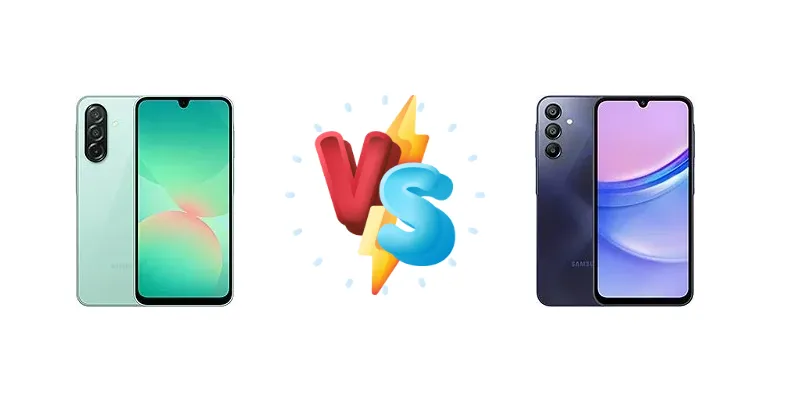
Samsung's A-series continues to dominate the mid-range market, offering compelling features at accessible price points. The Galaxy A26 and A15 represent two distinct approaches within this segment. The A26 aims for a balance of performance and longevity with its Exynos 1380 chipset, while the A15 prioritizes extended battery life and a vibrant display powered by the MediaTek Helio G99. This comparison dives deep into the specifics to determine which device best suits your needs.
🏆 Quick Verdict
For most users, the Samsung Galaxy A15 emerges as the better value. Its significantly longer active use battery life (15:28h vs 10:44h) and brighter display (808 nits vs 777 nits) provide a more enjoyable daily experience, outweighing the A26's slightly more powerful, but less efficient, chipset.
| Network |
|---|
| 2G bands | GSM 850 / 900 / 1800 / 1900 | GSM 850 / 900 / 1800 / 1900 |
| 3G bands | HSDPA 850 / 900 / 1700(AWS) / 1900 / 2100 | HSDPA 850 / 900 / 2100 |
| 4G bands | 1, 2, 3, 4, 5, 7, 8, 12, 17, 20, 26, 28, 32, 38, 40, 41, 66 | 1, 3, 5, 7, 8, 20, 28, 38, 40, 41 |
| 5G bands | 1, 3, 5, 7, 8, 20, 28, 38, 40, 41, 66, 77, 78 SA/NSA/Sub6 | - |
| Speed | HSPA, LTE, 5G | HSPA, LTE |
| Technology | GSM / HSPA / LTE / 5G | GSM / HSPA / LTE |
| Launch |
|---|
| Announced | 2025, March 02 | 2023, December 11 |
| Status | Available. Released 2025, March 19 | Available. Released 2023, December 16 |
| Body |
|---|
| Build | Glass front (Gorilla Glass Victus+), plastic frame, glass back (Gorilla Glass Victus+) | Glass front, plastic back, plastic frame |
| Dimensions | 164 x 77.5 x 7.7 mm (6.46 x 3.05 x 0.30 in) | 160.1 x 76.8 x 8.4 mm (6.30 x 3.02 x 0.33 in) |
| SIM | Nano-SIM + Nano-SIM | · Nano-SIM· Nano-SIM + Nano-SIM |
| Weight | 200 g (7.05 oz) | 200 g (7.05 oz) |
| Display |
|---|
| Protection | Corning Gorilla Glass Victus+, Mohs level 5 | - |
| Resolution | 1080 x 2340 pixels, 19.5:9 ratio (~385 ppi density) | 1080 x 2340 pixels, 19.5:9 ratio (~396 ppi density) |
| Size | 6.7 inches, 110.2 cm2 (~86.7% screen-to-body ratio) | 6.5 inches, 103.7 cm2 (~84.3% screen-to-body ratio) |
| Type | Super AMOLED, 120Hz | Super AMOLED, 90Hz, 800 nits (HBM) |
| Platform |
|---|
| CPU | Octa-core (4x2.4 GHz Cortex-A78 & 4x2.0 GHz Cortex-A55) - GlobalOcta-core (2x2.4 GHz Cortex-A78 & 6x2.0 GHz Cortex-A55) - LATAM | Octa-core (2x2.2 GHz Cortex-A76 & 6x2.0 GHz Cortex-A55) |
| Chipset | Exynos 1380 (5 nm) - GlobalExynos 1280 (5 nm) - LATAM | Mediatek Helio G99 (6 nm) |
| GPU | Mali-G68 MP5 - GlobalMali-G68 - LATAM | Mali-G57 MC2 |
| OS | Android 15, up to 6 major Android upgrades, One UI 7 | Android 14, up to 4 major Android upgrades, One UI 7 |
| Memory |
|---|
| Card slot | microSDXC (uses shared SIM slot) | microSDXC (uses shared SIM slot) |
| Internal | 128GB 4GB RAM, 128GB 6GB RAM, 128GB 8GB RAM, 256GB 6GB RAM, 256GB 8GB RAM | 128GB 4GB RAM, 128GB 6GB RAM, 128GB 8GB RAM, 256GB 6GB RAM, 256GB 8GB RAM |
| Main Camera |
|---|
| Features | LED flash, panorama, HDR | LED flash, panorama, HDR |
| Triple | 50 MP, f/1.8, 27mm (wide), 1/2.76", 0.64µm, PDAF, OIS
8 MP, f/2.2, 120˚ (ultrawide), 1/4.0", 1.12µm
2 MP (macro) | 50 MP, f/1.8, 26mm (wide), 1/2.8", 0.64µm, PDAF
5 MP, f/2.2, 17mm (ultrawide), 1/5.0", 1.12µm
2 MP (macro) |
| Video | 4K@30fps, 1080p@30fps, 720p@480fps, gyro-EIS | 1080p@30fps |
| Selfie camera |
|---|
| Single | 13 MP, f/2.2, (wide), 1/3.06", 1.12µm | 13 MP, f/2.0, 26mm (wide), 1/3.06", 1.12µm |
| Video | 1080p@30fps | 1080p@30fps |
| Sound |
|---|
| 35mm jack | No | Yes |
| Loudspeaker | Yes | Yes |
| Comms |
|---|
| Bluetooth | 5.3, A2DP, LE | 5.3, A2DP, LE |
| NFC | Yes (market/region dependent) | Yes (market/region dependent) |
| Positioning | GPS, GALILEO, GLONASS, BDS, QZSS | GPS, GALILEO, GLONASS, BDS, QZSS |
| Radio | Unspecified | FM radio (market/region dependent) |
| USB | USB Type-C 2.0, OTG | USB Type-C 2.0 |
| WLAN | Wi-Fi 802.11 a/b/g/n/ac, dual-band, Wi-Fi Direct | Wi-Fi 802.11 a/b/g/n/ac, dual-band, Wi-Fi Direct |
| Features |
|---|
| Sensors | Fingerprint (side-mounted), accelerometer, gyro, compass | Fingerprint (side-mounted), accelerometer, compass |
| Battery |
|---|
| Charging | 25W wired | 25W wired |
| Type | 5000 mAh | 5000 mAh |
| Misc |
|---|
| Colors | Black, White, Mint, Peach Pink | Brave Black, Optimistic Blue, Magical Blue, Personality Yellow |
| Models | SM-A266E, SM-A266E/DS, SM-A266E/DSN, SM-A266B, SM-A266B/DS, SM-A266B/DSN, SM-A266U, SM-A266U1, SM-A266W | SM-A155F, SM-A155F/DSN, SM-A155M, SM-A155M/DS, SM-A155P, SM-A155R |
| Price | $ 194.87 / C$ 292.99 / £ 167.00 / € 194.00 / ₹ 20,398 | € 168.99 / $ 125.00 / £ 113.00 |
| SAR | 0.75 W/kg (head) 1.09 W/kg (body) | - |
| SAR EU | 0.41 W/kg (head) 0.96 W/kg (body) | 0.42 W/kg (head) 1.29 W/kg (body) |
| EU LABEL |
|---|
| Battery | 37:05h endurance, 1200 cycles | - |
| Energy | Class C | - |
| Free fall | Class B (269 falls) | - |
| Repairability | Class C | - |
Samsung Galaxy A26
- More powerful CPU for demanding tasks
- Potentially better image processing
- Slightly more efficient chipset (5nm)
- Significantly shorter active use battery life
- Less bright display
- LATAM variant has reduced CPU core count
Samsung Galaxy A15
- Exceptional battery life (15:28h active use)
- Brighter display for outdoor visibility
- More efficient chipset (6nm)
- Less powerful CPU for demanding tasks
- Potentially less advanced image processing
- May struggle with sustained performance in very demanding games
Display Comparison
The Galaxy A15 boasts a brighter display, reaching 808 nits compared to the A26’s 777 nits. This translates to better visibility under direct sunlight. While both displays likely utilize LCD technology (given the price segment), the A15’s higher peak brightness is a tangible advantage. We lack information on panel technology (LTPO, PWM frequency) but the brightness difference is a clear win for the A15, especially for outdoor users. Bezels are assumed to be similar, typical of this price range.
Camera Comparison
Without detailed camera specs beyond the chipsets, a direct comparison is limited. Both phones likely feature a multi-camera setup with a primary sensor, ultrawide, and potentially a macro lens. The image signal processor (ISP) within the Exynos 1380 *should* offer more advanced image processing capabilities, potentially resulting in better dynamic range and low-light performance. However, the Helio G99’s ISP is also capable, and image quality will heavily depend on sensor size and lens quality – data we currently lack. We can safely assume the 2MP macro cameras on both devices offer limited utility.
Performance
The A26’s Exynos 1380 (5nm) and A15’s MediaTek Helio G99 (6nm) represent different architectural approaches. The Exynos 1380, with its Cortex-A78 cores, offers a performance edge in CPU-intensive tasks, particularly the Global variant with 4x A78 cores. However, the LATAM variant has a reduced core count (2x A78), narrowing the gap. The Helio G99, while using older Cortex-A76 cores, benefits from a more efficient 6nm process. This efficiency contributes to the A15’s superior battery life. The A26’s 5nm process *should* offer better thermal efficiency, but the Helio G99’s lower peak power draw may mitigate this advantage. Real-world performance differences will be noticeable in demanding apps, favoring the A26, but the A15 will likely maintain smoother sustained performance due to better thermal management.
Battery Life
The Galaxy A15 shines in battery performance. Its active use score of 15:28h significantly surpasses the A26’s 10:44h. While the A26 boasts a longer battery endurance rating (37:05h vs unknown for A15), this is likely due to the A26’s less power-hungry chipset in standby. Both phones support 25W wired charging, meaning 0-100% charge times will be comparable, around 1.5-2 hours. The A15’s superior active use score makes it the clear winner for users who prioritize all-day battery life.
Buying Guide
Buy the Samsung Galaxy A26 if you prioritize occasional bursts of higher performance for tasks like light gaming or video editing, and are willing to trade some battery life for it. The Exynos 1380 offers a more capable CPU for demanding applications. Buy the Samsung Galaxy A15 if you value all-day battery life, a brighter screen for outdoor visibility, and a consistently smooth experience for everyday tasks like browsing, social media, and streaming. It’s the ideal choice for users who prioritize efficiency and longevity.
Frequently Asked Questions
❓ Does the Exynos 1380 in the A26 overheat during prolonged gaming sessions?
While the 5nm process *should* aid in thermal management, the A26's higher peak performance could lead to throttling during extended gaming. The Helio G99 in the A15, being less power-hungry, is likely to maintain more consistent performance over longer periods, even if its peak performance is lower.
❓ Is the difference in display brightness between the A26 and A15 noticeable in everyday use?
Yes, the 808 nits of the A15's display will be noticeably brighter than the A26's 777 nits, especially when viewing content outdoors or in brightly lit environments. This makes the A15 a better choice for users who frequently use their phones in these conditions.
❓ How does the LATAM variant of the A26 with the reduced core count affect performance?
The LATAM variant's reduction from 4 to 2 Cortex-A78 cores will result in a noticeable performance decrease in CPU-intensive tasks compared to the Global variant. While still capable, it will be closer in performance to the A15's Helio G99, diminishing one of the A26's key advantages.
❓ What type of charging protocol do both phones support, and how long does a full charge take?
Both the Galaxy A26 and A15 support 25W wired charging via USB-C. Based on typical charging curves for phones with similar battery capacities, a full charge from 0-100% is expected to take approximately 1.5 to 2 hours for both devices.