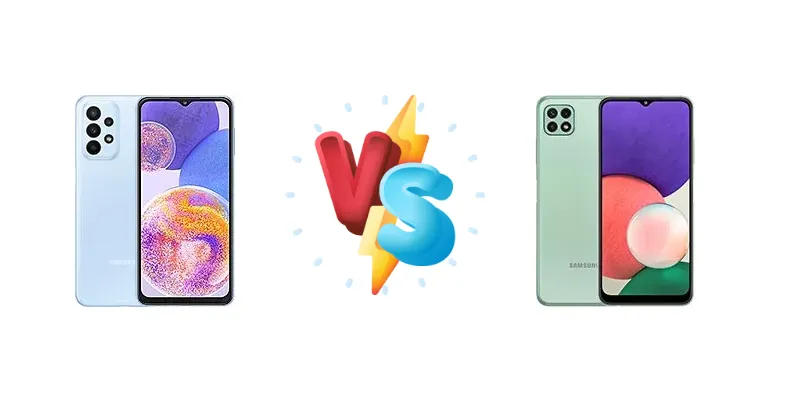
Samsung's A-series continues to dominate the budget smartphone space, but choosing between models can be tricky. The Galaxy A23 and A22 5G represent distinct approaches – the A23 focuses on incremental improvements to core specs, while the A22 5G prioritized early 5G connectivity. This comparison dives deep into the differences to help you determine which phone best suits your needs.
🏆 Quick Verdict
For most users, the Samsung Galaxy A23 emerges as the better choice. Its more efficient Snapdragon 680 chipset, coupled with a slightly improved battery endurance rating of 130 hours, provides a smoother overall experience. While the A22 5G offers 5G connectivity, the A23’s display and processing power offer a more compelling daily user experience.
| Network |
|---|
| 2G bands | GSM 850 / 900 / 1800 / 1900 | GSM 850 / 900 / 1800 / 1900 |
| 3G bands | HSDPA 850 / 900 / 2100 | HSDPA 850 / 900 / 1900 / 2100 |
| 4G bands | 1, 3, 5, 7, 8, 20, 28, 38, 40, 41 | 1, 2, 3, 5, 7, 8, 20, 28, 38, 40, 41 |
| 5G bands | - | 1, 3, 5, 7, 8, 20, 28, 38, 40, 41, 78, 79 SA/NSA/Sub6 |
| Speed | HSPA, LTE | HSPA, LTE, 5G |
| Technology | GSM / HSPA / LTE | GSM / HSPA / LTE / 5G |
| Launch |
|---|
| Announced | 2022, March 04 | 2021, June 03 |
| Status | Available. Released 2022, March 25 | Available. Released 2021, June 24 |
| Body |
|---|
| Build | Glass front (Gorilla Glass 5), plastic frame, plastic back | Glass front, plastic frame, plastic back |
| Dimensions | 165.4 x 76.9 x 8.4 mm (6.51 x 3.03 x 0.33 in) | 167.2 x 76.4 x 9 mm (6.58 x 3.01 x 0.35 in) |
| SIM | · Nano-SIM· Nano-SIM + Nano-SIM | · Nano-SIM· Nano-SIM + Nano-SIM |
| Weight | 195 g (6.88 oz) | 203 g (7.16 oz) |
| Display |
|---|
| Protection | Corning Gorilla Glass 5 | - |
| Resolution | 1080 x 2408 pixels, 20:9 ratio (~400 ppi density) | 1080 x 2400 pixels, 20:9 ratio (~399 ppi density) |
| Size | 6.6 inches, 104.9 cm2 (~82.5% screen-to-body ratio) | 6.6 inches, 105.2 cm2 (~82.3% screen-to-body ratio) |
| Type | PLS LCD, 90Hz | TFT LCD, 90Hz |
| Platform |
|---|
| CPU | Octa-core (4x2.4 GHz Kryo 265 Gold & 4x1.9 GHz Kryo 265 Silver) | Octa-core (2x2.2 GHz Cortex-A76 & 6x2.0 GHz Cortex-A55) |
| Chipset | Qualcomm SM6225 Snapdragon 680 4G (6 nm) | Mediatek Dimensity 700 (7 nm) |
| GPU | Adreno 610 | Mali-G57 MC2 |
| OS | Android 12, upgradable to Android 14, One UI 6.1 | Android 11, upgradable to Android 13, One UI core 5 |
| Memory |
|---|
| Card slot | microSDXC (dedicated slot) | microSDXC (dedicated slot) |
| Internal | 64GB 4GB RAM, 64GB 6GB RAM, 128GB 4GB RAM, 128GB 6GB RAM, 128GB 8GB RAM | 64GB 4GB RAM, 128GB 4GB RAM, 128GB 6GB RAM, 128GB 8GB RAM |
| | eMMC 5.1 | - |
| Main Camera |
|---|
| Features | LED flash, panorama, HDR | LED flash, panorama, HDR |
| Quad | 50 MP, f/1.8, (wide), PDAF, OIS
5 MP, f/2.2, 123˚ (ultrawide), 1/5.0", 1.12µm
2 MP (macro)
Auxiliary lens | - |
| Single | 8 MP, f/2.2, (wide) | 8 MP, f/2.0, (wide) |
| Triple | - | 48 MP, f/1.8, (wide), PDAF
5 MP, f/2.2, 115˚ (ultrawide), 1/5.0", 1.12µm
Auxiliary lens |
| Video | 1080p@30fps | 1152p@30fps |
| Selfie camera |
|---|
| Single | 8 MP, f/2.2, (wide) | 8 MP, f/2.0, (wide) |
| Video | 1080p@30fps | 1080p@30fps |
| Sound |
|---|
| 3.5mm jack | Yes | Yes |
| 35mm jack | Yes | Yes |
| Loudspeaker | Yes | Yes |
| Comms |
|---|
| Bluetooth | 5.0, A2DP, LE | 5.0, A2DP, LE |
| NFC | Yes (market/region dependent) | Yes (market/region dependent) |
| Positioning | GPS, GLONASS, GALILEO, BDS | GPS, GLONASS, GALILEO, BDS |
| Radio | FM radio | FM radio |
| USB | USB Type-C 2.0 | USB Type-C 2.0 |
| WLAN | Wi-Fi 802.11 a/b/g/n/ac, dual-band, Wi-Fi Direct | Wi-Fi 802.11 a/b/g/n/ac, dual-band, Wi-Fi Direct |
| Features |
|---|
| Sensors | Fingerprint (side-mounted), accelerometer, gyro, compass | Fingerprint (side-mounted), accelerometer, gyro, proximity, compass |
| | Virtual proximity sensing | - |
| Battery |
|---|
| Charging | 25W wired | 15W wired |
| Type | Li-Po 5000 mAh | Li-Po 5000 mAh |
| Misc |
|---|
| Colors | Black, White, Peach, Blue | Gray, White, Mint, Violet |
| Models | SM-A235F, SM-A235F/DS, SM-A235F/DSN, SM-A235M, SM-A235M/DS, SM-A235N | SM-A226B, SM-A226B/DS, SM-A226B/DSN, SM-A226BR, SM-A226BR/N, SM-A226L, SC-56B |
| Price | £ 99.00 / ₹ 14,999 | £ 92.00 / € 125.99 |
| SAR | 0.48 W/kg (head) | - |
| SAR EU | 0.36 W/kg (head) 0.96 W/kg (body) | 0.73 W/kg (head) 1.23 W/kg (body) |
| Tests |
|---|
| Battery life |
Endurance rating 130h
|
Endurance rating 118h
|
| Camera |
Photo / Video |
Photo / Video |
| Display |
Contrast ratio: 1241:1 |
Contrast ratio: 1631:1 (nominal) |
| Loudspeaker |
-27.6 LUFS (Good)
|
-28.5 LUFS (Average)
|
| Performance |
AnTuTu: 273554 (v9)
GeekBench: 1632 (v5.1)
GFXBench: 6.7fps (ES 3.1 onscreen) |
AnTuTu: 242155 (v8), 223188 (v9)
GeekBench: 6913 (v4.4), 1719 (v5.1)
GFXBench: 12fps (ES 3.1 onscreen) |
Samsung Galaxy A23
- Longer battery life (130h endurance)
- Faster 25W charging
- Brighter display (464 nits)
- More efficient Snapdragon 680 chipset
- Lacks 5G connectivity
- Camera specs are not significantly improved
Samsung Galaxy A22 5G
- 5G connectivity for faster data speeds
- Higher nominal contrast ratio (1631:1)
- Potentially lower price point (depending on retailer)
- Good value for early 5G adopters
- Shorter battery life (118h endurance)
- Slower 15W charging
- Less efficient Dimensity 700 chipset
- Dimmer display (385 nits)
Display Comparison
The Galaxy A23 boasts a contrast ratio of 1241:1 and a peak brightness of 464 nits, offering a noticeably more vibrant image compared to the A22 5G’s 1631:1 contrast ratio and 385 nits. While the A22 5G has a higher *nominal* contrast ratio, the A23’s higher brightness translates to better visibility outdoors. Both displays are adequate for everyday use, but the A23’s superior brightness is a clear advantage for media consumption in bright environments. The difference in contrast ratios, while present on paper, is less noticeable in real-world usage.
Camera Comparison
Both phones feature a photo/video camera setup, but detailed sensor information is lacking. Without specifics on sensor size or aperture, it’s difficult to make a definitive judgment. However, given Samsung’s typical image processing style, both phones likely prioritize vibrant colors and strong contrast. The presence of a 2MP macro camera on both devices is largely inconsequential; these sensors typically deliver limited detail. The real-world camera performance will likely depend more on software optimization than hardware differences.
Performance
The chipset is where the most significant difference lies. The Galaxy A23 utilizes the Qualcomm Snapdragon 680 (6nm), while the A22 5G features the MediaTek Dimensity 700 (7nm). While both are octa-core CPUs, the Snapdragon 680’s newer architecture and 6nm process offer improved efficiency. The A23’s CPU configuration (4x2.4 GHz Kryo 265 Gold & 4x1.9 GHz Kryo 265 Silver) provides a slight edge in single-core performance, while the A22 5G’s (2x2.2 GHz Cortex-A76 & 6x2.0 GHz Cortex-A55) focuses on a more balanced approach. The 6nm process of the Snapdragon 680 also suggests better thermal management, potentially leading to less throttling during sustained workloads.
Battery Life
The Galaxy A23 edges out the A22 5G in battery endurance, achieving a rating of 130 hours compared to the A22 5G’s 118 hours. This 12-hour difference, while not massive, is noticeable in daily use. The A23 also supports 25W wired charging, significantly faster than the A22 5G’s 15W charging. This means the A23 can replenish its battery much quicker, reducing downtime. The Snapdragon 680’s efficiency further contributes to the A23’s longer battery life.
Buying Guide
Buy the Samsung Galaxy A23 if you prioritize longer battery life, a brighter and higher contrast display, and a more modern chipset for smoother app performance. Buy the Samsung Galaxy A22 5G if 5G connectivity is absolutely essential and you're willing to trade off some processing power and display quality for it. The A22 5G remains a viable option for those in areas with strong 5G coverage and limited budgets.
Frequently Asked Questions
❓ Does the MediaTek Dimensity 700 in the A22 5G tend to overheat during prolonged gaming sessions?
While the Dimensity 700 is a capable chip, it's known to throttle under sustained load more readily than the Snapdragon 680. The 7nm process helps, but the A23’s 6nm Snapdragon 680 and potentially better thermal design should result in more consistent performance during extended gaming.
❓ Is the 2MP macro camera on either phone worth using for detailed close-up shots?
Generally, no. 2MP macro cameras on budget phones typically lack the resolution and detail to produce truly impressive close-up images. They are often included as a marketing feature but deliver limited real-world benefit. Stick to the main camera for most shots.
❓ Will the Galaxy A22 5G's 5G connectivity significantly improve my data speeds compared to 4G?
That depends entirely on your location and carrier coverage. If you live in an area with robust 5G infrastructure, you'll experience significantly faster download and upload speeds. However, if 5G coverage is spotty, you may not see a substantial difference.
❓ How long does it realistically take to fully charge the Galaxy A23 from 0% to 100% with the 25W charger?
With the included 25W charger, the Galaxy A23 should fully charge from 0% to 100% in approximately 1 hour and 30 minutes to 2 hours, depending on usage during charging. This is considerably faster than the A22 5G’s 15W charging.