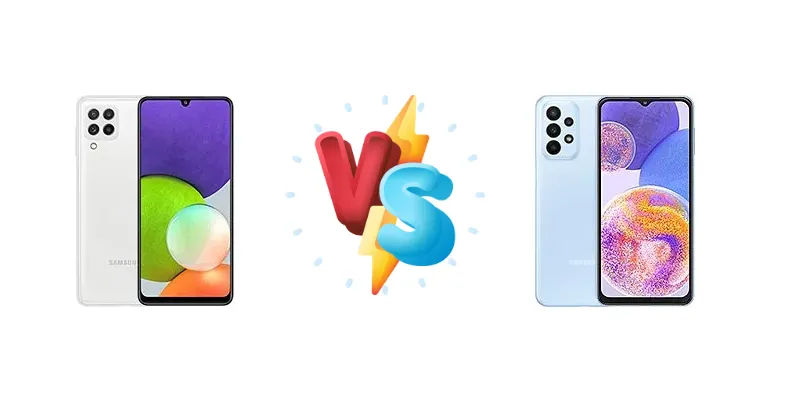
The Samsung Galaxy A22 and A23 represent Samsung's continued push in the affordable smartphone market. While both aim to deliver a solid experience without breaking the bank, the A23 introduces key improvements in processing power and charging speed. This comparison dissects these differences, helping you determine if the A23 justifies an upgrade or if the A22 remains a compelling value.
🏆 Quick Verdict
For most users, the Samsung Galaxy A23 is the better choice. Its Snapdragon 680 chipset, built on a more efficient 6nm process, provides a noticeable performance boost over the A22’s Helio G80. Coupled with 25W charging, the A23 offers a more future-proof and convenient experience, despite a slightly dimmer display.
| Network |
|---|
| 2G bands | GSM 850 / 900 / 1800 / 1900 | GSM 850 / 900 / 1800 / 1900 |
| 3G bands | HSDPA 850 / 900 / 2100 | HSDPA 850 / 900 / 2100 |
| 4G bands | 1, 3, 5, 7, 8, 20, 28, 38, 40, 41 | 1, 3, 5, 7, 8, 20, 28, 38, 40, 41 |
| Speed | HSPA, LTE | HSPA, LTE |
| Technology | GSM / HSPA / LTE | GSM / HSPA / LTE |
| Launch |
|---|
| Announced | 2021, June 03 | 2022, March 04 |
| Status | Available. Released 2021, July 01 | Available. Released 2022, March 25 |
| Body |
|---|
| Build | Glass front, plastic frame, plastic back | Glass front (Gorilla Glass 5), plastic frame, plastic back |
| Dimensions | 159.3 x 73.6 x 8.4 mm (6.27 x 2.90 x 0.33 in) | 165.4 x 76.9 x 8.4 mm (6.51 x 3.03 x 0.33 in) |
| SIM | · Nano-SIM· Nano-SIM + Nano-SIM | · Nano-SIM· Nano-SIM + Nano-SIM |
| Weight | 186 g (6.56 oz) | 195 g (6.88 oz) |
| Display |
|---|
| Protection | - | Corning Gorilla Glass 5 |
| Resolution | 720 x 1600 pixels, 20:9 ratio (~274 ppi density) | 1080 x 2408 pixels, 20:9 ratio (~400 ppi density) |
| Size | 6.4 inches, 98.9 cm2 (~84.3% screen-to-body ratio) | 6.6 inches, 104.9 cm2 (~82.5% screen-to-body ratio) |
| Type | Super AMOLED, 90Hz, 600 nits | PLS LCD, 90Hz |
| Platform |
|---|
| CPU | Octa-core (2x2.0 GHz Cortex-A75 & 6x1.8 GHz Cortex-A55) | Octa-core (4x2.4 GHz Kryo 265 Gold & 4x1.9 GHz Kryo 265 Silver) |
| Chipset | Mediatek MT6769V/CU Helio G80 (12 nm) | Qualcomm SM6225 Snapdragon 680 4G (6 nm) |
| GPU | Mali-G52 MC2 | Adreno 610 |
| OS | Android 11, upgradable to Android 13, One UI 5 | Android 12, upgradable to Android 14, One UI 6.1 |
| Memory |
|---|
| Card slot | microSDXC (dedicated slot) | microSDXC (dedicated slot) |
| Internal | 64GB 4GB RAM, 128GB 4GB RAM, 128GB 6GB RAM | 64GB 4GB RAM, 64GB 6GB RAM, 128GB 4GB RAM, 128GB 6GB RAM, 128GB 8GB RAM |
| | eMMC 5.1 | eMMC 5.1 |
| Main Camera |
|---|
| Features | LED flash, panorama, HDR | LED flash, panorama, HDR |
| Quad | 48 MP, f/1.8, (wide), 1/2.0", 0.8µm, PDAF, OIS
8 MP, f/2.2, 123˚ (ultrawide), 1/4.0", 1.12µm
2 MP (macro)
Auxiliary lens | 50 MP, f/1.8, (wide), PDAF, OIS
5 MP, f/2.2, 123˚ (ultrawide), 1/5.0", 1.12µm
2 MP (macro)
Auxiliary lens |
| Single | 13 MP, f/2.2, (wide), 1/3.1", 1.12µm | 8 MP, f/2.2, (wide) |
| Video | 1080p@30fps | 1080p@30fps |
| Selfie camera |
|---|
| Single | 13 MP, f/2.2, (wide), 1/3.1", 1.12µm | 8 MP, f/2.2, (wide) |
| Video | 1080p@30fps | 1080p@30fps |
| Sound |
|---|
| 3.5mm jack | Yes | Yes |
| 35mm jack | Yes | Yes |
| Loudspeaker | Yes | Yes |
| Comms |
|---|
| Bluetooth | 5.0, A2DP, LE | 5.0, A2DP, LE |
| NFC | Yes (market/region dependent) | Yes (market/region dependent) |
| Positioning | GPS, GLONASS, GALILEO, BDS | GPS, GLONASS, GALILEO, BDS |
| Radio | FM radio | FM radio |
| USB | USB Type-C 2.0 | USB Type-C 2.0 |
| WLAN | Wi-Fi 802.11 a/b/g/n/ac, dual-band, Wi-Fi Direct | Wi-Fi 802.11 a/b/g/n/ac, dual-band, Wi-Fi Direct |
| Features |
|---|
| Sensors | Fingerprint (side-mounted), accelerometer, gyro, compass | Fingerprint (side-mounted), accelerometer, gyro, compass |
| | Virtual proximity sensing | Virtual proximity sensing |
| Battery |
|---|
| Charging | 15W wired | 25W wired |
| Type | Li-Po 5000 mAh | Li-Po 5000 mAh |
| Misc |
|---|
| Colors | Black, White, Mint, Violet | Black, White, Peach, Blue |
| Models | SM-A225F, SM-A225F/DS, SM-A225M, SM-A225M/DS | SM-A235F, SM-A235F/DS, SM-A235F/DSN, SM-A235M, SM-A235M/DS, SM-A235N |
| Price | € 193.97 / £ 160.00 | £ 99.00 / ₹ 14,999 |
| SAR | - | 0.48 W/kg (head) |
| SAR EU | 0.52 W/kg (head) 1.59 W/kg (body) | 0.36 W/kg (head) 0.96 W/kg (body) |
| Tests |
|---|
| Battery life |
Endurance rating 121h
|
Endurance rating 130h
|
| Camera |
Photo / Video |
Photo / Video |
| Display |
Contrast ratio: Infinite (nominal) |
Contrast ratio: 1241:1 |
| Loudspeaker |
-30.6 LUFS (Below average)
|
-27.6 LUFS (Good)
|
| Performance |
AnTuTu: 185358 (v8), 165959 (v9)
GeekBench: 5464 (v4.4), 1372 (v5.1)
GFXBench: 16fps (ES 3.1 onscreen) |
AnTuTu: 273554 (v9)
GeekBench: 1632 (v5.1)
GFXBench: 6.7fps (ES 3.1 onscreen) |
Samsung Galaxy A22
- Higher peak display brightness (597 nits)
- Lower price point (typically)
- Solid battery endurance (121h)
- Less powerful processor (Helio G80)
- Slower charging (15W)
- Less efficient chipset (12nm)
Samsung Galaxy A23
- More efficient processor (Snapdragon 680, 6nm)
- Faster charging (25W)
- Improved contrast ratio (1241:1)
- Lower peak display brightness (464 nits)
- Slightly higher price
- Similar battery endurance to A22
Display Comparison
The Galaxy A23 features a display with a measured peak brightness of 464 nits, a significant drop from the A22’s 597 nits. However, the A23 boasts a contrast ratio of 1241:1, a substantial improvement over the A22’s ‘infinite’ (nominal) ratio, suggesting deeper blacks and more vibrant colors. While the A23’s lower brightness may be noticeable outdoors, the improved contrast enhances the viewing experience in typical indoor conditions. Both displays lack high refresh rates, limiting their appeal to users prioritizing fluid scrolling.
Camera Comparison
Both devices feature a photo/video camera setup, but detailed sensor information is lacking. Without specifics, it’s difficult to definitively declare a winner. However, the A23’s processor benefits image processing, potentially leading to better noise reduction and dynamic range. The A22’s camera is likely adequate for casual photography, but the A23’s improved processing power suggests a more refined camera experience. The presence of a 2MP macro camera on both devices is largely inconsequential due to its limited resolution and image quality.
Performance
The most significant upgrade in the A23 is its chipset: the Qualcomm Snapdragon 680 4G (6nm) versus the MediaTek Helio G80 (12nm) in the A22. The 6nm process node of the Snapdragon 680 translates to improved power efficiency and reduced thermal throttling, allowing for sustained performance during demanding tasks. The A23’s CPU configuration – octa-core (4x2.4 GHz Kryo 265 Gold & 4x1.9 GHz Kryo 265 Silver) – also offers a performance advantage over the A22’s (2x2.0 GHz Cortex-A75 & 6x1.8 GHz Cortex-A55). This difference is particularly noticeable in app launch times and multitasking.
Battery Life
The Galaxy A23 offers an endurance rating of 130 hours, a slight improvement over the A22’s 121 hours. This difference, while not massive, is likely attributable to the more efficient Snapdragon 680 chipset. Crucially, the A23 supports 25W wired charging, a significant upgrade from the A22’s 15W charging. This faster charging capability drastically reduces the time required to replenish the battery, offering a more convenient user experience. While both phones offer solid battery life, the A23’s faster charging is a major advantage.
Buying Guide
Buy the Samsung Galaxy A22 if you prioritize maximizing battery life and are on an extremely tight budget, and your usage is primarily limited to basic tasks like calls, texts, and light social media. Buy the Samsung Galaxy A23 if you value smoother multitasking, faster app loading times, and quicker charging, even if it means a slightly higher initial investment. The A23 is the better option for users who play mobile games or frequently use demanding applications.
Frequently Asked Questions
❓ Does the Snapdragon 680 in the A23 get hot during extended gaming sessions?
The Snapdragon 680, built on a 6nm process, is significantly more thermally efficient than the Helio G80 in the A22. While it will warm up during prolonged gaming, it's less prone to significant throttling, maintaining a more consistent frame rate over longer periods. Expect playable performance in most popular mobile titles.
❓ Is the 25W charging on the A23 a significant improvement over the A22's 15W charging in real-world use?
Yes, the 25W charging on the A23 is a substantial improvement. While exact 0-100% times will vary, you can expect a significantly faster recharge – potentially shaving off over an hour compared to the A22. This is particularly beneficial for users who frequently find themselves needing to quickly top up their battery.
❓ Will I notice a difference in app loading times and multitasking between the A22 and A23?
Absolutely. The Snapdragon 680 in the A23, coupled with its more efficient architecture, delivers a noticeable improvement in app loading times and multitasking performance. Switching between apps will be smoother, and demanding applications will run more responsively.