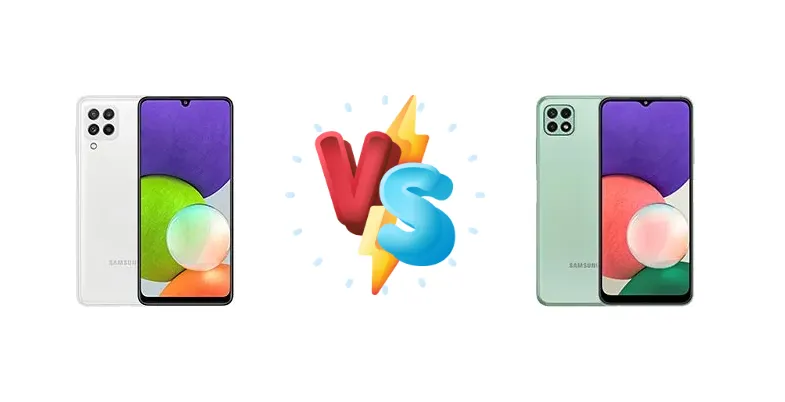
Samsung's Galaxy A-series aims to deliver essential smartphone features at accessible price points. The Galaxy A22 and A22 5G represent two variations on this theme, with the key differentiator being 5G connectivity and a more powerful chipset. But these changes come with trade-offs. This comparison dissects the differences to help you determine which model best suits your needs.
🏆 Quick Verdict
For most users, the Samsung Galaxy A22 5G is the better buy. The Mediatek Dimensity 700 chipset provides a noticeable performance uplift over the Helio G80 in the standard A22, making it more future-proof and capable of handling demanding tasks. While the A22 boasts slightly better battery endurance and a brighter display, the performance gains of the 5G model outweigh these advantages.
| Network |
|---|
| 2G bands | GSM 850 / 900 / 1800 / 1900 | GSM 850 / 900 / 1800 / 1900 |
| 3G bands | HSDPA 850 / 900 / 2100 | HSDPA 850 / 900 / 1900 / 2100 |
| 4G bands | 1, 3, 5, 7, 8, 20, 28, 38, 40, 41 | 1, 2, 3, 5, 7, 8, 20, 28, 38, 40, 41 |
| 5G bands | - | 1, 3, 5, 7, 8, 20, 28, 38, 40, 41, 78, 79 SA/NSA/Sub6 |
| Speed | HSPA, LTE | HSPA, LTE, 5G |
| Technology | GSM / HSPA / LTE | GSM / HSPA / LTE / 5G |
| Launch |
|---|
| Announced | 2021, June 03 | 2021, June 03 |
| Status | Available. Released 2021, July 01 | Available. Released 2021, June 24 |
| Body |
|---|
| Build | Glass front, plastic frame, plastic back | Glass front, plastic frame, plastic back |
| Dimensions | 159.3 x 73.6 x 8.4 mm (6.27 x 2.90 x 0.33 in) | 167.2 x 76.4 x 9 mm (6.58 x 3.01 x 0.35 in) |
| SIM | · Nano-SIM· Nano-SIM + Nano-SIM | · Nano-SIM· Nano-SIM + Nano-SIM |
| Weight | 186 g (6.56 oz) | 203 g (7.16 oz) |
| Display |
|---|
| Resolution | 720 x 1600 pixels, 20:9 ratio (~274 ppi density) | 1080 x 2400 pixels, 20:9 ratio (~399 ppi density) |
| Size | 6.4 inches, 98.9 cm2 (~84.3% screen-to-body ratio) | 6.6 inches, 105.2 cm2 (~82.3% screen-to-body ratio) |
| Type | Super AMOLED, 90Hz, 600 nits | TFT LCD, 90Hz |
| Platform |
|---|
| CPU | Octa-core (2x2.0 GHz Cortex-A75 & 6x1.8 GHz Cortex-A55) | Octa-core (2x2.2 GHz Cortex-A76 & 6x2.0 GHz Cortex-A55) |
| Chipset | Mediatek MT6769V/CU Helio G80 (12 nm) | Mediatek Dimensity 700 (7 nm) |
| GPU | Mali-G52 MC2 | Mali-G57 MC2 |
| OS | Android 11, upgradable to Android 13, One UI 5 | Android 11, upgradable to Android 13, One UI core 5 |
| Memory |
|---|
| Card slot | microSDXC (dedicated slot) | microSDXC (dedicated slot) |
| Internal | 64GB 4GB RAM, 128GB 4GB RAM, 128GB 6GB RAM | 64GB 4GB RAM, 128GB 4GB RAM, 128GB 6GB RAM, 128GB 8GB RAM |
| | eMMC 5.1 | - |
| Main Camera |
|---|
| Features | LED flash, panorama, HDR | LED flash, panorama, HDR |
| Quad | 48 MP, f/1.8, (wide), 1/2.0", 0.8µm, PDAF, OIS
8 MP, f/2.2, 123˚ (ultrawide), 1/4.0", 1.12µm
2 MP (macro)
Auxiliary lens | - |
| Single | 13 MP, f/2.2, (wide), 1/3.1", 1.12µm | 8 MP, f/2.0, (wide) |
| Triple | - | 48 MP, f/1.8, (wide), PDAF
5 MP, f/2.2, 115˚ (ultrawide), 1/5.0", 1.12µm
Auxiliary lens |
| Video | 1080p@30fps | 1152p@30fps |
| Selfie camera |
|---|
| Single | 13 MP, f/2.2, (wide), 1/3.1", 1.12µm | 8 MP, f/2.0, (wide) |
| Video | 1080p@30fps | 1080p@30fps |
| Sound |
|---|
| 3.5mm jack | Yes | Yes |
| 35mm jack | Yes | Yes |
| Loudspeaker | Yes | Yes |
| Comms |
|---|
| Bluetooth | 5.0, A2DP, LE | 5.0, A2DP, LE |
| NFC | Yes (market/region dependent) | Yes (market/region dependent) |
| Positioning | GPS, GLONASS, GALILEO, BDS | GPS, GLONASS, GALILEO, BDS |
| Radio | FM radio | FM radio |
| USB | USB Type-C 2.0 | USB Type-C 2.0 |
| WLAN | Wi-Fi 802.11 a/b/g/n/ac, dual-band, Wi-Fi Direct | Wi-Fi 802.11 a/b/g/n/ac, dual-band, Wi-Fi Direct |
| Features |
|---|
| Sensors | Fingerprint (side-mounted), accelerometer, gyro, compass | Fingerprint (side-mounted), accelerometer, gyro, proximity, compass |
| | Virtual proximity sensing | - |
| Battery |
|---|
| Charging | 15W wired | 15W wired |
| Type | Li-Po 5000 mAh | Li-Po 5000 mAh |
| Misc |
|---|
| Colors | Black, White, Mint, Violet | Gray, White, Mint, Violet |
| Models | SM-A225F, SM-A225F/DS, SM-A225M, SM-A225M/DS | SM-A226B, SM-A226B/DS, SM-A226B/DSN, SM-A226BR, SM-A226BR/N, SM-A226L, SC-56B |
| Price | € 193.97 / £ 160.00 | £ 92.00 / € 125.99 |
| SAR EU | 0.52 W/kg (head) 1.59 W/kg (body) | 0.73 W/kg (head) 1.23 W/kg (body) |
| Tests |
|---|
| Battery life |
Endurance rating 121h
|
Endurance rating 118h
|
| Camera |
Photo / Video |
Photo / Video |
| Display |
Contrast ratio: Infinite (nominal) |
Contrast ratio: 1631:1 (nominal) |
| Loudspeaker |
-30.6 LUFS (Below average)
|
-28.5 LUFS (Average)
|
| Performance |
AnTuTu: 185358 (v8), 165959 (v9)
GeekBench: 5464 (v4.4), 1372 (v5.1)
GFXBench: 16fps (ES 3.1 onscreen) |
AnTuTu: 242155 (v8), 223188 (v9)
GeekBench: 6913 (v4.4), 1719 (v5.1)
GFXBench: 12fps (ES 3.1 onscreen) |
Samsung Galaxy A22
- Slightly longer battery life (121h endurance)
- Brighter display for outdoor visibility (597 nits)
- Potentially lower price point
- Less powerful processor (Helio G80)
- Less efficient chipset (12nm process)
- Lacks 5G connectivity
Samsung Galaxy A22 5G
- Faster processor (Dimensity 700)
- More efficient chipset (7nm process)
- 5G connectivity for faster data speeds
- Higher contrast ratio for better image quality
- Slightly shorter battery life (118h endurance)
- Dimmer display (385 nits)
Display Comparison
The displays represent a clear divergence in priorities. The Galaxy A22 achieves a significantly higher peak brightness of 597 nits, making it more legible under direct sunlight. However, the A22 5G counters with a superior contrast ratio of 1631:1 compared to the A22’s nominal ‘infinite’ ratio, suggesting deeper blacks and more vibrant colors. This higher contrast is likely due to the panel technology used, though specifics aren't provided. The A22 5G’s 385 nits, while lower, is still adequate for indoor use, and the improved contrast makes a noticeable difference in overall image quality.
Camera Comparison
Both devices feature a 'Photo / Video' camera setup, but detailed sensor information is lacking. Without specifics on megapixel counts, sensor sizes, or aperture values, a direct comparison is difficult. It's reasonable to assume both phones offer similar image quality given their price points, focusing on computational photography to enhance results. The absence of details suggests neither phone is a standout performer in the camera department, and the 2MP macro lenses commonly found in this segment are unlikely to deliver significant value.
Performance
The core difference lies in the chipsets. The Galaxy A22 utilizes the Mediatek Helio G80, a 12nm processor with a dual-cluster CPU configuration (2x2.0 GHz Cortex-A75 & 6x1.8 GHz Cortex-A55). The A22 5G, however, steps up to the Mediatek Dimensity 700, built on a more efficient 7nm process. This translates to a performance advantage for the 5G model, with its faster Cortex-A76 cores (2x2.2 GHz) and improved GPU. The 7nm node also contributes to better thermal efficiency, potentially reducing throttling during sustained workloads. The A22 5G will offer a smoother experience in everyday tasks and a more enjoyable gaming experience.
Battery Life
Battery life is relatively close, with the Galaxy A22 achieving an endurance rating of 121 hours and the A22 5G scoring 118 hours. This suggests the more efficient Dimensity 700 chipset in the A22 5G partially offsets the power demands of 5G connectivity. Both phones support 15W wired charging, meaning charge times will be comparable. The A22’s slightly higher endurance rating indicates it will last a bit longer on a single charge under similar usage conditions, but the difference is unlikely to be substantial in real-world scenarios.
Buying Guide
Buy the Samsung Galaxy A22 if you prioritize maximum battery life and a brighter screen for outdoor visibility, and 5G connectivity isn't a necessity. You'll also save some money. Buy the Samsung Galaxy A22 5G if you want a smoother, more responsive experience, especially when multitasking or playing games, and future-proofed 5G support is important to you. The performance boost justifies the slight compromise in battery endurance.
Frequently Asked Questions
❓ Will the Dimensity 700 in the A22 5G handle demanding games like PUBG or Call of Duty?
The Mediatek Dimensity 700 is a significant step up from the Helio G80 and is capable of running PUBG and Call of Duty Mobile at medium settings with reasonable frame rates. While it won't deliver a flagship gaming experience, it provides a much smoother and more enjoyable gaming experience than the A22.
❓ Does the A22 5G's 5G connectivity actually make a noticeable difference in everyday use?
The benefit of 5G depends heavily on your location and carrier coverage. If you live in an area with strong 5G signals, you'll experience significantly faster download and upload speeds, especially for large files or streaming high-resolution video. However, if 5G coverage is limited, you may not see a substantial difference compared to 4G LTE.
❓ Is the 15W charging speed sufficient, or will it take a long time to fully charge either phone?
15W charging is relatively slow by today's standards. Expect both phones to take around 2-3 hours to fully charge from 0% to 100%. While not ideal, it's typical for phones in this price range. Overnight charging is recommended.