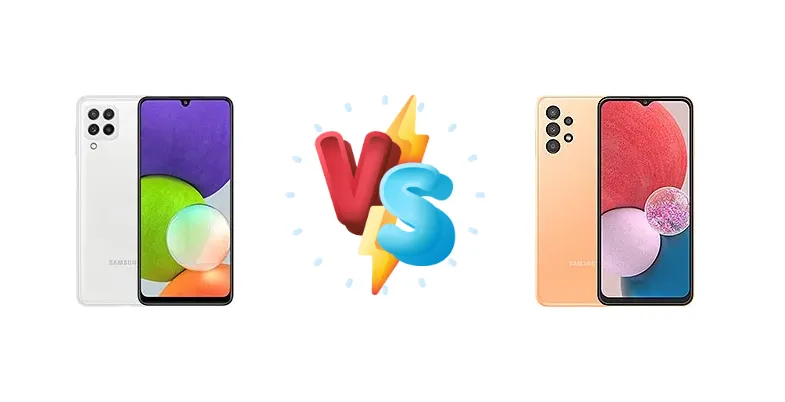
Samsung's A-series continues to dominate the budget smartphone market, but choosing between models like the Galaxy A22 and A13 can be tricky. Both offer a familiar Samsung experience at an accessible price point, but significant differences in chipset and display technology create distinct user experiences. This comparison dissects these differences to determine which phone offers the best value.
🏆 Quick Verdict
For most users, the Samsung Galaxy A13 emerges as the better choice. While the A22 boasts slightly better battery endurance, the A13’s more efficient Exynos 850 chipset, built on an 8nm process, provides a smoother overall experience and potentially better long-term performance, making it a more future-proof option.
| Network |
|---|
| 2G bands | GSM 850 / 900 / 1800 / 1900 | GSM 850 / 900 / 1800 / 1900 |
| 3G bands | HSDPA 850 / 900 / 2100 | HSDPA 850 / 900 / 2100 |
| 4G bands | 1, 3, 5, 7, 8, 20, 28, 38, 40, 41 | 1, 3, 5, 7, 8, 20, 28, 38, 40, 41 |
| Speed | HSPA, LTE | HSPA, LTE |
| Technology | GSM / HSPA / LTE | GSM / HSPA / LTE |
| Launch |
|---|
| Announced | 2021, June 03 | 2022, March 04 |
| Status | Available. Released 2021, July 01 | Available. Released 2022, March 23 |
| Body |
|---|
| Build | Glass front, plastic frame, plastic back | Glass front (Gorilla Glass 5), plastic frame, plastic back |
| Dimensions | 159.3 x 73.6 x 8.4 mm (6.27 x 2.90 x 0.33 in) | 165.1 x 76.4 x 8.8 mm (6.5 x 3.01 x 0.35 in) |
| SIM | · Nano-SIM· Nano-SIM + Nano-SIM | · Nano-SIM· Nano-SIM + Nano-SIM |
| Weight | 186 g (6.56 oz) | 195 g (6.88 oz) |
| Display |
|---|
| Protection | - | Corning Gorilla Glass 5 |
| Resolution | 720 x 1600 pixels, 20:9 ratio (~274 ppi density) | 1080 x 2408 pixels, 20:9 ratio (~400 ppi density) |
| Size | 6.4 inches, 98.9 cm2 (~84.3% screen-to-body ratio) | 6.6 inches, 104.9 cm2 (~83.2% screen-to-body ratio) |
| Type | Super AMOLED, 90Hz, 600 nits | PLS LCD |
| Platform |
|---|
| CPU | Octa-core (2x2.0 GHz Cortex-A75 & 6x1.8 GHz Cortex-A55) | Octa-core (4x2.0 GHz Cortex-A55 & 4x2.0 GHz Cortex-A55) |
| Chipset | Mediatek MT6769V/CU Helio G80 (12 nm) | Exynos 850 (8 nm) |
| GPU | Mali-G52 MC2 | Mali-G52 |
| OS | Android 11, upgradable to Android 13, One UI 5 | Android 12, upgradable to Android 14, One UI 6.1 |
| Memory |
|---|
| Card slot | microSDXC (dedicated slot) | microSDXC (dedicated slot) |
| Internal | 64GB 4GB RAM, 128GB 4GB RAM, 128GB 6GB RAM | 32GB 3GB RAM, 32GB 4GB RAM, 64GB 4GB RAM, 128GB 3GB RAM, 128GB 4GB RAM, 128GB 6GB RAM |
| | eMMC 5.1 | eMMC 5.1 |
| Main Camera |
|---|
| Features | LED flash, panorama, HDR | LED flash, panorama, HDR |
| Quad | 48 MP, f/1.8, (wide), 1/2.0", 0.8µm, PDAF, OIS
8 MP, f/2.2, 123˚ (ultrawide), 1/4.0", 1.12µm
2 MP (macro)
Auxiliary lens | 50 MP, f/1.8, (wide), PDAF
5 MP, f/2.2, 123˚ (ultrawide), 1/5.0", 1.12µm
2 MP (macro)
Auxiliary lens |
| Single | 13 MP, f/2.2, (wide), 1/3.1", 1.12µm | 8 MP, f/2.2, (wide) |
| Video | 1080p@30fps | 1080p@30fps |
| Selfie camera |
|---|
| Single | 13 MP, f/2.2, (wide), 1/3.1", 1.12µm | 8 MP, f/2.2, (wide) |
| Video | 1080p@30fps | 1080p@30fps |
| Sound |
|---|
| 3.5mm jack | Yes | Yes |
| 35mm jack | Yes | Yes |
| Loudspeaker | Yes | Yes |
| Comms |
|---|
| Bluetooth | 5.0, A2DP, LE | 5.0, A2DP, LE |
| NFC | Yes (market/region dependent) | Yes (market/region dependent) |
| Positioning | GPS, GLONASS, GALILEO, BDS | GPS, GLONASS, GALILEO, BDS |
| Radio | FM radio | No |
| USB | USB Type-C 2.0 | USB Type-C 2.0, OTG |
| WLAN | Wi-Fi 802.11 a/b/g/n/ac, dual-band, Wi-Fi Direct | Wi-Fi 802.11 a/b/g/n/ac, dual-band, Wi-Fi Direct |
| Features |
|---|
| Sensors | Fingerprint (side-mounted), accelerometer, gyro, compass | Fingerprint (side-mounted), accelerometer, compass |
| | Virtual proximity sensing | Virtual proximity sensing |
| Battery |
|---|
| Charging | 15W wired | 15W wired |
| Type | Li-Po 5000 mAh | Li-Po 5000 mAh |
| Misc |
|---|
| Colors | Black, White, Mint, Violet | Black, White, Peach, Blue |
| Models | SM-A225F, SM-A225F/DS, SM-A225M, SM-A225M/DS | SM-A135F, SM-A135F/DS, SM-A135M, SM-A135U, SM-A135U1, SM-A135N |
| Price | € 193.97 / £ 160.00 | € 94.99 / $ 129.99 / £ 89.00 |
| SAR | - | 0.49 W/kg (head) |
| SAR EU | 0.52 W/kg (head) 1.59 W/kg (body) | 0.37 W/kg (head) 1.39 W/kg (body) |
| Tests |
|---|
| Battery life |
Endurance rating 121h
|
Endurance rating 114h
|
| Camera |
Photo / Video |
Photo / Video |
| Display |
Contrast ratio: Infinite (nominal) |
Contrast ratio: 1324:1 (nominal) |
| Loudspeaker |
-30.6 LUFS (Below average)
|
-29.7 LUFS (Average)
|
| Performance |
AnTuTu: 185358 (v8), 165959 (v9)
GeekBench: 5464 (v4.4), 1372 (v5.1)
GFXBench: 16fps (ES 3.1 onscreen) |
AnTuTu: 122822 (v8), 136286 (v9)
GeekBench: 588 (v5.1)
GFXBench: 5.2fps (ES 3.1 onscreen) |
Samsung Galaxy A22
- Slightly longer battery life (121h endurance)
- Potentially higher peak CPU performance in short bursts
- Familiar Samsung One UI experience
- Less efficient chipset (12nm process)
- Lower display contrast ratio
- Potential for more throttling under sustained load
Samsung Galaxy A13
- More efficient chipset (8nm process)
- Higher display contrast ratio for better visuals
- Smoother overall user experience
- Potentially better long-term performance
- Slightly shorter battery life (114h endurance)
- CPU clock speeds are lower on prime cores
- Similar camera performance to A22
Display Comparison
Both the A22 and A13 feature displays capable of 587-597 nits of peak brightness, ensuring adequate visibility outdoors. However, the A13’s contrast ratio of 1324:1 significantly surpasses the A22’s ‘infinite’ (nominal) ratio, suggesting deeper blacks and a more vibrant image. This difference is likely due to panel technology and calibration. While both are LCDs, the A13’s higher contrast ratio translates to a more visually appealing experience, particularly when consuming media. The similar brightness levels mean neither excels in direct sunlight, but the A13’s contrast gives it an edge in typical indoor conditions.
Camera Comparison
Both phones offer a standard photo/video camera setup, but detailed sensor information is lacking. Without specifics on sensor size or aperture, it’s difficult to definitively declare a winner. However, given Samsung’s image processing algorithms are consistent across the A-series, the A13’s more capable chipset could provide a slight advantage in post-processing speed and image quality. The inclusion of a 2MP macro camera on both devices is largely a marketing feature, offering limited practical benefit due to the small sensor size and lack of optical image stabilization (OIS).
Performance
The core difference between these phones lies in their chipsets. The A22 utilizes the Mediatek Helio G80, a 12nm chip with a performance-focused CPU configuration (2x2.0 GHz Cortex-A75 & 6x1.8 GHz Cortex-A55). The A13, however, employs Samsung’s Exynos 850, fabricated on a more efficient 8nm process. While the A22’s CPU boasts higher clock speeds on its prime cores, the A13’s Exynos 850 benefits from a more modern architecture and improved power efficiency. The A13’s CPU configuration (4x2.0 GHz Cortex-A55 & 4x2.0 GHz Cortex-A55) is less complex, but the 8nm process allows it to maintain performance with less heat and power draw. This translates to smoother multitasking and potentially less throttling during sustained workloads.
Battery Life
The Samsung Galaxy A22 holds a slight edge in battery endurance, achieving a measured 121 hours compared to the A13’s 114 hours. However, this 7-hour difference is relatively small, and the A13’s more efficient Exynos 850 chipset could mitigate this gap in real-world usage. Both phones support 15W wired charging, meaning charge times will be comparable – roughly 2-3 hours for a full charge. The A22’s longer endurance is beneficial for users who frequently find themselves away from a power source, but the A13’s efficiency offers a more balanced approach.
Buying Guide
Buy the Samsung Galaxy A22 if you prioritize maximum battery life and are primarily focused on basic tasks like calling, texting, and light social media. Buy the Samsung Galaxy A13 if you value a more responsive user experience, slightly better display quality, and a chipset that’s more efficient for everyday use, even if it means a small trade-off in endurance.
Frequently Asked Questions
❓ Does the Exynos 850 in the A13 tend to overheat during prolonged gaming sessions?
The Exynos 850’s 8nm process is designed for efficiency, meaning it generates less heat than the A22’s Helio G80. While it won’t deliver flagship-level gaming performance, it’s less prone to significant throttling during extended gaming, offering a more consistent experience.
❓ Is the 2MP macro camera on either phone worth using for detailed close-up shots?
Unfortunately, the 2MP macro cameras on both the A22 and A13 are largely marketing features. The small sensor size and lack of autofocus result in images that are often soft and lack detail. They’re usable in ideal lighting conditions, but don’t expect professional-quality macro photography.
❓ Can the Samsung Galaxy A13 handle demanding games like PUBG Mobile at high frame rates?
The A13 can run PUBG Mobile, but achieving consistently high frame rates (60fps or higher) will likely require lowering the graphics settings. The Exynos 850 is capable, but it’s not a gaming powerhouse. Expect a playable experience at medium settings.
❓ Which phone is better for watching videos and streaming content?
The Samsung Galaxy A13 is the better choice for video consumption. Its higher contrast ratio results in deeper blacks and a more immersive viewing experience, making videos and streaming content more enjoyable.