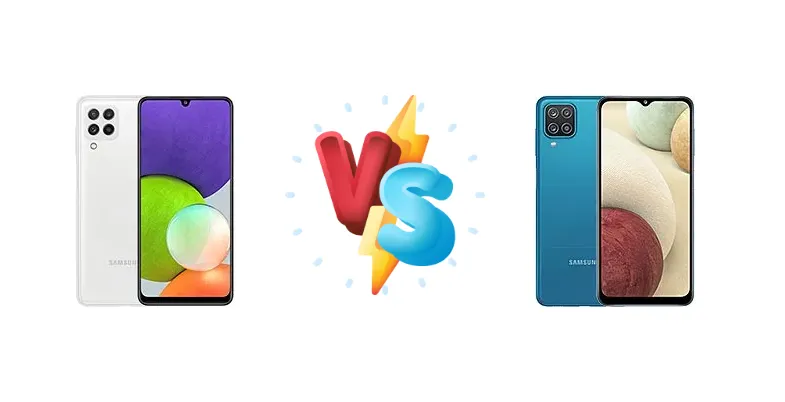
The Samsung Galaxy A22 and A12 represent Samsung’s commitment to providing affordable smartphones. While both devices target the budget-conscious consumer, they differ significantly in processing power and display quality. This comparison dives deep into the specifications to determine which phone delivers the best value for your money.
🏆 Quick Verdict
For most users, the Samsung Galaxy A22 is the superior choice. Its Helio G80 chipset provides a noticeable performance boost over the A12’s Helio P35, making it better suited for multitasking and gaming. While the A12 boasts slightly better endurance, the A22’s brighter display is a worthwhile trade-off.
| Network |
|---|
| 2G bands | GSM 850 / 900 / 1800 / 1900 | GSM 850 / 900 / 1800 / 1900 |
| 3G bands | HSDPA 850 / 900 / 2100 | HSDPA 850 / 900 / 2100 |
| 4G bands | 1, 3, 5, 7, 8, 20, 28, 38, 40, 41 | 1, 3, 5, 7, 8, 20, 28, 38, 40, 41 |
| Speed | HSPA, LTE | HSPA 42.2/5.76 Mbps, LTE Cat4 150/50 Mbps |
| Technology | GSM / HSPA / LTE | GSM / HSPA / LTE |
| Launch |
|---|
| Announced | 2021, June 03 | 2020, November 24. Released 2020, December 21 |
| Status | Available. Released 2021, July 01 | Discontinued |
| Body |
|---|
| Build | Glass front, plastic frame, plastic back | Glass front, plastic back, plastic frame |
| Dimensions | 159.3 x 73.6 x 8.4 mm (6.27 x 2.90 x 0.33 in) | 164 x 75.8 x 8.9 mm (6.46 x 2.98 x 0.35 in) |
| SIM | · Nano-SIM· Nano-SIM + Nano-SIM | · Nano-SIM· Nano-SIM + Nano-SIM |
| Weight | 186 g (6.56 oz) | 205 g (7.23 oz) |
| Display |
|---|
| Resolution | 720 x 1600 pixels, 20:9 ratio (~274 ppi density) | 720 x 1600 pixels, 20:9 ratio (~270 ppi density) |
| Size | 6.4 inches, 98.9 cm2 (~84.3% screen-to-body ratio) | 6.5 inches, 102.0 cm2 (~82.1% screen-to-body ratio) |
| Type | Super AMOLED, 90Hz, 600 nits | PLS LCD |
| Platform |
|---|
| CPU | Octa-core (2x2.0 GHz Cortex-A75 & 6x1.8 GHz Cortex-A55) | Octa-core (4x2.35 GHz Cortex-A53 & 4x1.8 GHz Cortex-A53) |
| Chipset | Mediatek MT6769V/CU Helio G80 (12 nm) | Mediatek MT6765 Helio P35 (12 nm) |
| GPU | Mali-G52 MC2 | PowerVR GE8320 |
| OS | Android 11, upgradable to Android 13, One UI 5 | Android 10, upgradable to Android 12, One UI 4.1 |
| Memory |
|---|
| Card slot | microSDXC (dedicated slot) | microSDXC (dedicated slot) |
| Internal | 64GB 4GB RAM, 128GB 4GB RAM, 128GB 6GB RAM | 32GB 2GB RAM, 32GB 3GB RAM, 32GB 4GB RAM, 64GB 2GB RAM, 64GB 4GB RAM, 128GB 2GB RAM, 128GB 3GB RAM, 128GB 4GB RAM, 128GB 6GB RAM |
| | eMMC 5.1 | eMMC 5.1 |
| Main Camera |
|---|
| - | Go |
| Features | LED flash, panorama, HDR | LED flash, panorama, HDR |
| Quad | 48 MP, f/1.8, (wide), 1/2.0", 0.8µm, PDAF, OIS
8 MP, f/2.2, 123˚ (ultrawide), 1/4.0", 1.12µm
2 MP (macro)
Auxiliary lens | 48 MP, f/2.0, 26mm (wide), AF
5 MP, f/2.2, 123˚ (ultrawide)
2 MP (macro)
Auxiliary lens |
| Single | 13 MP, f/2.2, (wide), 1/3.1", 1.12µm | - |
| Video | 1080p@30fps | 1080p@30fps |
| Selfie camera |
|---|
| Single | 13 MP, f/2.2, (wide), 1/3.1", 1.12µm | 8 MP, f/2.2 |
| Video | 1080p@30fps | 1080p@30fps |
| Sound |
|---|
| 3.5mm jack | Yes | Yes |
| 35mm jack | Yes | Yes |
| Loudspeaker | Yes | Yes |
| Comms |
|---|
| Bluetooth | 5.0, A2DP, LE | 5.0, A2DP, LE |
| NFC | Yes (market/region dependent) | Yes (market/region dependent) |
| Positioning | GPS, GLONASS, GALILEO, BDS | GPS, GLONASS, GALILEO, BDS |
| Radio | FM radio | FM radio, RDS, recording |
| USB | USB Type-C 2.0 | USB Type-C 2.0 |
| WLAN | Wi-Fi 802.11 a/b/g/n/ac, dual-band, Wi-Fi Direct | Wi-Fi 802.11 b/g/n, Wi-Fi Direct |
| Features |
|---|
| Sensors | Fingerprint (side-mounted), accelerometer, gyro, compass | Fingerprint (side-mounted), accelerometer |
| | Virtual proximity sensing | Virtual proximity sensing |
| Battery |
|---|
| Charging | 15W wired | 15W wired |
| Type | Li-Po 5000 mAh | Li-Po 5000 mAh |
| Misc |
|---|
| Colors | Black, White, Mint, Violet | Black, White, Blue, Red |
| Models | SM-A225F, SM-A225F/DS, SM-A225M, SM-A225M/DS | SM-A125F/DSN, SM-A125F/DS, SM-A125F, SM-A125M, SM-A125U, SM-A125U1, SM-A125N, SM-A125W |
| Price | € 193.97 / £ 160.00 | € 78.89 / $ 60.00 / £ 69.99 |
| SAR EU | 0.52 W/kg (head) 1.59 W/kg (body) | 0.67 W/kg (head) 1.38 W/kg (body) |
| Tests |
|---|
| Battery life |
Endurance rating 121h
| Endurance rating 123h |
| Camera |
Photo / Video |
Photo / Video |
| Display |
Contrast ratio: Infinite (nominal) |
Contrast ratio: 1363:1 (nominal) |
| Loudspeaker |
-30.6 LUFS (Below average)
|
-30.4 LUFS (Below average) |
| Performance |
AnTuTu: 185358 (v8), 165959 (v9)
GeekBench: 5464 (v4.4), 1372 (v5.1)
GFXBench: 16fps (ES 3.1 onscreen) |
AnTuTu: 107189 (v8)
GeekBench: 1034 (v5.1)
GFXBench: 5fps (ES 3.1 onscreen) |
Samsung Galaxy A22
- Faster processor for smoother performance
- Brighter display for better visibility
- Potentially better camera image processing
- Slightly lower battery endurance rating
- May experience more battery drain during heavy use
Samsung Galaxy A12
- Slightly longer battery life
- Lower price point (typically)
- Good contrast ratio for the price
- Slower processor for less demanding tasks
- Dimmer display, less visible outdoors
Display Comparison
The Samsung Galaxy A22 features a display capable of reaching 597 nits of peak brightness, a substantial improvement over the A12’s 472 nits. This difference translates to significantly better visibility outdoors and in brightly lit environments. While both displays have an 'infinite' (nominal) contrast ratio, the A12’s measured 1363:1 contrast ratio provides a more defined visual experience than the A22's unspecified ratio. The A22’s higher brightness is particularly beneficial for media consumption and gaming.
Camera Comparison
Both phones feature a photo/video camera setup, but the context data doesn’t provide enough detail for a meaningful comparison beyond the chipset’s image signal processor (ISP) capabilities. The Helio G80 in the A22 generally offers better image processing, potentially leading to improved photo and video quality, especially in low-light conditions. Without specific sensor details, it’s difficult to assess the true camera performance difference. We can assume the A22's ISP will handle noise reduction and dynamic range more effectively.
Performance
The core difference between these two phones lies in their chipsets. The Galaxy A22 utilizes the Mediatek Helio G80, an octa-core processor with a configuration of 2x2.0 GHz Cortex-A75 and 6x1.8 GHz Cortex-A55 cores. This is a significant upgrade over the A12’s Helio P35, which features 4x2.35 GHz Cortex-A53 and 4x1.8 GHz Cortex-A53 cores. The A75 cores in the G80 offer superior single-core performance, resulting in snappier app launches and smoother multitasking. The A12’s P35, while adequate for basic tasks, will struggle with more demanding applications. The G80’s architecture is better suited for sustained workloads.
Battery Life
Both the A22 and A12 offer an endurance rating of approximately 121-123 hours, indicating comparable battery life. The A12 edges out the A22 by a small margin, but the difference is negligible in real-world usage. Both devices support 15W wired charging, meaning charging times will be similar. The A22’s more powerful processor will consume more power during intensive tasks, potentially reducing its overall battery life in those scenarios, but the difference is unlikely to be substantial for typical users.
Buying Guide
Buy the Samsung Galaxy A22 if you prioritize smoother performance for everyday tasks and occasional gaming, and value a brighter, more visible display. Buy the Samsung Galaxy A12 if your primary needs are basic communication, light social media use, and maximizing battery life, and you are on a very tight budget.
Frequently Asked Questions
❓ Will the Helio G80 in the A22 handle demanding games like PUBG or Call of Duty?
The Helio G80 is capable of running PUBG and Call of Duty Mobile, but you’ll likely need to lower the graphics settings to achieve a smooth frame rate. It’s not a gaming powerhouse, but it’s a significant step up from the A12’s Helio P35 for gaming performance.
❓ Is the difference in display brightness between the A22 and A12 noticeable in everyday use?
Yes, the 597 nits of peak brightness on the A22 makes a substantial difference, especially when viewing content outdoors or in brightly lit rooms. The A12’s 472 nits can appear washed out in these conditions.
❓ Does the A12’s slightly better battery endurance rating translate to a significant real-world difference?
The difference in endurance is minimal – around 2 hours. Both phones will comfortably last a full day with moderate use. The A22’s more powerful processor will consume more power during intensive tasks, but the overall difference in battery life is unlikely to be noticeable for most users.
❓ Are there any significant differences in software features between the A22 and A12?
Both devices run Samsung’s One UI, but the A22 may receive software updates for a longer period due to its newer chipset. The core software experience is largely the same, however.