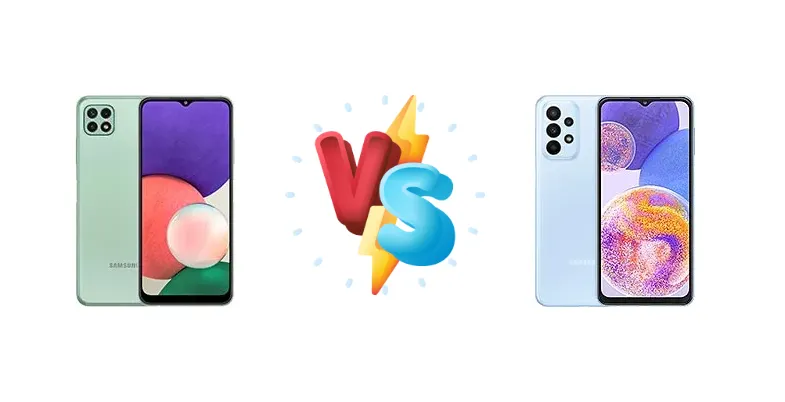
The Samsung Galaxy A22 5G launched as a compelling entry point into 5G connectivity, but the newer A23 aims to refine the formula. This comparison dives deep into the key differences – from display brightness and chipset architecture to battery endurance and charging speeds – to determine which device offers the best value for budget-conscious consumers.
🏆 Quick Verdict
For most users, the Samsung Galaxy A23 is the better buy. Its significantly brighter display (464 nits vs 385 nits) and improved battery life (130h endurance vs 118h) outweigh the performance trade-off from the Snapdragon 680 compared to the Dimensity 700. The faster 25W charging is also a major convenience.
| Network |
|---|
| 2G bands | GSM 850 / 900 / 1800 / 1900 | GSM 850 / 900 / 1800 / 1900 |
| 3G bands | HSDPA 850 / 900 / 1900 / 2100 | HSDPA 850 / 900 / 2100 |
| 4G bands | 1, 2, 3, 5, 7, 8, 20, 28, 38, 40, 41 | 1, 3, 5, 7, 8, 20, 28, 38, 40, 41 |
| 5G bands | 1, 3, 5, 7, 8, 20, 28, 38, 40, 41, 78, 79 SA/NSA/Sub6 | - |
| Speed | HSPA, LTE, 5G | HSPA, LTE |
| Technology | GSM / HSPA / LTE / 5G | GSM / HSPA / LTE |
| Launch |
|---|
| Announced | 2021, June 03 | 2022, March 04 |
| Status | Available. Released 2021, June 24 | Available. Released 2022, March 25 |
| Body |
|---|
| Build | Glass front, plastic frame, plastic back | Glass front (Gorilla Glass 5), plastic frame, plastic back |
| Dimensions | 167.2 x 76.4 x 9 mm (6.58 x 3.01 x 0.35 in) | 165.4 x 76.9 x 8.4 mm (6.51 x 3.03 x 0.33 in) |
| SIM | · Nano-SIM· Nano-SIM + Nano-SIM | · Nano-SIM· Nano-SIM + Nano-SIM |
| Weight | 203 g (7.16 oz) | 195 g (6.88 oz) |
| Display |
|---|
| Protection | - | Corning Gorilla Glass 5 |
| Resolution | 1080 x 2400 pixels, 20:9 ratio (~399 ppi density) | 1080 x 2408 pixels, 20:9 ratio (~400 ppi density) |
| Size | 6.6 inches, 105.2 cm2 (~82.3% screen-to-body ratio) | 6.6 inches, 104.9 cm2 (~82.5% screen-to-body ratio) |
| Type | TFT LCD, 90Hz | PLS LCD, 90Hz |
| Platform |
|---|
| CPU | Octa-core (2x2.2 GHz Cortex-A76 & 6x2.0 GHz Cortex-A55) | Octa-core (4x2.4 GHz Kryo 265 Gold & 4x1.9 GHz Kryo 265 Silver) |
| Chipset | Mediatek Dimensity 700 (7 nm) | Qualcomm SM6225 Snapdragon 680 4G (6 nm) |
| GPU | Mali-G57 MC2 | Adreno 610 |
| OS | Android 11, upgradable to Android 13, One UI core 5 | Android 12, upgradable to Android 14, One UI 6.1 |
| Memory |
|---|
| Card slot | microSDXC (dedicated slot) | microSDXC (dedicated slot) |
| Internal | 64GB 4GB RAM, 128GB 4GB RAM, 128GB 6GB RAM, 128GB 8GB RAM | 64GB 4GB RAM, 64GB 6GB RAM, 128GB 4GB RAM, 128GB 6GB RAM, 128GB 8GB RAM |
| | - | eMMC 5.1 |
| Main Camera |
|---|
| Features | LED flash, panorama, HDR | LED flash, panorama, HDR |
| Quad | - | 50 MP, f/1.8, (wide), PDAF, OIS
5 MP, f/2.2, 123˚ (ultrawide), 1/5.0", 1.12µm
2 MP (macro)
Auxiliary lens |
| Single | 8 MP, f/2.0, (wide) | 8 MP, f/2.2, (wide) |
| Triple | 48 MP, f/1.8, (wide), PDAF
5 MP, f/2.2, 115˚ (ultrawide), 1/5.0", 1.12µm
Auxiliary lens | - |
| Video | 1152p@30fps | 1080p@30fps |
| Selfie camera |
|---|
| Single | 8 MP, f/2.0, (wide) | 8 MP, f/2.2, (wide) |
| Video | 1080p@30fps | 1080p@30fps |
| Sound |
|---|
| 3.5mm jack | Yes | Yes |
| 35mm jack | Yes | Yes |
| Loudspeaker | Yes | Yes |
| Comms |
|---|
| Bluetooth | 5.0, A2DP, LE | 5.0, A2DP, LE |
| NFC | Yes (market/region dependent) | Yes (market/region dependent) |
| Positioning | GPS, GLONASS, GALILEO, BDS | GPS, GLONASS, GALILEO, BDS |
| Radio | FM radio | FM radio |
| USB | USB Type-C 2.0 | USB Type-C 2.0 |
| WLAN | Wi-Fi 802.11 a/b/g/n/ac, dual-band, Wi-Fi Direct | Wi-Fi 802.11 a/b/g/n/ac, dual-band, Wi-Fi Direct |
| Features |
|---|
| Sensors | Fingerprint (side-mounted), accelerometer, gyro, proximity, compass | Fingerprint (side-mounted), accelerometer, gyro, compass |
| | - | Virtual proximity sensing |
| Battery |
|---|
| Charging | 15W wired | 25W wired |
| Type | Li-Po 5000 mAh | Li-Po 5000 mAh |
| Misc |
|---|
| Colors | Gray, White, Mint, Violet | Black, White, Peach, Blue |
| Models | SM-A226B, SM-A226B/DS, SM-A226B/DSN, SM-A226BR, SM-A226BR/N, SM-A226L, SC-56B | SM-A235F, SM-A235F/DS, SM-A235F/DSN, SM-A235M, SM-A235M/DS, SM-A235N |
| Price | £ 92.00 / € 125.99 | £ 99.00 / ₹ 14,999 |
| SAR | - | 0.48 W/kg (head) |
| SAR EU | 0.73 W/kg (head) 1.23 W/kg (body) | 0.36 W/kg (head) 0.96 W/kg (body) |
| Tests |
|---|
| Battery life |
Endurance rating 118h
|
Endurance rating 130h
|
| Camera |
Photo / Video |
Photo / Video |
| Display |
Contrast ratio: 1631:1 (nominal) |
Contrast ratio: 1241:1 |
| Loudspeaker |
-28.5 LUFS (Average)
|
-27.6 LUFS (Good)
|
| Performance |
AnTuTu: 242155 (v8), 223188 (v9)
GeekBench: 6913 (v4.4), 1719 (v5.1)
GFXBench: 12fps (ES 3.1 onscreen) |
AnTuTu: 273554 (v9)
GeekBench: 1632 (v5.1)
GFXBench: 6.7fps (ES 3.1 onscreen) |
Samsung Galaxy A22 5G
- 5G Connectivity for faster data speeds
- More powerful processor for demanding apps
- Slightly lower price point (potentially)
- Dimmer display, less visible outdoors
- Slower 15W charging
- Shorter battery life
Samsung Galaxy A23
- Brighter display for better outdoor visibility
- Longer battery life for all-day use
- Faster 25W charging for quicker top-ups
- Lacks 5G connectivity
- Slightly less powerful processor
- May be slightly more expensive
Display Comparison
The Samsung Galaxy A23 boasts a noticeably brighter display, reaching 464 nits compared to the A22 5G’s 385 nits. This translates to better outdoor visibility, a crucial advantage for everyday use. While both displays feature a contrast ratio around 1200:1 to 1600:1, the higher brightness of the A23 provides a more vibrant and engaging viewing experience. The A22 5G's lower brightness may struggle in direct sunlight, requiring users to seek shade. Both displays lack high refresh rates, targeting the budget segment.
Camera Comparison
Both phones are equipped with a photo/video camera system, but detailed sensor information is lacking. Without specifics on sensor size or aperture, it’s difficult to make a definitive judgment. The inclusion of a 2MP macro camera on both devices suggests limited utility, as these sensors typically lack the resolution and quality for detailed close-up shots. Image processing will likely be similar, leaning on Samsung’s established algorithms. The absence of Optical Image Stabilization (OIS) on either device suggests reliance on software stabilization.
Performance
The chipset is where the biggest difference lies. The A22 5G utilizes the Mediatek Dimensity 700 (7nm), featuring a dual-cluster configuration with 2x 2.2 GHz Cortex-A76 cores and 6x 2.0 GHz Cortex-A55 cores. The A23, however, steps down to the Qualcomm Snapdragon 680 4G (6nm). While the Snapdragon 680 is built on a more efficient 6nm process, potentially offering better thermal management, its CPU configuration – 4x 2.4 GHz Kryo 265 Gold and 4x 1.9 GHz Kryo 265 Silver – doesn’t necessarily translate to a performance leap over the Dimensity 700 in all scenarios. The A22 5G’s 5G modem is a key advantage for those in areas with 5G coverage, a feature absent in the A23.
Battery Life
The Samsung Galaxy A23 edges out the A22 5G in battery endurance, achieving a rating of 130 hours compared to the A22 5G’s 118 hours. This improvement is partially attributable to the more efficient Snapdragon 680 chipset. Furthermore, the A23 supports 25W wired charging, a significant upgrade over the A22 5G’s 15W charging. This faster charging speed translates to a quicker turnaround time from 0-100%, reducing downtime and increasing usability.
Buying Guide
Buy the Samsung Galaxy A22 5G if you prioritize 5G connectivity and a slightly more powerful processor for demanding tasks, and are willing to accept a dimmer screen and slower charging. Buy the Samsung Galaxy A23 if you value a brighter, more visible display, longer battery life, and faster charging, even if it means sacrificing 5G and some raw processing power.
Frequently Asked Questions
❓ Does the Snapdragon 680 in the A23 get hot during extended gaming sessions?
The Snapdragon 680's 6nm process is generally more thermally efficient than the Dimensity 700's 7nm process. While it won't deliver flagship-level gaming performance, it should handle moderate gaming sessions without significant overheating, though sustained high-intensity gaming may lead to some throttling.
❓ Is the 5G connectivity on the A22 5G worth the trade-offs in battery life and display brightness?
That depends on your location and data usage. If you live in an area with robust 5G coverage and frequently download large files or stream high-resolution video, the A22 5G's 5G connectivity could be beneficial. However, if 5G isn't readily available or you primarily use Wi-Fi, the A23's superior display and battery life are likely more valuable.
❓ How much faster is the 25W charging on the A23 compared to the 15W charging on the A22 5G?
While exact charge times depend on various factors, the A23's 25W charging will significantly reduce charging time. Expect a roughly 40-50% faster charge from 0-100% compared to the A22 5G, making it more convenient for users who need to quickly top up their battery.