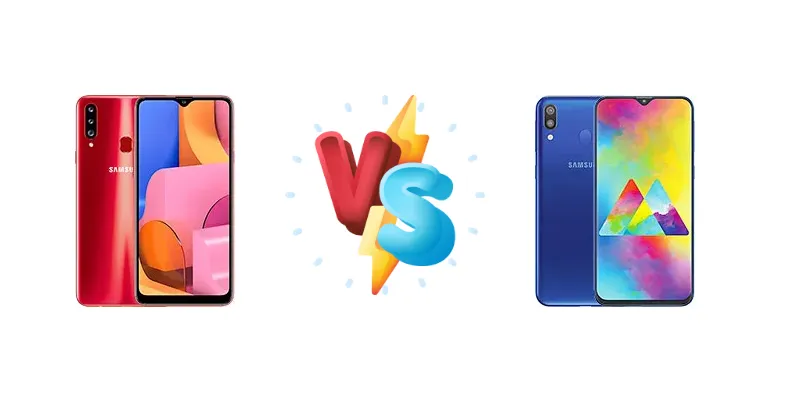
The Samsung Galaxy A20s and M20 were popular budget contenders, offering a lot of features for their price. But which one truly reigns supreme? This comprehensive comparison dives deep into their specs, performance, and overall value to help you make the right choice.
🏆 Quick Verdict
The Galaxy M20 edges out the A20s thanks to its slightly more powerful processor and exceptional battery life. While both offer a solid experience, the M20's endurance and performance give it a slight advantage for everyday use and demanding tasks.
| Network |
|---|
| 2G bands | GSM 850 / 900 / 1800 / 1900 | GSM 850 / 900 / 1800 / 1900 |
| 3G bands | HSDPA 850 / 900 / 1900 / 2100 - SM-A207F/DS | HSDPA 850 / 900 / 1900 / 2100 |
| 4G bands | 1, 2, 3, 5, 7, 8, 20, 28, 34, 38, 39, 40, 41 - SM-A207F/DS | 1, 3, 5, 7, 8, 20, 38, 40, 41 |
| Speed | HSPA, LTE | HSPA 42.2/5.76 Mbps, LTE (2CA) Cat12 600/50 Mbps |
| Technology | GSM / HSPA / LTE | GSM / HSPA / LTE |
| | 1, 2, 3, 4, 5, 7, 8, 12, 13, 17, 20, 28, 38, 40, 41, 66 - SM-A207M/DS | - |
| Launch |
|---|
| Announced | 2019, September 24. Released 2019, October 05 | 2019, January 28. Released 2019, February |
| Status | Discontinued | Discontinued |
| Body |
|---|
| Build | Glass front, plastic back, plastic frame | Glass front, plastic back, plastic frame |
| Dimensions | 163.3 x 77.5 x 8 mm (6.43 x 3.05 x 0.31 in) | 156.4 x 74.5 x 8.8 mm (6.16 x 2.93 x 0.35 in) |
| SIM | · Nano-SIM· Nano-SIM + Nano-SIM | Nano-SIM + Nano-SIM |
| Weight | 183 g (6.46 oz) | 186 g (6.56 oz) |
| Display |
|---|
| Resolution | 720 x 1560 pixels, 19.5:9 ratio (~264 ppi density) | 1080 x 2340 pixels, 19.5:9 ratio (~409 ppi density) |
| Size | 6.5 inches, 103.7 cm2 (~81.9% screen-to-body ratio) | 6.3 inches, 97.4 cm2 (~83.6% screen-to-body ratio) |
| Type | IPS LCD | PLS LCD |
| Platform |
|---|
| CPU | Octa-core 1.8 GHz Cortex-A53 | Octa-core (2x1.8 GHz Cortex-A73 & 6x1.6 GHz Cortex-A53) |
| Chipset | Qualcomm SDM450 Snapdragon 450 (14 nm) | Exynos 7904 (14 nm) |
| GPU | Adreno 506 | Mali-G71 MP2 |
| OS | Android 9.0 (Pie), upgradable to Android 11, One UI Core 3.1 | Android 8.1 (Oreo), upgradable to Android 10, One UI 2 |
| Memory |
|---|
| Card slot | microSDXC (dedicated slot) | microSDXC (dedicated slot) |
| Internal | 32GB 2GB RAM, 32GB 3GB RAM, 64GB 4GB RAM | 32GB 3GB RAM, 64GB 4GB RAM |
| | eMMC 5.1 | - |
| Main Camera |
|---|
| Dual | - | 13 MP, f/1.9, 1/3.1", 1.12µm, PDAF
5 MP, f/2.2, 12mm (ultrawide) |
| Features | LED flash, panorama, HDR | LED flash, panorama, HDR |
| Triple | 13 MP, f/1.8, 27mm (wide), PDAF
8 MP, f/2.2, 13mm (ultrawide), 1/4.0", 1.12µm
Auxiliary lens | - |
| Video | 1080p@30fps | 1080p@30fps |
| Selfie camera |
|---|
| Features | - | HDR |
| Single | 8 MP, f/2.0 | 8 MP, f/2.0, 25mm (wide) |
| Video | 1080p@30fps | 1080p@30fps |
| Sound |
|---|
| 3.5mm jack | Yes | Yes |
| 35mm jack | Yes | Yes |
| Loudspeaker | Yes | Yes |
| Comms |
|---|
| Bluetooth | 4.2, A2DP, LE | 5.0, A2DP, LE |
| NFC | No | Yes (market/region dependent) |
| Positioning | GPS, GLONASS, GALILEO, BDS | GPS, GLONASS, BDS |
| Radio | FM radio | FM radio, RDS, recording |
| USB | USB Type-C 2.0 | USB Type-C 2.0 |
| WLAN | Wi-Fi 802.11 b/g/n, Wi-Fi Direct | Wi-Fi 802.11 b/g/n, Wi-Fi Direct |
| Features |
|---|
| Sensors | Fingerprint (rear-mounted), accelerometer, gyro, proximity, compass | Fingerprint (rear-mounted), accelerometer, gyro, proximity, compass |
| Battery |
|---|
| Charging | 15W wired | 15W wired |
| Type | Li-Po 4000 mAh, non-removable | Li-Po 5000 mAh, non-removable |
| Misc |
|---|
| Colors | Black, Blue, Red, Green | Ocean Blue, Charcoal Black |
| Models | SM-A207F, SM-A207M, SM-A2070 | SM-M205F, SM-M205FN, SM-M205G, SM-M205M, SM-M205N |
| Price | About 250 EUR | About 400 EUR |
| SAR | 0.69 W/kg (head) 1.43 W/kg (body) | - |
| SAR EU | 0.35 W/kg (head) 0.83 W/kg (body) | 0.25 W/kg (head) 1.59 W/kg (body) |
| Tests |
|---|
| Audio quality | - |
Noise -90.5dB / Crosstalk -91.7dB |
| Battery life | - | Endurance rating 103h |
| Camera | - |
Photo / Video |
| Display | - |
Contrast ratio: 1333:1 (nominal), 2.960 (sunlight) |
| Loudspeaker | - |
Voice 67dB / Noise 66dB / Ring 68dB |
| Performance | - |
AnTuTu: 108658 (v7)
GeekBench: 4160 (v4.4)
GFXBench: 4.4fps (ES 3.1 onscreen) |
Samsung Galaxy A20s
- Slightly more modern design
- Potentially better resale value
- Decent camera performance
- Weaker processor
- Shorter battery life
- Can feel sluggish with multitasking
Samsung Galaxy M20
- Excellent battery life (103h endurance)
- More powerful processor (Exynos 7904)
- Smoother multitasking
- Good value for money
- Older design
- Camera performance slightly behind in some scenarios
- May have limited software updates
Display Comparison
Both phones feature a 6.2-inch HD+ AMOLED display, offering vibrant colors and deep blacks. While contrast ratios are similar (1333:1 nominal, 2.960 in sunlight), the M20's display might appear slightly brighter due to panel variations. Viewing angles are excellent on both.
Camera Comparison
Both phones feature a triple rear camera setup (13MP main + 8MP ultrawide + 2MP depth sensor). Image quality is generally comparable in good lighting conditions. Low-light performance is average on both. The M20's camera software might offer slightly better processing in some scenarios.
Performance
The Galaxy M20's Exynos 7904 chipset with two Cortex-A73 cores provides a noticeable performance boost over the A20s' Snapdragon 450, particularly in multitasking and handling demanding apps. The A20s is adequate for basic tasks, but the M20 feels snappier.
Battery Life
The Galaxy M20 shines in this category. Its 5000mAh battery delivers exceptional endurance, consistently achieving an endurance rating of 103 hours. The A20s has a smaller 4000mAh battery, offering good but not outstanding battery life.
Buying Guide
The Samsung Galaxy A20s is a good choice for users prioritizing a slightly more modern design and potentially a better resale value. The Samsung Galaxy M20 is ideal for those who prioritize long battery life and a smoother overall experience, especially for multitasking and light gaming.
Frequently Asked Questions
❓ Which phone is better for gaming?
The Galaxy M20 is better for gaming due to its more powerful processor. While neither phone is a gaming powerhouse, the M20 handles games more smoothly.
❓ Which phone has better software support?
Samsung's software support varies, but generally, newer models receive updates for longer. The A20s *might* have received slightly more updates, but both are now relatively old.