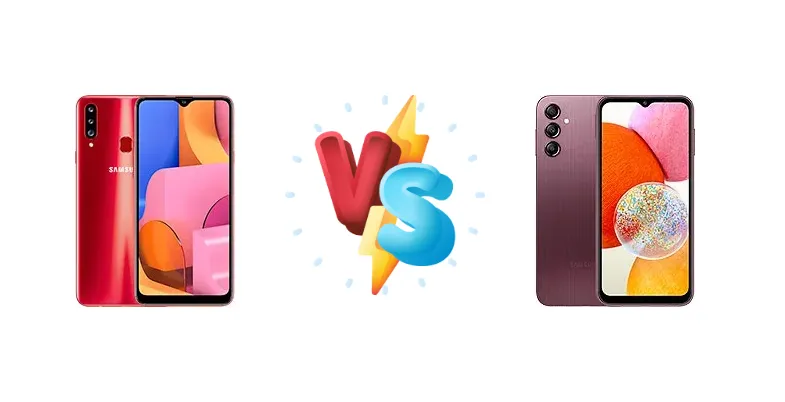
Choosing a budget-friendly smartphone can be tough. The Samsung Galaxy A20s and A14 are popular contenders, offering solid features at an affordable price. But which one is right for you? This comprehensive comparison dives deep into their specs and performance.
🏆 Quick Verdict
The Samsung Galaxy A14 is the clear winner. While the A20s was a strong contender in its time, the A14 boasts a significantly faster processor, improved camera capabilities, and a more modern design, making it the better value overall.
| Network |
|---|
| 2G bands | GSM 850 / 900 / 1800 / 1900 | GSM 850 / 900 / 1800 / 1900 |
| 3G bands | HSDPA 850 / 900 / 1900 / 2100 - SM-A207F/DS | HSDPA 850 / 900 / 2100 |
| 4G bands | 1, 2, 3, 5, 7, 8, 20, 28, 34, 38, 39, 40, 41 - SM-A207F/DS | 1, 3, 5, 7, 8, 20, 28, 38, 40, 41 |
| Speed | HSPA, LTE | HSPA, LTE |
| Technology | GSM / HSPA / LTE | GSM / HSPA / LTE |
| | 1, 2, 3, 4, 5, 7, 8, 12, 13, 17, 20, 28, 38, 40, 41, 66 - SM-A207M/DS | - |
| Launch |
|---|
| Announced | 2019, September 24. Released 2019, October 05 | 2023, February 28 |
| Status | Discontinued | Available. Released 2023, March 27 |
| Body |
|---|
| Build | Glass front, plastic back, plastic frame | Glass front, plastic back, plastic frame |
| Dimensions | 163.3 x 77.5 x 8 mm (6.43 x 3.05 x 0.31 in) | 167.7 x 78 x 9.1 mm (6.60 x 3.07 x 0.36 in) |
| SIM | · Nano-SIM· Nano-SIM + Nano-SIM | · Nano-SIM· Nano-SIM + Nano-SIM |
| Weight | 183 g (6.46 oz) | 201 g (7.09 oz) |
| Display |
|---|
| Resolution | 720 x 1560 pixels, 19.5:9 ratio (~264 ppi density) | 1080 x 2408 pixels, 20:9 ratio (~400 ppi density) |
| Size | 6.5 inches, 103.7 cm2 (~81.9% screen-to-body ratio) | 6.6 inches, 104.9 cm2 (~80.2% screen-to-body ratio) |
| Type | IPS LCD | PLS LCD |
| Platform |
|---|
| CPU | Octa-core 1.8 GHz Cortex-A53 | Octa-core (2x2.0 GHz Cortex-A75 & 6x1.8 GHz Cortex-A55) - Version AOcta-core (4x2.0 GHz Cortex-A55 & 4x2.0 GHz Cortex-A55) - Version B |
| Chipset | Qualcomm SDM450 Snapdragon 450 (14 nm) | Mediatek MT6769 Helio G80 (12 nm) - Version AExynos 850 (8 nm) - Version B |
| GPU | Adreno 506 | Mali-G52 MC2 |
| OS | Android 9.0 (Pie), upgradable to Android 11, One UI Core 3.1 | Android 13, upgradable to Android 15, One UI 7 |
| Memory |
|---|
| Card slot | microSDXC (dedicated slot) | microSDXC (dedicated slot) |
| Internal | 32GB 2GB RAM, 32GB 3GB RAM, 64GB 4GB RAM | 64GB 4GB RAM, 128GB 4GB RAM, 128GB 6GB RAM |
| | eMMC 5.1 | - |
| Main Camera |
|---|
| Features | LED flash, panorama, HDR | LED flash, panorama, HDR |
| Single | - | 13 MP, f/2.0, (wide) |
| Triple | 13 MP, f/1.8, 27mm (wide), PDAF
8 MP, f/2.2, 13mm (ultrawide), 1/4.0", 1.12µm
Auxiliary lens | 50 MP, f/1.8, 26mm (wide), 1/2.75", 0.64µm, PDAF
5 MP, f/2.2, 17mm (ultrawide), 1/5.0", 1.12µm
2 MP (macro) |
| Video | 1080p@30fps | 1080p@30fps |
| Selfie camera |
|---|
| Single | 8 MP, f/2.0 | 13 MP, f/2.0, 26mm (wide), 1/3.1", 1.12µm |
| Video | 1080p@30fps | 1080p@30fps |
| Sound |
|---|
| 3.5mm jack | Yes | Yes |
| 35mm jack | Yes | Yes |
| Loudspeaker | Yes | Yes |
| Comms |
|---|
| Bluetooth | 4.2, A2DP, LE | 5.1 or 5.3, A2DP, LE |
| NFC | No | Yes (market/region dependent) |
| Positioning | GPS, GLONASS, GALILEO, BDS | GPS, GALILEO, GLONASS, BDS, QZSS |
| Radio | FM radio | Unspecified |
| USB | USB Type-C 2.0 | USB Type-C 2.0 |
| WLAN | Wi-Fi 802.11 b/g/n, Wi-Fi Direct | Wi-Fi 802.11 a/b/g/n/ac, dual-band, Wi-Fi Direct |
| Features |
|---|
| Sensors | Fingerprint (rear-mounted), accelerometer, gyro, proximity, compass | Fingerprint (side-mounted), accelerometer, proximity, compass |
| Battery |
|---|
| Charging | 15W wired | 15W wired |
| Type | Li-Po 4000 mAh, non-removable | Li-Po 5000 mAh |
| Misc |
|---|
| Colors | Black, Blue, Red, Green | Black, Dark Red, Silver, Green |
| Models | SM-A207F, SM-A207M, SM-A2070 | SM-A145F, SM-A145F/DSN, SM-A145M, SM-A145M/DS, SM-A145P, SM-A145R |
| Price | About 250 EUR | € 85.76 / $ 147.60 / £ 79.95 |
| SAR | 0.69 W/kg (head) 1.43 W/kg (body) | - |
| SAR EU | 0.35 W/kg (head) 0.83 W/kg (body) | 0.46 W/kg (head) 1.37 W/kg (body) |
Samsung Galaxy A20s
- Affordable
- Decent battery life
- Good value for the price (when new)
- Outdated chipset
- Lower resolution display
- Less capable camera
- Slower performance
Samsung Galaxy A14
- Faster processor
- Improved camera
- Larger and sharper display
- Modern design
- Better battery efficiency
- Charging speed could be faster
- Plastic build (common for this price range)
Display Comparison
The Galaxy A14 generally has a larger display (6.6 inches vs 6.5 inches on the A20s) and often a higher resolution (FHD+ vs HD+ on the A20s), resulting in a sharper and more immersive viewing experience. Both use an LCD panel, so don't expect OLED quality, but the A14's larger size and resolution give it an edge.
Camera Comparison
The A14 typically features a more versatile camera system with higher resolution sensors and improved image processing. While both offer decent image quality in good lighting, the A14 excels in low-light conditions and offers more features like improved video recording capabilities. The A20s camera is adequate but noticeably less capable.
Performance
The A14's chipset (Helio G80 or Exynos 850) is a substantial upgrade over the A20s' Snapdragon 450. The A14 handles multitasking and demanding apps much more smoothly. The A20s can feel sluggish at times, especially with multiple apps open.
Battery Life
Both phones offer similar battery capacity (around 5000mAh), but the A14's more efficient chipset allows for better battery life in real-world usage. Expect slightly longer usage times on the A14.
Buying Guide
Who should buy the Samsung Galaxy A20s? Those looking for a very budget-friendly option and are okay with older hardware. Who should buy the Samsung Galaxy A14? Anyone seeking a reliable, modern smartphone with better performance and camera features without breaking the bank.
Frequently Asked Questions
❓ Is the Samsung Galaxy A20s still worth buying?
Only if you're on an extremely tight budget and can find it at a significantly reduced price. Otherwise, the A14 offers a much better overall experience.
❓ Which chipset is better: Snapdragon 450 or Helio G80/Exynos 850?
The Helio G80 and Exynos 850 are significantly more powerful than the Snapdragon 450, offering noticeably better performance in all areas.
❓ Does the A14 support 5G?
Some variants of the A14 support 5G, while others are 4G only. Check the specific model number to confirm.