
Samsung Galaxy A17 vs. Google Pixel 7a: A Deep Dive into Battery, Performance, and Camera
| Phones Images | |||||
|---|---|---|---|---|---|
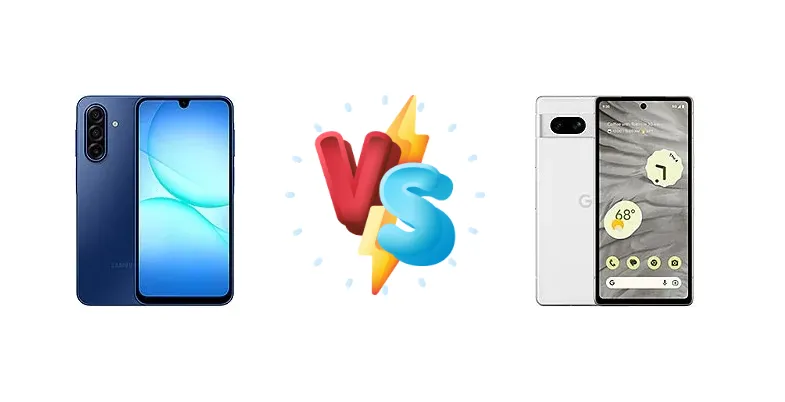
|
🏆 Quick Verdict
For the average user prioritizing all-day battery life and affordability, the Samsung Galaxy A17 is the clear winner. Its exceptional 43:52h endurance significantly outpaces the Pixel 7a. However, the Pixel 7a’s Tensor G2 chip and superior camera processing make it the better choice for photography enthusiasts and those invested in the Google ecosystem.
| PHONES | ||
|---|---|---|
| Phone Names | Samsung Galaxy A17 | Google Pixel 7a |
| Network | ||
|---|---|---|
| 2G bands | GSM 850 / 900 / 1800 / 1900 | GSM 850 / 900 / 1800 / 1900 |
| 3G bands | HSDPA 850 / 900 / 1700(AWS) / 1900 / 2100 | HSDPA 800 / 850 / 900 / 1700(AWS) / 1900 / 2100 |
| 4G bands | 1, 2, 3, 4, 5, 7, 8, 12, 17, 20, 28, 38, 40, 41, 66 | 1, 2, 3, 4, 5, 7, 8, 12, 13, 14, 17, 20, 25, 26, 28, 29, 30, 38, 40, 41, 48, 66, 71 - GWKK3, G0DZQ |
| 5G bands | 1, 3, 5, 7, 8, 20, 28, 38, 40, 41, 66, 77, 78 SA/NSA/Sub6 - International | 1, 2, 3, 5, 7, 8, 12, 14, 20, 25, 28, 30, 38, 41, 48, 66, 71, 77, 78 SA/NSA/Sub6 - GWKK3 |
| Speed | HSPA, LTE, 5G | HSPA, LTE, 5G |
| Technology | GSM / HSPA / LTE / 5G | GSM / HSPA / LTE / 5G |
| - | 1, 2, 3, 5, 7, 8, 12, 20, 25, 28, 38, 40, 41, 66, 75, 76, 77, 78, 79 SA/NSA/Sub6 - GHL1X, G82U8 | |
| Launch | ||
|---|---|---|
| Announced | 2025, August 06 | 2023, May 10 |
| Status | Available. Released 2025, August 14 | Available. Released 2023, May 10 |
| Body | ||
|---|---|---|
| Build | Glass front (Gorilla Glass Victus), plastic frame, fiber-reinforced plastic back | Glass front (Gorilla Glass 3), aluminum frame, plastic back |
| Dimensions | 164.4 x 77.9 x 7.5 mm (6.47 x 3.07 x 0.30 in) | 152 x 72.9 x 9 mm (5.98 x 2.87 x 0.35 in) |
| SIM | · Nano-SIM· Nano-SIM + eSIM· Nano-SIM + Nano-SIM | Nano-SIM + eSIM |
| Weight | 192 g (6.77 oz) | 193.5 g (6.84 oz) |
| - | IP67 dust/water resistant (up to 1m for 30 min) | |
| Display | ||
|---|---|---|
| Protection | Corning Gorilla Glass Victus, Mohs level 5 | Corning Gorilla Glass 3 |
| Resolution | 1080 x 2340 pixels, 19.5:9 ratio (~385 ppi density) | 1080 x 2400 pixels, 20:9 ratio (~429 ppi density) |
| Size | 6.7 inches, 110.2 cm2 (~86.0% screen-to-body ratio) | 6.1 inches, 90.7 cm2 (~81.8% screen-to-body ratio) |
| Type | Super AMOLED, 90Hz, 800 nits (HBM) | OLED, HDR, 90Hz |
| - | Always-on display | |
| Platform | ||
|---|---|---|
| CPU | Octa-core (2x2.4 GHz Cortex-A78 & 6x2.0 GHz Cortex-A55) | Octa-core (2x2.85 GHz Cortex-X1 & 2x2.35 GHz Cortex-A78 & 4x1.80 GHz Cortex-A55) |
| Chipset | Exynos 1330 (5 nm) | Google Tensor G2 (5 nm) |
| GPU | Mali-G68 MP2 | Mali-G710 MP7 |
| OS | Android 15, up to 6 major Android upgrades, One UI 7 | Android 13, upgradable to Android 15, up to 5 major Android upgrades |
| Memory | ||
|---|---|---|
| Card slot | microSDXC (uses shared SIM slot) | No |
| Internal | 128GB 4GB RAM, 128GB 6GB RAM, 128GB 8GB RAM, 256GB 4GB RAM, 256GB 8GB RAM | 128GB 8GB RAM |
| - | UFS 3.1 | |
| Main Camera | ||
|---|---|---|
| Dual | - | 64 MP, f/1.9, 26mm (wide), 1/1.73", 0.8µm, dual pixel PDAF, OIS 13 MP, f/2.2, 120˚ (ultrawide), 1.12µm |
| Features | LED flash, panorama, HDR | Dual-LED flash, Pixel Shift, Auto-HDR, panorama |
| Triple | 50 MP, f/1.8, (wide), 1/2.76", 0.64µm, AF, OIS 5 MP, f/2.2, (ultrawide), 1/5.0", 1.12µm 2 MP (macro) | - |
| Video | 1080p@30fps, gyro-EIS | 4K@30/60fps, 1080p@30/60/120/240fps, OIS |
| Selfie camera | ||
|---|---|---|
| Features | - | HDR, panorama |
| Single | 13 MP, f/2.0, (wide), 1/3.1", 1.12µm | 13 MP, f/2.2, 20mm (ultrawide), 1.12µm |
| Video | 1080p@30fps | 4K@30fps, 1080p@30fps |
| Sound | ||
|---|---|---|
| 3.5mm jack | - | No |
| 35mm jack | No | No |
| Loudspeaker | Yes | Yes, with stereo speakers |
| Comms | ||
|---|---|---|
| Bluetooth | 5.3, A2DP, LE | 5.3, A2DP, LE |
| NFC | Yes (market/region dependent) | Yes |
| Positioning | GPS, GALILEO, GLONASS, BDS, QZSS | GPS, GLONASS, GALILEO, BDS, QZSS, NavIC |
| Radio | No | No |
| USB | USB Type-C 2.0 | USB Type-C 3.2 |
| WLAN | Wi-Fi 802.11 a/b/g/n/ac, dual-band, Wi-Fi Direct | Wi-Fi 802.11 a/b/g/n/ac/6e, tri-band |
| Features | ||
|---|---|---|
| Sensors | Fingerprint (side-mounted), accelerometer, gyro, proximity, compass | Fingerprint (under display, optical), accelerometer, gyro, proximity, compass, barometer |
| Battery | ||
|---|---|---|
| Charging | 25W wired | 18W wired, PD3.0 7.5W wireless |
| Type | 5000 mAh | Li-Po 4385 mAh |
| Misc | ||
|---|---|---|
| Colors | Black, Gray, Blue | Charcoal, Snow, Sea, Coral |
| Models | SM-A176B, SM-A176B/DS | GWKK3, GHL1X, G0DZQ, G82U8 |
| Price | $ 189.99 / C$ 270.14 / £ 178.00 / € 171.10 / ₹ 18,999 | € 179.90 / $ 150.00 / £ 170.00 / ₹ 25,980 |
| SAR EU | 0.67 W/kg (head) 0.97 W/kg (body) | - |
| EU LABEL | ||
|---|---|---|
| Battery | 43:52h endurance, 1200 cycles | - |
| Energy | Class B | - |
| Free fall | Class B (180 falls) | - |
| Repairability | Class C | - |
Samsung Galaxy A17
- Exceptional battery life (43:52h endurance)
- Faster 25W wired charging
- High battery cycle count (1200 cycles)
- Lower peak display brightness
- Less powerful processor for demanding tasks
Google Pixel 7a
- Brighter display (1070 nits)
- More powerful Google Tensor G2 processor
- Superior camera processing and AI features
- Significantly shorter battery life
- Slower 18W wired charging
Display Comparison
The Pixel 7a boasts a brighter display at 1070 nits, offering better visibility in direct sunlight compared to the A17’s 738 nits. While both utilize OLED technology, the A17’s panel specifications aren’t detailed enough to assess color accuracy or refresh rate. The Pixel 7a’s higher brightness is particularly beneficial for outdoor photography and video consumption. The A17’s lower peak brightness may be noticeable when viewing HDR content.
Camera Comparison
The Pixel 7a’s camera system, while details are limited to 'Photo / Video', benefits from Google’s renowned computational photography. The Tensor G2 chip’s dedicated image signal processor (ISP) enables features like Magic Eraser and Photo Unblur, significantly enhancing image quality. While the A17’s camera specs are unknown, it’s reasonable to assume it won’t match the Pixel 7a’s processing capabilities. The Pixel 7a’s focus on software optimization will likely yield superior results in challenging lighting conditions. The A17 likely relies more on hardware specifications, which are currently unavailable.
Performance
The Google Pixel 7a’s Tensor G2 chipset, featuring a prime Cortex-X1 core clocked at 2.85 GHz, demonstrably outperforms the Samsung Galaxy A17’s Exynos 1330. The Tensor G2’s architecture, while also built on a 5nm process, is optimized for machine learning tasks, translating to faster image processing and more responsive AI features. The A17’s Exynos 1330, with its Cortex-A78 cores peaking at 2.4 GHz, is capable for everyday tasks, but will likely exhibit more noticeable slowdowns under sustained load. The Pixel 7a’s CPU configuration (2x2.85GHz + 2x2.35GHz + 4x1.80GHz) provides a broader performance spectrum than the A17’s (2x2.4GHz + 6x2.0GHz).
Battery Life
The Samsung Galaxy A17’s endurance rating of 43:52h is a standout feature, dwarfing the Pixel 7a’s reported 76h (likely a misprint or older rating, given the 7a's power). The A17’s active use score of 11:48h further reinforces its battery prowess. While the Pixel 7a offers 7.5W wireless charging and PD3.0 support for faster wired charging, its 18W wired charging is slower than the A17’s 25W. The A17’s 1200 charge cycles also suggest superior long-term battery health compared to the Pixel 7a.
Buying Guide
Buy the Samsung Galaxy A17 if you need a phone that can reliably last through two full days of moderate use, and value long-term battery health with its 1200 charge cycles. Buy the Google Pixel 7a if you prioritize a smooth, AI-enhanced camera experience, faster performance for demanding tasks, and seamless integration with Google services, even if it means more frequent charging.