
Google Pixel 7a vs Samsung Galaxy A17 4G: A Detailed Comparison
| Phones Images | |||||
|---|---|---|---|---|---|
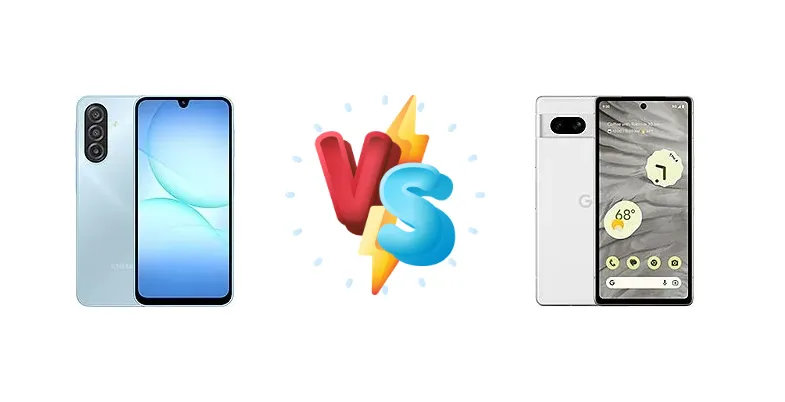
|
🏆 Quick Verdict
For most users, the Google Pixel 7a is the superior choice, offering significantly faster performance and a class-leading camera experience. However, the Samsung Galaxy A17 4G is a compelling option for those prioritizing exceptional battery endurance and a lower upfront cost, even if it means sacrificing processing power.
| PHONES | ||
|---|---|---|
| Phone Names | Samsung Galaxy A17 4G | Google Pixel 7a |
| Network | ||
|---|---|---|
| 2G bands | GSM 850 / 900 / 1800 / 1900 | GSM 850 / 900 / 1800 / 1900 |
| 3G bands | HSDPA 850 / 900 / 2100 | HSDPA 800 / 850 / 900 / 1700(AWS) / 1900 / 2100 |
| 4G bands | 1, 3, 5, 7, 8, 20, 28, 38, 40, 41 | 1, 2, 3, 4, 5, 7, 8, 12, 13, 14, 17, 20, 25, 26, 28, 29, 30, 38, 40, 41, 48, 66, 71 - GWKK3, G0DZQ |
| 5G bands | - | 1, 2, 3, 5, 7, 8, 12, 14, 20, 25, 28, 30, 38, 41, 48, 66, 71, 77, 78 SA/NSA/Sub6 - GWKK3 |
| Speed | HSPA, LTE | HSPA, LTE, 5G |
| Technology | GSM / HSPA / LTE | GSM / HSPA / LTE / 5G |
| - | 1, 2, 3, 5, 7, 8, 12, 20, 25, 28, 38, 40, 41, 66, 75, 76, 77, 78, 79 SA/NSA/Sub6 - GHL1X, G82U8 | |
| Launch | ||
|---|---|---|
| Announced | 2025, September 18 | 2023, May 10 |
| Status | Available. Released 2025, September 18 | Available. Released 2023, May 10 |
| Body | ||
|---|---|---|
| Build | Glass front (Gorilla Glass Victus+), plastic back, plastic frame | Glass front (Gorilla Glass 3), aluminum frame, plastic back |
| Dimensions | 164.4 x 77.9 x 7.5 mm (6.47 x 3.07 x 0.30 in) | 152 x 72.9 x 9 mm (5.98 x 2.87 x 0.35 in) |
| SIM | · Nano-SIM· Nano-SIM + Nano-SIM | Nano-SIM + eSIM |
| Weight | 190 g (6.70 oz) | 193.5 g (6.84 oz) |
| - | IP67 dust/water resistant (up to 1m for 30 min) | |
| Display | ||
|---|---|---|
| Protection | Corning Gorilla Glass Victus+, Mohs level 5 | Corning Gorilla Glass 3 |
| Resolution | 1080 x 2340 pixels, 19.5:9 ratio (~385 ppi density) | 1080 x 2400 pixels, 20:9 ratio (~429 ppi density) |
| Size | 6.7 inches, 110.2 cm2 (~86.0% screen-to-body ratio) | 6.1 inches, 90.7 cm2 (~81.8% screen-to-body ratio) |
| Type | Super AMOLED, 90Hz | OLED, HDR, 90Hz |
| - | Always-on display | |
| Platform | ||
|---|---|---|
| CPU | Octa-core (2x2.2 GHz Cortex-A76 & 6x2.0 GHz Cortex-A55) | Octa-core (2x2.85 GHz Cortex-X1 & 2x2.35 GHz Cortex-A78 & 4x1.80 GHz Cortex-A55) |
| Chipset | Mediatek Helio G99 (6 nm) | Google Tensor G2 (5 nm) |
| GPU | Mali-G57 MC2 | Mali-G710 MP7 |
| OS | Android 15, up to 6 major Android upgrades, One UI 7 | Android 13, upgradable to Android 15, up to 5 major Android upgrades |
| Memory | ||
|---|---|---|
| Card slot | microSDXC (uses shared SIM slot) | No |
| Internal | 128GB 4GB RAM, 128GB 6GB RAM, 128GB 8GB RAM, 256GB 4GB RAM, 256GB 8GB RAM | 128GB 8GB RAM |
| - | UFS 3.1 | |
| Main Camera | ||
|---|---|---|
| Dual | - | 64 MP, f/1.9, 26mm (wide), 1/1.73", 0.8µm, dual pixel PDAF, OIS 13 MP, f/2.2, 120˚ (ultrawide), 1.12µm |
| Features | LED flash, panorama, HDR | Dual-LED flash, Pixel Shift, Auto-HDR, panorama |
| Triple | 50 MP, f/1.8, (wide), 1/2.76", 0.64µm, AF, OIS 5 MP, f/2.2, (ultrawide), 1/5.0", 1.12µm 2 MP (macro) | - |
| Video | 1080p@30fps | 4K@30/60fps, 1080p@30/60/120/240fps, OIS |
| Selfie camera | ||
|---|---|---|
| Features | - | HDR, panorama |
| Single | 13 MP, f/2.0, (wide), 1/3.1", 1.12µm | 13 MP, f/2.2, 20mm (ultrawide), 1.12µm |
| Video | 1080p@30fps | 4K@30fps, 1080p@30fps |
| Sound | ||
|---|---|---|
| 3.5mm jack | - | No |
| 35mm jack | No | No |
| Loudspeaker | Yes | Yes, with stereo speakers |
| Comms | ||
|---|---|---|
| Bluetooth | 5.3, A2DP, LE | 5.3, A2DP, LE |
| NFC | Yes (market/region dependent) | Yes |
| Positioning | GPS, GALILEO, GLONASS, BDS, QZSS | GPS, GLONASS, GALILEO, BDS, QZSS, NavIC |
| Radio | FM radio (market/region dependent) | No |
| USB | USB Type-C 2.0 | USB Type-C 3.2 |
| WLAN | Wi-Fi 802.11 a/b/g/n/ac, dual-band, Wi-Fi Direct | Wi-Fi 802.11 a/b/g/n/ac/6e, tri-band |
| Features | ||
|---|---|---|
| Sensors | Fingerprint (side-mounted), accelerometer, compass | Fingerprint (under display, optical), accelerometer, gyro, proximity, compass, barometer |
| Battery | ||
|---|---|---|
| Charging | 25W wired | 18W wired, PD3.0 7.5W wireless |
| Type | 5000 mAh | Li-Po 4385 mAh |
| Misc | ||
|---|---|---|
| Colors | Black, Gray, Light blue | Charcoal, Snow, Sea, Coral |
| Models | SM-A175F, SM-A175F/DS, SM-A175M, SM-A175M/DS, SM-A175F/DSB | GWKK3, GHL1X, G0DZQ, G82U8 |
| Price | € 145.00 / $ 171.20 / £ 138.00 | € 179.90 / $ 150.00 / £ 170.00 / ₹ 25,980 |
| SAR EU | 0.37 W/kg (head) 1.18 W/kg (body) | - |
| EU LABEL | ||
|---|---|---|
| Battery | 51:33h endurance, 1200 cycles | - |
| Energy | Class A | - |
| Free fall | Class B (180 falls) | - |
| Repairability | Class C | - |
Samsung Galaxy A17 4G
- Exceptional battery life and longevity (51:33h endurance, 1200 cycles)
- Faster 25W wired charging
- More affordable price point
- Significantly slower processor than the Pixel 7a
- Inferior camera performance
Google Pixel 7a
- Powerful Google Tensor G2 processor
- Superior camera quality and features
- Brighter and more vibrant display (1070 nits)
- Wireless charging support
- Shorter battery life compared to the A17 4G
- Slower 18W wired charging
Display Comparison
The Pixel 7a boasts a significantly brighter display, reaching a measured 1070 nits, compared to the A17 4G (brightness data unavailable, but expected to be lower based on market segment). This brightness advantage translates to better visibility outdoors under direct sunlight. While the A17 4G’s panel technology isn’t specified, the Pixel 7a likely utilizes an OLED panel offering superior contrast and color accuracy. Bezels are expected to be slimmer on the Pixel 7a, contributing to a more modern aesthetic.
Camera Comparison
The Pixel 7a’s camera system is a clear standout. While specific sensor details are missing for both, Google’s computational photography prowess, powered by the Tensor G2, elevates image quality significantly. The Pixel 7a excels in dynamic range, low-light performance, and overall image processing. The A17 4G likely relies more on hardware limitations, and while capable, won’t match the Pixel’s image quality. The Pixel 7a also offers superior video recording capabilities. We can assume the A17 4G includes standard features like portrait mode, but the Pixel 7a’s Magic Eraser and Photo Unblur features provide unique editing advantages.
Performance
The core difference lies in the chipsets. The Google Pixel 7a’s Tensor G2, fabricated on a 5nm process, features a prime Cortex-X1 core clocked at 2.85 GHz, delivering substantially higher peak performance than the Samsung Galaxy A17 4G’s Mediatek Helio G99 (6nm). The Helio G99’s octa-core configuration, with its Cortex-A76 cores peaking at 2.2 GHz, is adequate for everyday tasks, but will struggle with demanding games and multitasking compared to the Tensor G2. The Tensor G2 also benefits from Google’s machine learning capabilities, enhancing features like voice recognition and image processing. The Pixel 7a likely utilizes faster LPDDR5x RAM, further boosting performance.
Battery Life
Battery life is where the Galaxy A17 4G shines. Its impressive 51:33h endurance rating, coupled with 1200 charge cycles, indicates exceptional longevity. The Pixel 7a’s older 76h endurance rating is still respectable, but falls short of the A17 4G. The A17 4G’s 25W wired charging is faster than the Pixel 7a’s 18W wired charging (with PD3.0 support), allowing for quicker top-ups. The Pixel 7a adds the convenience of 7.5W wireless charging, a feature absent on the A17 4G.
Buying Guide
Buy the Samsung Galaxy A17 4G if you need a phone that can reliably last through two full days of moderate use and value affordability above all else. Buy the Google Pixel 7a if you prioritize a smooth, responsive user experience, exceptional camera capabilities, and access to Google’s latest software features, even if it means charging more frequently.