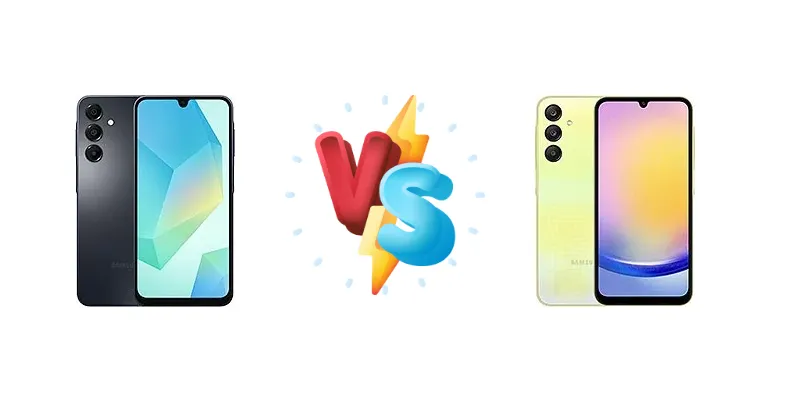
Samsung's Galaxy A series continues to dominate the budget and mid-range smartphone market. The A16 and A25 represent compelling options, but cater to slightly different priorities. The A16 focuses on maximizing battery life and offering a solid, reliable experience, while the A25 aims for a performance boost with a more modern chipset. This comparison dives deep into the specifics to determine which device delivers the best value.
🏆 Quick Verdict
For the average user prioritizing longevity and consistent performance, the Samsung Galaxy A16 emerges as the winner. Its significantly superior battery endurance (45:10h vs 10:19h active use) and brighter display outweigh the A25’s faster processor for everyday tasks. However, users who frequently game or require more demanding app performance will benefit from the A25.
| Network |
|---|
| 2G bands | GSM 850 / 900 / 1800 / 1900 | GSM 850 / 900 / 1800 / 1900 |
| 3G bands | HSDPA 850 / 900 / 2100 | HSDPA 850 / 900 / 1700(AWS) / 1900 / 2100 |
| 4G bands | 1, 3, 5, 7, 8, 20, 28, 38, 40, 41 | 1, 2, 3, 4, 5, 7, 8, 12, 13, 17, 20, 26, 28, 38, 40, 41, 66 |
| 5G bands | - | 1, 3, 5, 7, 8, 26, 28, 40, 41, 66, 77, 78 SA/NSA/Sub6 |
| Speed | HSPA, LTE | HSPA, LTE, 5G |
| Technology | GSM / HSPA / LTE | GSM / HSPA / LTE / 5G |
| Launch |
|---|
| Announced | 2024, October 15 | 2023, December 11 |
| Status | Available. Released 2024, November 20 | Available. Released 2023, December 16 |
| Body |
|---|
| Build | Glass front, plastic back, plastic frame | Glass front, plastic frame, plastic back |
| Dimensions | 164.4 x 77.9 x 7.9 mm (6.47 x 3.07 x 0.31 in) | 161 x 76.5 x 8.3 mm (6.34 x 3.01 x 0.33 in) |
| SIM | · Nano-SIM· Nano-SIM + Nano-SIM | · Nano-SIM· Nano-SIM + Nano-SIM |
| Weight | 200 g (7.05 oz) | 197 g (6.95 oz) |
| Display |
|---|
| Protection | Mohs level 5 | - |
| Resolution | 1080 x 2340 pixels, 19.5:9 ratio (~385 ppi density) | 1080 x 2340 pixels, 19.5:9 ratio (~396 ppi density) |
| Size | 6.7 inches, 110.2 cm2 (~86.0% screen-to-body ratio) | 6.5 inches, 103.7 cm2 (~84.2% screen-to-body ratio) |
| Type | Super AMOLED, 90Hz | Super AMOLED, 120Hz, 1000 nits (HBM) |
| Platform |
|---|
| CPU | Octa-core (2x2.2 GHz Cortex-A76 & 6x2.0 GHz Cortex-A55) | Octa-core (2x2.4 GHz Cortex-A78 & 6x2.0 GHz Cortex-A55) |
| Chipset | Mediatek Helio G99 (6 nm) | Exynos 1280 (5 nm) |
| GPU | Mali-G57 MC2 | Mali-G68 |
| OS | Android 14, up to 6 major Android upgrades, One UI 7 | Android 14, up to 4 major Android upgrades, One UI 7 |
| Memory |
|---|
| Card slot | microSDXC (uses shared SIM slot) | microSDXC (uses shared SIM slot) |
| Internal | 128GB 4GB RAM, 128GB 6GB RAM, 128GB 8GB RAM, 256GB 4GB RAM, 256GB 6GB RAM, 256GB 8GB RAM | 128GB 4GB RAM, 128GB 6GB RAM, 128GB 8GB RAM, 256GB 6GB RAM, 256GB 8GB RAM |
| Main Camera |
|---|
| Features | LED flash, panorama, HDR | LED flash, panorama, HDR |
| Triple | 50 MP, f/1.8, (wide), 1/2.76", 0.64µm, AF
5 MP, f/2.2, (ultrawide), 1/5.0", 1.12µm
2 MP (macro) | 50 MP, f/1.8, 27mm (wide), 1/2.76", 0.64µm, PDAF, OIS
8 MP, f/2.2, 120˚ (ultrawide), 1/4", 1.12µm
2 MP (macro) |
| Video | 1080p@30fps | 4K@30fps, 1080p@30/60fps, gyro-EIS |
| Selfie camera |
|---|
| Single | 13 MP, f/2.0, (wide), 1/3.1", 1.12µm | 13 MP, f/2.2, (wide), 1/3.06", 1.12µm |
| Video | 1080p@30fps | 1080p@30fps |
| Sound |
|---|
| 35mm jack | No | Yes |
| Loudspeaker | Yes | Yes, with stereo speakers |
| Comms |
|---|
| Bluetooth | 5.3, A2DP, LE | 5.3, A2DP, LE |
| NFC | Yes (market/region dependent) | Yes (market/region dependent) |
| Positioning | GPS, GALILEO, GLONASS, BDS, QZSS | GPS, GLONASS, GALILEO, BDS, QZSS |
| Radio | FM radio (market/region dependent) | Market/region dependent |
| USB | USB Type-C 2.0 | USB Type-C 2.0 |
| WLAN | Wi-Fi 802.11 a/b/g/n/ac, dual-band, Wi-Fi Direct | Wi-Fi 802.11 a/b/g/n/ac, dual-band, Wi-Fi Direct |
| Features |
|---|
| Sensors | Fingerprint (side-mounted), accelerometer, compass | Fingerprint (side-mounted), accelerometer, gyro, compass |
| Battery |
|---|
| Charging | 25W wired | 25W wired |
| Type | 5000 mAh | 5000 mAh |
| Misc |
|---|
| Colors | Gray, water green, midnight blue | Brave Black, Personality Yellow, Fantasy Blue, Optimistic Blue |
| Models | SM-A165F, SM-A165F/DS, SM-A165M, SM-A165M/DS, SM-A165F/DSB | SM-A256E, SM-A256E/DS, SM-A256E/DSN, SM-A256B, SM-A256B/DS, SM-A256B/DSN, SM-A256U, SM-A256U1 |
| Price | € 117.89 / $ 122.00 / £ 97.99 | € 175.99 / $ 120.32 / ₹ 18,399 |
| SAR EU | 0.31 W/kg (head) 1.08 W/kg (body) | 0.46 W/kg (head) 1.19 W/kg (body) |
| EU LABEL |
|---|
| Battery | 45:10h endurance, 1200 cycles | - |
| Energy | Class B | - |
| Free fall | Class B (180 falls) | - |
| Repairability | Class C | - |
Samsung Galaxy A16
- Exceptional battery life (45:10h endurance)
- Brighter display (808 nits)
- More affordable price point (likely)
- Less powerful processor
- Potentially slower app loading times
Samsung Galaxy A25
- Faster processor (Exynos 1280)
- Brighter display (1030 nits)
- Improved multitasking capabilities
- Significantly shorter battery life (10:19h)
- Potentially higher price
Display Comparison
The Samsung Galaxy A25 boasts a brighter display at 1030 nits compared to the A16’s 808 nits, making it more readable under direct sunlight. While both displays likely utilize LCD technology (given the price points), the A25’s higher peak brightness is a tangible advantage. However, the A16’s brightness is still very respectable and will be sufficient for most users. Details regarding refresh rates and panel type (IPS vs. TFT) are missing, but both are likely 60Hz panels to maintain battery efficiency.
Camera Comparison
Context data is limited regarding camera capabilities beyond the mention of 'Photo / Video' for the A25. Given the A-series positioning, both phones likely feature multi-camera setups with a primary sensor, ultrawide, and potentially a macro lens. Without sensor size or aperture information, it’s difficult to make a definitive judgment. The A25’s image processing, powered by the Exynos 1280’s ISP, may offer slightly better dynamic range and detail. The A16’s camera performance will likely be adequate for social media sharing and casual photography.
Performance
The core difference lies in the chipsets. The A25’s Exynos 1280 (5nm) offers a clear architectural advantage over the A16’s MediaTek Helio G99 (6nm). The Exynos 1280 utilizes Cortex-A78 cores, which are more powerful than the A76 cores found in the Helio G99. This translates to faster app loading times, smoother multitasking, and improved gaming performance. The 5nm fabrication process of the Exynos 1280 also contributes to better thermal efficiency, potentially reducing throttling during sustained workloads. However, the A16’s Helio G99 is still a capable processor for everyday tasks.
Battery Life
Battery life is where the A16 truly shines. Its 45:10h endurance rating is significantly higher than the A25’s 10:19h active use score. This translates to a full day of heavy use, and potentially two days for moderate users. While both phones support 25W wired charging, the A16’s larger battery capacity means it will take longer to fully charge. The A25’s shorter battery life is a trade-off for its more powerful processor, requiring more frequent charging.
Buying Guide
Buy the Samsung Galaxy A16 if you need exceptional battery life, a bright and easily visible display for outdoor use, and a dependable experience for everyday tasks like browsing, social media, and communication. Buy the Samsung Galaxy A25 if you prioritize smoother performance in demanding applications, occasional gaming, and are willing to trade some battery life for a more responsive user experience.
Frequently Asked Questions
❓ Does the Exynos 1280 in the A25 tend to overheat during prolonged gaming sessions?
While the Exynos 1280 is a capable chip, its thermal performance in the A25 will depend on Samsung’s cooling solution. The 5nm process helps with efficiency, but extended gaming at high settings could still lead to some throttling. Expect performance to be sustained, but not necessarily at peak levels for very long periods.
❓ Is the 2MP macro camera on either phone actually useful for taking detailed close-up photos?
Generally, 2MP macro cameras on budget smartphones offer limited detail and image quality. They are often included for marketing purposes but rarely deliver truly impressive results. Expect soft images and limited dynamic range. They can be fun to experiment with, but don't expect professional-level macro photography.
❓ What kind of charging speeds can I realistically expect with the 25W charging on both devices?
While both support 25W charging, the actual 0-100% charge time will vary. The A16’s larger battery will take longer to fill – likely around 1 hour 45 minutes to 2 hours. The A25, with its smaller battery, should charge faster, potentially around 1 hour 30 minutes to 1 hour 45 minutes. Charging speeds also depend on the charger and cable used.
❓ Will the A25 be able to run demanding games like PUBG Mobile at high frame rates?
The Exynos 1280 should be capable of running PUBG Mobile at high settings, but achieving a consistent 60fps may require reducing graphics settings. The A25’s thermal management will play a crucial role in maintaining stable frame rates during extended gaming sessions. Expect some frame drops during intense firefights.