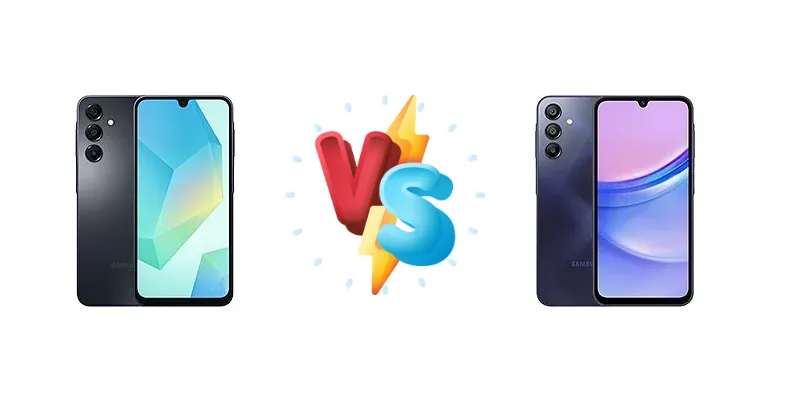
Samsung's A-series continues to dominate the budget smartphone space, and the A16 and A15 represent compelling options for cost-conscious consumers. While both devices share a core chipset, subtle differences in battery performance and endurance make choosing between them a nuanced decision. This comparison breaks down every key aspect to help you determine which phone best suits your needs.
🏆 Quick Verdict
For the average user prioritizing all-day battery life, the Samsung Galaxy A15 edges out the A16. Its slightly superior active use score of 15:28h, compared to the A16’s 14:43h, translates to more screen-on time. However, the A16’s 1200 charge cycles offer a potential longevity advantage.
| Network |
|---|
| 2G bands | GSM 850 / 900 / 1800 / 1900 | GSM 850 / 900 / 1800 / 1900 |
| 3G bands | HSDPA 850 / 900 / 2100 | HSDPA 850 / 900 / 2100 |
| 4G bands | 1, 3, 5, 7, 8, 20, 28, 38, 40, 41 | 1, 3, 5, 7, 8, 20, 28, 38, 40, 41 |
| Speed | HSPA, LTE | HSPA, LTE |
| Technology | GSM / HSPA / LTE | GSM / HSPA / LTE |
| Launch |
|---|
| Announced | 2024, October 15 | 2023, December 11 |
| Status | Available. Released 2024, November 20 | Available. Released 2023, December 16 |
| Body |
|---|
| Build | Glass front, plastic back, plastic frame | Glass front, plastic back, plastic frame |
| Dimensions | 164.4 x 77.9 x 7.9 mm (6.47 x 3.07 x 0.31 in) | 160.1 x 76.8 x 8.4 mm (6.30 x 3.02 x 0.33 in) |
| SIM | · Nano-SIM· Nano-SIM + Nano-SIM | · Nano-SIM· Nano-SIM + Nano-SIM |
| Weight | 200 g (7.05 oz) | 200 g (7.05 oz) |
| Display |
|---|
| Protection | Mohs level 5 | - |
| Resolution | 1080 x 2340 pixels, 19.5:9 ratio (~385 ppi density) | 1080 x 2340 pixels, 19.5:9 ratio (~396 ppi density) |
| Size | 6.7 inches, 110.2 cm2 (~86.0% screen-to-body ratio) | 6.5 inches, 103.7 cm2 (~84.3% screen-to-body ratio) |
| Type | Super AMOLED, 90Hz | Super AMOLED, 90Hz, 800 nits (HBM) |
| Platform |
|---|
| CPU | Octa-core (2x2.2 GHz Cortex-A76 & 6x2.0 GHz Cortex-A55) | Octa-core (2x2.2 GHz Cortex-A76 & 6x2.0 GHz Cortex-A55) |
| Chipset | Mediatek Helio G99 (6 nm) | Mediatek Helio G99 (6 nm) |
| GPU | Mali-G57 MC2 | Mali-G57 MC2 |
| OS | Android 14, up to 6 major Android upgrades, One UI 7 | Android 14, up to 4 major Android upgrades, One UI 7 |
| Memory |
|---|
| Card slot | microSDXC (uses shared SIM slot) | microSDXC (uses shared SIM slot) |
| Internal | 128GB 4GB RAM, 128GB 6GB RAM, 128GB 8GB RAM, 256GB 4GB RAM, 256GB 6GB RAM, 256GB 8GB RAM | 128GB 4GB RAM, 128GB 6GB RAM, 128GB 8GB RAM, 256GB 6GB RAM, 256GB 8GB RAM |
| Main Camera |
|---|
| Features | LED flash, panorama, HDR | LED flash, panorama, HDR |
| Triple | 50 MP, f/1.8, (wide), 1/2.76", 0.64µm, AF
5 MP, f/2.2, (ultrawide), 1/5.0", 1.12µm
2 MP (macro) | 50 MP, f/1.8, 26mm (wide), 1/2.8", 0.64µm, PDAF
5 MP, f/2.2, 17mm (ultrawide), 1/5.0", 1.12µm
2 MP (macro) |
| Video | 1080p@30fps | 1080p@30fps |
| Selfie camera |
|---|
| Single | 13 MP, f/2.0, (wide), 1/3.1", 1.12µm | 13 MP, f/2.0, 26mm (wide), 1/3.06", 1.12µm |
| Video | 1080p@30fps | 1080p@30fps |
| Sound |
|---|
| 35mm jack | No | Yes |
| Loudspeaker | Yes | Yes |
| Comms |
|---|
| Bluetooth | 5.3, A2DP, LE | 5.3, A2DP, LE |
| NFC | Yes (market/region dependent) | Yes (market/region dependent) |
| Positioning | GPS, GALILEO, GLONASS, BDS, QZSS | GPS, GALILEO, GLONASS, BDS, QZSS |
| Radio | FM radio (market/region dependent) | FM radio (market/region dependent) |
| USB | USB Type-C 2.0 | USB Type-C 2.0 |
| WLAN | Wi-Fi 802.11 a/b/g/n/ac, dual-band, Wi-Fi Direct | Wi-Fi 802.11 a/b/g/n/ac, dual-band, Wi-Fi Direct |
| Features |
|---|
| Sensors | Fingerprint (side-mounted), accelerometer, compass | Fingerprint (side-mounted), accelerometer, compass |
| Battery |
|---|
| Charging | 25W wired | 25W wired |
| Type | 5000 mAh | 5000 mAh |
| Misc |
|---|
| Colors | Gray, water green, midnight blue | Brave Black, Optimistic Blue, Magical Blue, Personality Yellow |
| Models | SM-A165F, SM-A165F/DS, SM-A165M, SM-A165M/DS, SM-A165F/DSB | SM-A155F, SM-A155F/DSN, SM-A155M, SM-A155M/DS, SM-A155P, SM-A155R |
| Price | € 117.89 / $ 122.00 / £ 97.99 | € 168.99 / $ 125.00 / £ 113.00 |
| SAR EU | 0.31 W/kg (head) 1.08 W/kg (body) | 0.42 W/kg (head) 1.29 W/kg (body) |
| EU LABEL |
|---|
| Battery | 45:10h endurance, 1200 cycles | - |
| Energy | Class B | - |
| Free fall | Class B (180 falls) | - |
| Repairability | Class C | - |
Samsung Galaxy A16
- Potentially longer battery lifespan with 1200 charge cycles
- Identical performance to A15 thanks to the Helio G99 chipset
- 808 nits peak brightness ensures good outdoor visibility
- Slightly shorter active use battery life compared to A15
- Likely utilizes a standard 60Hz LCD panel
Samsung Galaxy A15
- Longer active use battery life (15:28h)
- Identical performance to A16 with the Helio G99 chipset
- 808 nits peak brightness ensures good outdoor visibility
- Potentially shorter battery lifespan with fewer charge cycles
- Likely utilizes a standard 60Hz LCD panel
Display Comparison
Both the Galaxy A16 and A15 feature displays capable of reaching a measured peak brightness of 808 nits, ensuring excellent visibility even in outdoor conditions. While both share the same brightness, the lack of information regarding panel technology (like LTPO) suggests both likely utilize standard 60Hz LCD panels. This means users won't experience the smoother scrolling or variable refresh rate benefits found on higher-end devices. Bezels are expected to be similar, given their positioning in the A-series lineup, and color accuracy is likely tuned for Samsung’s vibrant, but not necessarily color-accurate, profile.
Camera Comparison
Detailed camera specifications are missing, but given the A-series positioning, we can expect similar camera setups. The focus should be on the main sensor, as auxiliary lenses (like the often-present 2MP macro) offer limited utility. Image processing will likely lean towards Samsung’s signature vibrant style, potentially boosting colors and contrast. Without knowing sensor sizes or apertures, it’s difficult to definitively state which phone will capture better images, but the A15’s slightly better overall endurance might allow for more photo opportunities on a single charge.
Performance
The core of both devices is the Mediatek Helio G99 (6 nm) chipset, paired with an octa-core CPU configuration of 2x2.2 GHz Cortex-A76 and 6x2.0 GHz Cortex-A55 cores. This means performance will be virtually identical for most everyday tasks, including social media, web browsing, and light gaming. The 6nm process node contributes to reasonable thermal efficiency, but sustained heavy workloads will likely result in some throttling. The absence of information regarding RAM type (LPDDR4x vs LPDDR5) makes it difficult to assess potential memory bandwidth differences, but it's likely both utilize LPDDR4x to maintain cost-effectiveness.
Battery Life
The Galaxy A15 boasts an active use score of 15:28h, slightly surpassing the A16’s 14:43h. This translates to roughly 45 minutes of additional screen-on time during typical usage. Both devices support 25W wired charging, meaning 0-100% charge times will be comparable, likely around 1 hour 30 minutes to 2 hours. However, the A16 distinguishes itself with a claimed 1200 battery charge cycles, suggesting a longer lifespan before significant battery degradation occurs. This is a significant advantage for users who plan to keep their phones for an extended period.
Buying Guide
Buy the Samsung Galaxy A16 if you prioritize long-term battery health and anticipate keeping your phone for several years, benefiting from its 1200 charge cycles. Buy the Samsung Galaxy A15 if you need the longest possible battery life during a typical day of use, as its active use score demonstrates a slight advantage in real-world endurance.
Frequently Asked Questions
❓ Will the Mediatek Helio G99 struggle with demanding games like PUBG or Genshin Impact?
The Helio G99 is a capable chipset for casual gaming, but demanding titles like PUBG or Genshin Impact will likely require reduced graphics settings to maintain a playable frame rate. Expect some frame drops during intense scenes, and prolonged gaming sessions may lead to thermal throttling.
❓ How significant is the difference between 1200 charge cycles on the A16 versus a standard number of cycles on the A15?
1200 charge cycles on the A16 represents a substantial improvement in potential battery longevity. A typical smartphone battery degrades significantly after 500-800 cycles. The A16’s higher cycle count suggests it will maintain a higher capacity for a longer period, delaying the need for a battery replacement.
❓ Is the 25W charging speed fast enough for quick top-ups throughout the day?
While 25W charging isn't the fastest available, it's adequate for topping up the battery during short breaks. Expect a full charge to take around 1.5 to 2 hours, but a 30-minute charge can provide a significant boost in battery life.