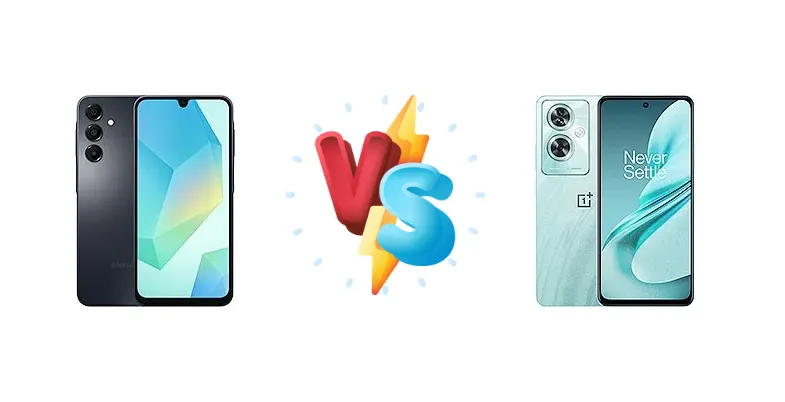
The sub-$200 smartphone market is fiercely competitive. The Samsung Galaxy A16 and OnePlus Nord N30 SE both aim to deliver a solid experience without breaking the bank, but they take different approaches. The A16 prioritizes endurance, while the N30 SE focuses on faster charging and a slightly newer chipset. This comparison will dissect their key differences to help you choose the right device.
🏆 Quick Verdict
For the average user prioritizing longevity, the Samsung Galaxy A16 emerges as the winner. Its exceptional 45:10h battery endurance and 1200 charge cycles significantly outweigh the Nord N30 SE’s faster charging, especially considering both phones share a similar CPU architecture.
| Network |
|---|
| 2G bands | GSM 850 / 900 / 1800 / 1900 | GSM 850 / 900 / 1800 / 1900 |
| 3G bands | HSDPA 850 / 900 / 2100 | HSDPA 850 / 900 / 1700(AWS) / 1900 / 2100 |
| 4G bands | 1, 3, 5, 7, 8, 20, 28, 38, 40, 41 | 1, 2, 3, 4, 5, 7, 8, 12, 13, 17, 18, 19, 20, 26, 28, 38, 39, 40, 41, 66 |
| 5G bands | - | 1, 3, 5, 7, 8, 20, 28, 38, 40, 41, 66, 77, 78 SA/NSA |
| Speed | HSPA, LTE | HSPA, LTE, 5G |
| Technology | GSM / HSPA / LTE | GSM / HSPA / LTE / 5G |
| Launch |
|---|
| Announced | 2024, October 15 | 2024, January 29 |
| Status | Available. Released 2024, November 20 | Available. Released 2024, January 31 |
| Body |
|---|
| Build | Glass front, plastic back, plastic frame | Glass front, plastic frame, plastic back |
| Dimensions | 164.4 x 77.9 x 7.9 mm (6.47 x 3.07 x 0.31 in) | 165.6 x 76 x 8 mm (6.52 x 2.99 x 0.31 in) |
| SIM | · Nano-SIM· Nano-SIM + Nano-SIM | Nano-SIM + Nano-SIM |
| Weight | 200 g (7.05 oz) | 193 g (6.81 oz) |
| Display |
|---|
| Protection | Mohs level 5 | - |
| Resolution | 1080 x 2340 pixels, 19.5:9 ratio (~385 ppi density) | 1080 x 2400 pixels, 20:9 ratio (~392 ppi density) |
| Size | 6.7 inches, 110.2 cm2 (~86.0% screen-to-body ratio) | 6.72 inches, 109.0 cm2 (~86.6% screen-to-body ratio) |
| Type | Super AMOLED, 90Hz | IPS LCD |
| Platform |
|---|
| CPU | Octa-core (2x2.2 GHz Cortex-A76 & 6x2.0 GHz Cortex-A55) | Octa-core (2x2.2 GHz Cortex-A76 & 6x2.0 GHz Cortex-A55) |
| Chipset | Mediatek Helio G99 (6 nm) | Mediatek Dimensity 6020 (7 nm) |
| GPU | Mali-G57 MC2 | Mali-G57 MC2 |
| OS | Android 14, up to 6 major Android upgrades, One UI 7 | Android 13, OxygenOS 13.1 |
| Memory |
|---|
| Card slot | microSDXC (uses shared SIM slot) | No |
| Internal | 128GB 4GB RAM, 128GB 6GB RAM, 128GB 8GB RAM, 256GB 4GB RAM, 256GB 6GB RAM, 256GB 8GB RAM | 128GB 4GB RAM |
| Main Camera |
|---|
| Dual | - | 50 MP, f/1.8, (wide), 1/2.76", 0.64µm, PDAF
Auxiliary lens |
| Features | LED flash, panorama, HDR | LED flash, HDR, panorama |
| Triple | 50 MP, f/1.8, (wide), 1/2.76", 0.64µm, AF
5 MP, f/2.2, (ultrawide), 1/5.0", 1.12µm
2 MP (macro) | - |
| Video | 1080p@30fps | 1080p@30fps |
| Selfie camera |
|---|
| Single | 13 MP, f/2.0, (wide), 1/3.1", 1.12µm | 8 MP, f/2.0, (wide), 1/4.0", 1.12µm |
| Video | 1080p@30fps | 1080p@30fps |
| Sound |
|---|
| 35mm jack | No | Yes |
| Loudspeaker | Yes | Yes, with stereo speakers |
| Comms |
|---|
| Bluetooth | 5.3, A2DP, LE | 5.3, A2DP, LE |
| NFC | Yes (market/region dependent) | Yes |
| Positioning | GPS, GALILEO, GLONASS, BDS, QZSS | GPS, GALILEO, GLONASS, BDS |
| Radio | FM radio (market/region dependent) | No |
| USB | USB Type-C 2.0 | USB Type-C 2.0, OTG |
| WLAN | Wi-Fi 802.11 a/b/g/n/ac, dual-band, Wi-Fi Direct | Wi-Fi 802.11 a/b/g/n/ac, dual-band |
| Features |
|---|
| Sensors | Fingerprint (side-mounted), accelerometer, compass | Fingerprint (side-mounted), accelerometer, gyro, proximity, compass |
| Battery |
|---|
| Charging | 25W wired | 33W wired, 51% in 30 min |
| Type | 5000 mAh | 5000 mAh |
| Misc |
|---|
| Colors | Gray, water green, midnight blue | Black Satin, Cyan |
| Models | SM-A165F, SM-A165F/DS, SM-A165M, SM-A165M/DS, SM-A165F/DSB | CPH2605 |
| Price | € 117.89 / $ 122.00 / £ 97.99 | About 510 EUR |
| SAR EU | 0.31 W/kg (head) 1.08 W/kg (body) | - |
| EU LABEL |
|---|
| Battery | 45:10h endurance, 1200 cycles | - |
| Energy | Class B | - |
| Free fall | Class B (180 falls) | - |
| Repairability | Class C | - |
Samsung Galaxy A16
- Exceptional battery endurance (45:10h)
- High battery cycle count (1200)
- Respectable peak brightness (808 nits)
- Slower charging speed (25W)
- Limited camera information
OnePlus Nord N30 SE
- Faster charging (33W, 51% in 30 min)
- Potentially more efficient chipset (Dimensity 6020, 7nm)
- Slightly newer chipset
- Battery endurance data unavailable
- Limited camera information
Display Comparison
Both phones feature similar CPU cores, but the display experience differs. The Samsung Galaxy A16 boasts a measured peak brightness of 808 nits, which is respectable for outdoor visibility. While panel technology isn't specified, the brightness suggests an LCD panel. The Nord N30 SE’s display specs are currently unavailable, making a direct comparison difficult. However, given the price point, it’s likely to be a similar LCD panel. Without refresh rate or resolution data, the A16’s brightness is the only quantifiable advantage at this time.
Camera Comparison
Camera details are sparse for both devices. Without sensor size, aperture, or image processing information, a meaningful comparison is impossible. It’s safe to assume both phones will feature a multi-camera setup with a primary sensor and supporting lenses, likely including a 2MP macro lens on both, which offers limited practical benefit. Image quality will heavily rely on software optimization, a factor we cannot assess with the available data.
Performance
Both the Samsung Galaxy A16 and OnePlus Nord N30 SE utilize an octa-core CPU configuration with 2x2.2 GHz Cortex-A76 and 6x2.0 GHz Cortex-A55 cores. However, the chipset differs: the A16 uses the Mediatek Helio G99 (6nm), while the N30 SE employs the Dimensity 6020 (7nm). The 7nm process of the Dimensity 6020 *should* offer slightly better power efficiency and potentially lower thermal throttling under sustained loads, but the core architecture is identical. Real-world performance differences will likely be minimal for everyday tasks, but the N30 SE might exhibit a slight edge in demanding gaming scenarios.
Battery Life
Battery life is where the Samsung Galaxy A16 truly shines. Its 45:10h endurance and 1200 charge cycles are exceptional for this price range, indicating a focus on long-term battery health. The OnePlus Nord N30 SE, while offering 33W wired charging (51% in 30 minutes), doesn’t disclose its battery capacity or endurance. The faster charging is convenient, but the A16’s significantly longer endurance and higher cycle count suggest it will retain its capacity for a longer period. The A16’s 25W charging is slower, but the overall battery experience is superior.
Buying Guide
Buy the Samsung Galaxy A16 if you need a phone that will reliably last through a full day – and many more – on a single charge, and if you value long-term battery health. Buy the OnePlus Nord N30 SE if you prioritize quicker top-ups and appreciate the convenience of 33W charging, even if it means slightly less overall battery life and fewer charge cycles.
Frequently Asked Questions
❓ Will the Mediatek Helio G99 in the Galaxy A16 struggle with demanding games like PUBG?
While not a flagship chipset, the Helio G99 is capable of running PUBG at medium settings. The CPU cores are identical to the N30 SE, but the G99's GPU is less powerful. Expect playable frame rates, but don't anticipate ultra settings or consistently high frame rates. Thermal management will be key, and prolonged gaming may lead to some throttling.
❓ How does the 33W charging on the Nord N30 SE compare to the 25W charging on the Galaxy A16 in real-world use?
The Nord N30 SE’s 33W charging will get you from 0-51% in 30 minutes, offering a quicker top-up. However, the Galaxy A16’s superior battery endurance means you’ll likely need to charge it less frequently. The convenience of faster charging is offset by the A16’s longer overall usability between charges.
❓ Is the difference between the 6nm and 7nm process nodes significant in everyday use?
The 7nm Dimensity 6020 *should* be slightly more power-efficient than the 6nm Helio G99, potentially leading to marginally better battery life during less intensive tasks. However, the difference is unlikely to be dramatic in real-world use, and the A16’s larger battery capacity and optimized endurance will likely be more noticeable.