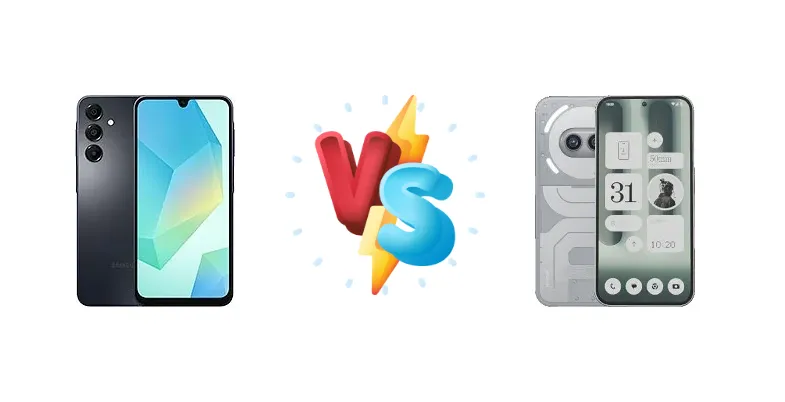
The Samsung Galaxy A16 and the Nothing Phone (2a) Plus represent distinct approaches to the mid-range smartphone market. The A16 focuses on providing essential features at an accessible price, while the Nothing Phone (2a) Plus aims to deliver a more refined experience with a focus on performance and design. This comparison will dissect their key specifications to determine which device best suits your needs.
🏆 Quick Verdict
For the average user prioritizing performance and faster charging, the Nothing Phone (2a) Plus is the clear winner. Its Dimensity 7350 Pro chipset and 50W charging significantly outperform the Galaxy A16’s Helio G99 and 25W charging, despite the A16’s slightly better battery endurance score.
| Network |
|---|
| 2G bands | GSM 850 / 900 / 1800 / 1900 | GSM 850 / 900 / 1800 / 1900 |
| 3G bands | HSDPA 850 / 900 / 2100 | HSDPA 800 / 850 / 900 / 1700(AWS) / 1900 / 2100 |
| 4G bands | 1, 3, 5, 7, 8, 20, 28, 38, 40, 41 | 1, 3, 4, 5, 7, 8, 18, 19, 20, 26, 28, 38, 39, 40, 41, 42, 66 |
| 5G bands | - | 1, 3, 5, 7, 8, 20, 28, 38, 40, 41, 66, 77, 78 SA/NSA |
| Speed | HSPA, LTE | HSPA, LTE, 5G |
| Technology | GSM / HSPA / LTE | GSM / HSPA / LTE / 5G |
| Launch |
|---|
| Announced | 2024, October 15 | 2024, July 31 |
| Status | Available. Released 2024, November 20 | Available. Released 2024, August 03 |
| Body |
|---|
| Build | Glass front, plastic back, plastic frame | Glass front (Gorilla Glass 5), plastic frame, plastic back |
| Dimensions | 164.4 x 77.9 x 7.9 mm (6.47 x 3.07 x 0.31 in) | 161.7 x 76.3 x 8.5 mm (6.37 x 3.00 x 0.33 in) |
| SIM | · Nano-SIM· Nano-SIM + Nano-SIM | Nano-SIM + Nano-SIM |
| Weight | 200 g (7.05 oz) | 190 g (6.70 oz) |
| Display |
|---|
| Protection | Mohs level 5 | Corning Gorilla Glass 5 |
| Resolution | 1080 x 2340 pixels, 19.5:9 ratio (~385 ppi density) | 1080 x 2412 pixels, 20:9 ratio (~395 ppi density) |
| Size | 6.7 inches, 110.2 cm2 (~86.0% screen-to-body ratio) | 6.7 inches, 107.5 cm2 (~87.1% screen-to-body ratio) |
| Type | Super AMOLED, 90Hz | AMOLED, 1B colors, 120Hz, 2160Hz PWM, HDR10+, 700 nits (typ), 1100 nits (HBM), 1300 nits (peak) |
| Platform |
|---|
| CPU | Octa-core (2x2.2 GHz Cortex-A76 & 6x2.0 GHz Cortex-A55) | Octa-core (2x3.0 GHz Cortex-A715 & 6x 2.0 GHz Cortex-A510) |
| Chipset | Mediatek Helio G99 (6 nm) | Mediatek Dimensity 7350 Pro (4 nm) |
| GPU | Mali-G57 MC2 | Mali-G610 MC4 |
| OS | Android 14, up to 6 major Android upgrades, One UI 7 | Android 14, up to 3 major Android upgrades, Nothing OS 3.0 |
| Memory |
|---|
| Card slot | microSDXC (uses shared SIM slot) | No |
| Internal | 128GB 4GB RAM, 128GB 6GB RAM, 128GB 8GB RAM, 256GB 4GB RAM, 256GB 6GB RAM, 256GB 8GB RAM | 256GB 8GB RAM, 256GB 12GB RAM |
| Main Camera |
|---|
| Dual | - | 50 MP, f/1.9, 24mm (wide), 1/1.57", 1.0µm, PDAF, OIS
50 MP, f/2.2, 114˚ (ultrawide), 1/2.76", 0.64µm |
| Features | LED flash, panorama, HDR | LED flash, panorama, HDR |
| Triple | 50 MP, f/1.8, (wide), 1/2.76", 0.64µm, AF
5 MP, f/2.2, (ultrawide), 1/5.0", 1.12µm
2 MP (macro) | - |
| Video | 1080p@30fps | 4K@30fps, 1080p@60/120fps, gyro-EIS |
| Selfie camera |
|---|
| Features | - | HDR |
| Single | 13 MP, f/2.0, (wide), 1/3.1", 1.12µm | 50 MP, f/2.2, (wide), 1/2.76" |
| Video | 1080p@30fps | 4K@30fps |
| Sound |
|---|
| 35mm jack | No | No |
| Loudspeaker | Yes | Yes, with stereo speakers |
| Comms |
|---|
| Bluetooth | 5.3, A2DP, LE | 5.3, A2DP, LE |
| NFC | Yes (market/region dependent) | Yes, 360˚ |
| Positioning | GPS, GALILEO, GLONASS, BDS, QZSS | GPS, GALILEO, GLONASS, BDS, QZSS |
| Radio | FM radio (market/region dependent) | No |
| USB | USB Type-C 2.0 | USB Type-C 2.0, OTG |
| WLAN | Wi-Fi 802.11 a/b/g/n/ac, dual-band, Wi-Fi Direct | Wi-Fi 802.11 a/b/g/n/ac/6, dual-band, Wi-Fi Direct |
| Features |
|---|
| Sensors | Fingerprint (side-mounted), accelerometer, compass | Fingerprint (under display, optical), accelerometer, gyro, proximity, compass |
| Battery |
|---|
| Charging | 25W wired | 50W wired, 50% in 21 min, 100% in 56 min |
| Type | 5000 mAh | 5000 mAh |
| Misc |
|---|
| Colors | Gray, water green, midnight blue | Black, Grey |
| Models | SM-A165F, SM-A165F/DS, SM-A165M, SM-A165M/DS, SM-A165F/DSB | A142P |
| Price | € 117.89 / $ 122.00 / £ 97.99 | € 269.90 / ₹ 22,599 |
| SAR EU | 0.31 W/kg (head) 1.08 W/kg (body) | - |
| EU LABEL |
|---|
| Battery | 45:10h endurance, 1200 cycles | - |
| Energy | Class B | - |
| Free fall | Class B (180 falls) | - |
| Repairability | Class C | - |
Samsung Galaxy A16
- Longer battery endurance rating
- More affordable price point
- High number of charge cycles (1200)
- Significantly slower processor
- Slower charging speed
- Lower display brightness
Nothing Phone (2a) Plus
- Faster and more efficient processor
- Significantly faster charging
- Brighter and more vibrant display
- Slightly lower battery endurance score
- Higher price point
- Potentially less charge cycle longevity
Display Comparison
The Nothing Phone (2a) Plus boasts a significantly brighter display, reaching 1097 nits compared to the Galaxy A16’s 808 nits. This translates to superior visibility outdoors under direct sunlight. While both displays likely utilize LCD technology (given the price points), the higher brightness of the Nothing Phone (2a) Plus provides a more vibrant and usable viewing experience. The A16’s lower peak brightness may require users to increase brightness levels, potentially impacting battery life. We lack PWM frequency data, but both are likely to be adequate for most users.
Camera Comparison
Without detailed camera specs beyond the main sensors, a direct comparison is difficult. However, the Nothing Phone (2a) Plus’s processor advantage likely extends to image processing, potentially resulting in better dynamic range and noise reduction. The A16 will likely rely more heavily on software processing to compensate for its less powerful chipset. The absence of OIS information for either device suggests both will rely on software stabilization, but the Nothing Phone (2a) Plus’s superior processing power could yield better results. We can assume both phones will include standard features like HDR and portrait modes.
Performance
The core difference between these two phones lies in their chipsets. The Nothing Phone (2a) Plus is powered by the Mediatek Dimensity 7350 Pro, a 4nm processor with Cortex-A715 cores clocked at 3.0 GHz. This is a substantial upgrade over the Galaxy A16’s Mediatek Helio G99 (6nm) featuring Cortex-A76 cores at 2.2 GHz. The Dimensity 7350 Pro’s newer architecture and smaller node size result in significantly improved CPU and GPU performance, making the Nothing Phone (2a) Plus better suited for gaming, multitasking, and demanding applications. The A16 will handle everyday tasks, but will struggle with more intensive workloads.
Battery Life
The Galaxy A16 claims a 45:10h endurance rating and 1200 charge cycles, while the Nothing Phone (2a) Plus achieves a 16:34h active use score. While the endurance score is a broader metric, the active use score provides a more realistic indication of daily performance. The Nothing Phone (2a) Plus’s faster 50W charging (50% in 21 minutes, 100% in 56 minutes) is a significant advantage over the A16’s 25W charging. This means less downtime and quicker top-ups. The A16’s longer endurance suggests it may last slightly longer on a single charge with minimal use, but the Nothing Phone (2a) Plus’s faster charging mitigates this difference for most users.
Buying Guide
Buy the Samsung Galaxy A16 if you prioritize maximum battery life and a lower upfront cost, and your usage primarily involves basic tasks like calling, texting, and light social media. Buy the Nothing Phone (2a) Plus if you value a smoother, more responsive user experience, faster charging, and are willing to spend a bit more for a more capable processor suited for gaming and demanding applications.
Frequently Asked Questions
❓ Does the Mediatek Helio G99 in the Galaxy A16 struggle with graphically intensive games like Genshin Impact?
Yes, the Helio G99 is a capable processor for everyday tasks, but it will likely struggle to maintain stable frame rates in demanding games like Genshin Impact, even on lower settings. Expect noticeable frame drops and potential overheating during extended gaming sessions.
❓ How does the 50W charging on the Nothing Phone (2a) Plus compare to other phones with similar wattage?
While 50W isn't the fastest charging available, the Nothing Phone (2a) Plus’s implementation is efficient. Reaching 50% charge in 21 minutes and 100% in 56 minutes is competitive and significantly faster than the Galaxy A16’s 25W charging. The efficiency is also aided by the Dimensity 7350 Pro’s power management capabilities.
❓ Is the difference in battery endurance between the A16 and the Nothing Phone (2a) Plus noticeable in real-world usage?
The difference is noticeable, but not drastic. The A16’s higher endurance score translates to slightly longer standby time and potentially a few extra hours of light use. However, the Nothing Phone (2a) Plus’s faster charging means you’ll spend less time tethered to a wall, effectively mitigating the endurance difference for most users.