
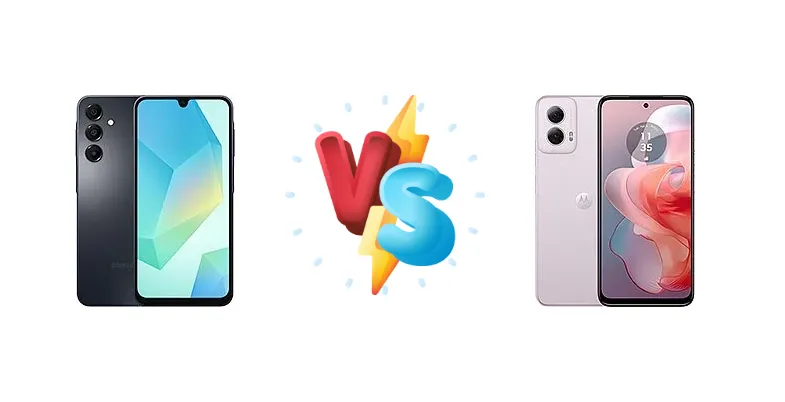
Moto G Power (2024) vs Samsung Galaxy A16: A Deep Dive into Budget Smartphone Choices
| Phones Images | |||||
|---|---|---|---|---|---|
|
🏆 Quick Verdict
For the average user, the Motorola Moto G Power (2024) is the stronger choice. Its Mediatek Dimensity 7020 chipset provides a noticeable performance uplift over the Galaxy A16’s Helio G99, translating to smoother multitasking and a more responsive user experience. While the A16 boasts impressive battery endurance, the G Power’s faster charging and wireless charging capabilities offer added convenience.
| PHONES | ||
|---|---|---|
| Phone Names | Samsung Galaxy A16 | Motorola Moto G Power (2024) |
| Network | ||
|---|---|---|
| 2G bands | GSM 850 / 900 / 1800 / 1900 | GSM 850 / 900 / 1800 / 1900 |
| 3G bands | HSDPA 850 / 900 / 2100 | HSDPA 850 / 900 / 1700(AWS) / 1900 / 2100 |
| 4G bands | 1, 3, 5, 7, 8, 20, 28, 38, 40, 41 | 1, 2, 3, 4, 5, 7, 8, 12, 13, 14, 17, 18, 20, 25, 26, 28, 29, 30, 38, 39, 40, 41, 48, 66, 71 |
| 5G bands | - | 2, 5, 7, 12, 14, 25, 26, 29, 30, 41, 48, 66, 70, 71, 77, 78 SA/NSA |
| Speed | HSPA, LTE | HSPA, LTE, 5G |
| Technology | GSM / HSPA / LTE | GSM / HSPA / LTE / 5G |
| Launch | ||
|---|---|---|
| Announced | 2024, October 15 | 2024, March 12 |
| Status | Available. Released 2024, November 20 | Available. Released 2024, March 22 |
| Body | ||
|---|---|---|
| Build | Glass front, plastic back, plastic frame | Glass front, silicone polymer back (eco leather), plastic frame |
| Dimensions | 164.4 x 77.9 x 7.9 mm (6.47 x 3.07 x 0.31 in) | 167.2 x 76.4 x 8.5 mm (6.58 x 3.01 x 0.33 in) |
| SIM | · Nano-SIM· Nano-SIM + Nano-SIM | Nano-SIM + eSIM |
| Weight | 200 g (7.05 oz) | 201 g (7.09 oz) |
| Display | ||
|---|---|---|
| Protection | Mohs level 5 | - |
| Resolution | 1080 x 2340 pixels, 19.5:9 ratio (~385 ppi density) | 1080 x 2400 pixels, 20:9 ratio (~393 ppi density) |
| Size | 6.7 inches, 110.2 cm2 (~86.0% screen-to-body ratio) | 6.7 inches, 108.4 cm2 (~84.8% screen-to-body ratio) |
| Type | Super AMOLED, 90Hz | IPS LCD, 120Hz |
| Platform | ||
|---|---|---|
| CPU | Octa-core (2x2.2 GHz Cortex-A76 & 6x2.0 GHz Cortex-A55) | Octa-core (2x2.2 GHz Cortex-A78 & 6x2.0 GHz Cortex-A55) |
| Chipset | Mediatek Helio G99 (6 nm) | Mediatek Dimensity 7020 (6 nm) |
| GPU | Mali-G57 MC2 | IMG BXM-8-256 |
| OS | Android 14, up to 6 major Android upgrades, One UI 7 | Android 14 |
| Memory | ||
|---|---|---|
| Card slot | microSDXC (uses shared SIM slot) | microSDXC (dedicated slot) |
| Internal | 128GB 4GB RAM, 128GB 6GB RAM, 128GB 8GB RAM, 256GB 4GB RAM, 256GB 6GB RAM, 256GB 8GB RAM | 128GB 8GB RAM |
| Main Camera | ||
|---|---|---|
| Dual | - | 50 MP, f/1.8, (wide), 0.64µm, PDAF, OIS 8 MP, f/2.2, 118˚ (ultrawide), 1.12µm, AF |
| Features | LED flash, panorama, HDR | LED flash, HDR, panorama |
| Triple | 50 MP, f/1.8, (wide), 1/2.76", 0.64µm, AF 5 MP, f/2.2, (ultrawide), 1/5.0", 1.12µm 2 MP (macro) | - |
| Video | 1080p@30fps | 1080p@30fps, gyro-EIS |
| Selfie camera | ||
|---|---|---|
| Features | - | HDR |
| Single | 13 MP, f/2.0, (wide), 1/3.1", 1.12µm | 16 MP, f/2.4, (wide), 1.0µm |
| Video | 1080p@30fps | 1080p@30fps |
| Sound | ||
|---|---|---|
| 35mm jack | No | Yes |
| Loudspeaker | Yes | Yes, with stereo speakers |
| Comms | ||
|---|---|---|
| Bluetooth | 5.3, A2DP, LE | 5.3, A2DP, LE |
| NFC | Yes (market/region dependent) | Yes |
| Positioning | GPS, GALILEO, GLONASS, BDS, QZSS | GPS, GLONASS, GALILEO |
| Radio | FM radio (market/region dependent) | No |
| USB | USB Type-C 2.0 | USB Type-C 2.0 |
| WLAN | Wi-Fi 802.11 a/b/g/n/ac, dual-band, Wi-Fi Direct | Wi-Fi 802.11 a/b/g/n/ac, dual-band |
| Features | ||
|---|---|---|
| Sensors | Fingerprint (side-mounted), accelerometer, compass | Fingerprint (side-mounted), accelerometer, gyro, proximity, compass, barometer |
| Battery | ||
|---|---|---|
| Charging | 25W wired | 30W wired 15W wireless |
| Type | 5000 mAh | 5000 mAh |
| Misc | ||
|---|---|---|
| Colors | Gray, water green, midnight blue | Midnight Blue, Pale Lilac |
| Models | SM-A165F, SM-A165F/DS, SM-A165M, SM-A165M/DS, SM-A165F/DSB | XT2415-3, XT2415V |
| Price | € 117.89 / $ 122.00 / £ 97.99 | $ 75.00 / C$ 209.97 / £ 149.00 |
| SAR EU | 0.31 W/kg (head) 1.08 W/kg (body) | - |
| EU LABEL | ||
|---|---|---|
| Battery | 45:10h endurance, 1200 cycles | - |
| Energy | Class B | - |
| Free fall | Class B (180 falls) | - |
| Repairability | Class C | - |
Samsung Galaxy A16
- Exceptional battery life (45:10h endurance)
- High peak display brightness (808 nits)
- Long-term battery health (1200 cycles)
- Less powerful processor (Helio G99)
- Slower charging speeds (25W wired only)
Motorola Moto G Power (2024)
- More powerful processor (Dimensity 7020)
- Faster wired and wireless charging (30W/15W)
- Potentially better image processing
- Battery life likely shorter than A16
- Battery cycle life not specified
Display Comparison
The Samsung Galaxy A16 features a display capable of reaching 808 nits of peak brightness, ensuring good visibility even outdoors. While the Moto G Power’s brightness isn’t specified, it’s likely comparable. Both devices likely utilize LCD panels given their price point, and neither is expected to offer high refresh rates. The A16’s brightness advantage will be most noticeable in direct sunlight, making it preferable for outdoor users. However, without knowing the G Power’s panel characteristics, a definitive judgment is difficult.
Camera Comparison
Without detailed camera specifications beyond the main sensors, a direct comparison is limited. Both phones likely feature multi-camera systems with a primary sensor and supporting lenses (often including a 2MP macro). The image processing algorithms will heavily influence the final image quality. Given Motorola’s recent improvements in computational photography, the G Power likely offers more refined image processing, potentially resulting in better dynamic range and low-light performance. The absence of OIS on either device suggests reliance on software stabilization.
Performance
The core difference lies in the chipsets. The Motorola Moto G Power (2024) utilizes the Mediatek Dimensity 7020, built on a 6nm process, featuring a CPU with 2x2.2 GHz Cortex-A78 cores and 6x2.0 GHz Cortex-A55 cores. This represents a significant upgrade over the Samsung Galaxy A16’s Mediatek Helio G99 (also 6nm) with its 2x2.2 GHz Cortex-A76 and 6x2.0 GHz Cortex-A55 configuration. The Cortex-A78 cores in the Dimensity 7020 offer superior single-core performance, resulting in snappier app launches and smoother multitasking. While both use the same Cortex-A55 efficiency cores, the A78s provide a clear advantage for demanding tasks. The G Power will handle more complex applications and games with greater ease.
Battery Life
The Samsung Galaxy A16 boasts impressive battery endurance, achieving 45 hours and 10 minutes of total usage and 14 hours and 43 minutes of active use. The Moto G Power’s battery capacity isn’t specified, but its charging capabilities are a key differentiator. The G Power supports 30W wired charging and 15W wireless charging, offering significantly more flexibility than the A16’s 25W wired charging. While the A16’s battery life is excellent, the G Power’s faster charging speeds minimize downtime, and the addition of wireless charging is a convenient feature for many users. The A16’s reported 1200 charge cycles suggest a focus on long-term battery health.
Buying Guide
Buy the Samsung Galaxy A16 if you absolutely prioritize maximizing battery life and need a phone that will reliably last through two full days of moderate use. Buy the Motorola Moto G Power (2024) if you value a more responsive and capable processor for everyday tasks, streaming, and light gaming, and appreciate the convenience of faster wired and wireless charging.