
Google Pixel 7a vs Samsung Galaxy A16: A Detailed Comparison
| Phones Images | |||||
|---|---|---|---|---|---|
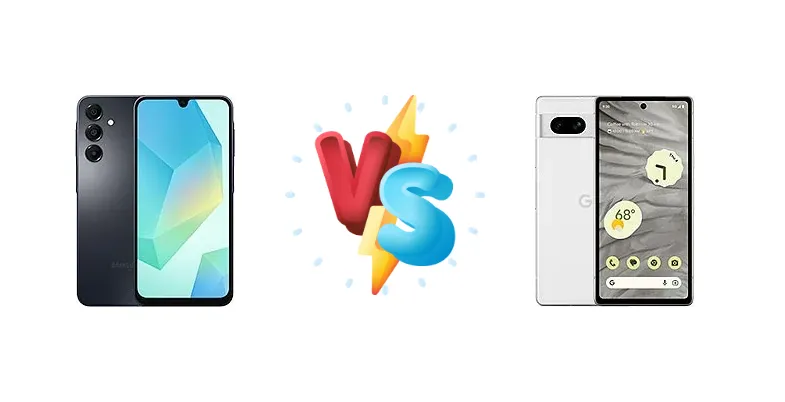
|
🏆 Quick Verdict
For the average user prioritizing camera quality and a smooth software experience, the Google Pixel 7a is the superior choice. However, the Samsung Galaxy A16 excels in battery life, offering a remarkable 45 hours and 10 minutes of endurance, making it ideal for users who demand all-day (and then some) power.
| PHONES | ||
|---|---|---|
| Phone Names | Samsung Galaxy A16 | Google Pixel 7a |
| Network | ||
|---|---|---|
| 2G bands | GSM 850 / 900 / 1800 / 1900 | GSM 850 / 900 / 1800 / 1900 |
| 3G bands | HSDPA 850 / 900 / 2100 | HSDPA 800 / 850 / 900 / 1700(AWS) / 1900 / 2100 |
| 4G bands | 1, 3, 5, 7, 8, 20, 28, 38, 40, 41 | 1, 2, 3, 4, 5, 7, 8, 12, 13, 14, 17, 20, 25, 26, 28, 29, 30, 38, 40, 41, 48, 66, 71 - GWKK3, G0DZQ |
| 5G bands | - | 1, 2, 3, 5, 7, 8, 12, 14, 20, 25, 28, 30, 38, 41, 48, 66, 71, 77, 78 SA/NSA/Sub6 - GWKK3 |
| Speed | HSPA, LTE | HSPA, LTE, 5G |
| Technology | GSM / HSPA / LTE | GSM / HSPA / LTE / 5G |
| - | 1, 2, 3, 5, 7, 8, 12, 20, 25, 28, 38, 40, 41, 66, 75, 76, 77, 78, 79 SA/NSA/Sub6 - GHL1X, G82U8 | |
| Launch | ||
|---|---|---|
| Announced | 2024, October 15 | 2023, May 10 |
| Status | Available. Released 2024, November 20 | Available. Released 2023, May 10 |
| Body | ||
|---|---|---|
| Build | Glass front, plastic back, plastic frame | Glass front (Gorilla Glass 3), aluminum frame, plastic back |
| Dimensions | 164.4 x 77.9 x 7.9 mm (6.47 x 3.07 x 0.31 in) | 152 x 72.9 x 9 mm (5.98 x 2.87 x 0.35 in) |
| SIM | · Nano-SIM· Nano-SIM + Nano-SIM | Nano-SIM + eSIM |
| Weight | 200 g (7.05 oz) | 193.5 g (6.84 oz) |
| - | IP67 dust/water resistant (up to 1m for 30 min) | |
| Display | ||
|---|---|---|
| Protection | Mohs level 5 | Corning Gorilla Glass 3 |
| Resolution | 1080 x 2340 pixels, 19.5:9 ratio (~385 ppi density) | 1080 x 2400 pixels, 20:9 ratio (~429 ppi density) |
| Size | 6.7 inches, 110.2 cm2 (~86.0% screen-to-body ratio) | 6.1 inches, 90.7 cm2 (~81.8% screen-to-body ratio) |
| Type | Super AMOLED, 90Hz | OLED, HDR, 90Hz |
| - | Always-on display | |
| Platform | ||
|---|---|---|
| CPU | Octa-core (2x2.2 GHz Cortex-A76 & 6x2.0 GHz Cortex-A55) | Octa-core (2x2.85 GHz Cortex-X1 & 2x2.35 GHz Cortex-A78 & 4x1.80 GHz Cortex-A55) |
| Chipset | Mediatek Helio G99 (6 nm) | Google Tensor G2 (5 nm) |
| GPU | Mali-G57 MC2 | Mali-G710 MP7 |
| OS | Android 14, up to 6 major Android upgrades, One UI 7 | Android 13, upgradable to Android 15, up to 5 major Android upgrades |
| Memory | ||
|---|---|---|
| Card slot | microSDXC (uses shared SIM slot) | No |
| Internal | 128GB 4GB RAM, 128GB 6GB RAM, 128GB 8GB RAM, 256GB 4GB RAM, 256GB 6GB RAM, 256GB 8GB RAM | 128GB 8GB RAM |
| - | UFS 3.1 | |
| Main Camera | ||
|---|---|---|
| Dual | - | 64 MP, f/1.9, 26mm (wide), 1/1.73", 0.8µm, dual pixel PDAF, OIS 13 MP, f/2.2, 120˚ (ultrawide), 1.12µm |
| Features | LED flash, panorama, HDR | Dual-LED flash, Pixel Shift, Auto-HDR, panorama |
| Triple | 50 MP, f/1.8, (wide), 1/2.76", 0.64µm, AF 5 MP, f/2.2, (ultrawide), 1/5.0", 1.12µm 2 MP (macro) | - |
| Video | 1080p@30fps | 4K@30/60fps, 1080p@30/60/120/240fps, OIS |
| Selfie camera | ||
|---|---|---|
| Features | - | HDR, panorama |
| Single | 13 MP, f/2.0, (wide), 1/3.1", 1.12µm | 13 MP, f/2.2, 20mm (ultrawide), 1.12µm |
| Video | 1080p@30fps | 4K@30fps, 1080p@30fps |
| Sound | ||
|---|---|---|
| 3.5mm jack | - | No |
| 35mm jack | No | No |
| Loudspeaker | Yes | Yes, with stereo speakers |
| Comms | ||
|---|---|---|
| Bluetooth | 5.3, A2DP, LE | 5.3, A2DP, LE |
| NFC | Yes (market/region dependent) | Yes |
| Positioning | GPS, GALILEO, GLONASS, BDS, QZSS | GPS, GLONASS, GALILEO, BDS, QZSS, NavIC |
| Radio | FM radio (market/region dependent) | No |
| USB | USB Type-C 2.0 | USB Type-C 3.2 |
| WLAN | Wi-Fi 802.11 a/b/g/n/ac, dual-band, Wi-Fi Direct | Wi-Fi 802.11 a/b/g/n/ac/6e, tri-band |
| Features | ||
|---|---|---|
| Sensors | Fingerprint (side-mounted), accelerometer, compass | Fingerprint (under display, optical), accelerometer, gyro, proximity, compass, barometer |
| Battery | ||
|---|---|---|
| Charging | 25W wired | 18W wired, PD3.0 7.5W wireless |
| Type | 5000 mAh | Li-Po 4385 mAh |
| Misc | ||
|---|---|---|
| Colors | Gray, water green, midnight blue | Charcoal, Snow, Sea, Coral |
| Models | SM-A165F, SM-A165F/DS, SM-A165M, SM-A165M/DS, SM-A165F/DSB | GWKK3, GHL1X, G0DZQ, G82U8 |
| Price | € 117.89 / $ 122.00 / £ 97.99 | € 179.90 / $ 150.00 / £ 170.00 / ₹ 25,980 |
| SAR EU | 0.31 W/kg (head) 1.08 W/kg (body) | - |
| EU LABEL | ||
|---|---|---|
| Battery | 45:10h endurance, 1200 cycles | - |
| Energy | Class B | - |
| Free fall | Class B (180 falls) | - |
| Repairability | Class C | - |
Samsung Galaxy A16
- Exceptional battery life and longevity (1200 cycles)
- More affordable price point
- Reliable performance for everyday tasks
- Less powerful processor compared to the Pixel 7a
- Lower display brightness
- Basic camera system
Google Pixel 7a
- Superior camera quality and computational photography
- Faster and more efficient processor (Tensor G2)
- Brighter and potentially more color-accurate display
- Wireless charging and PD3.0 support
- Shorter battery life compared to the Galaxy A16
- Higher price tag
- Potentially more thermal throttling under heavy load
Display Comparison
The Pixel 7a boasts a brighter display at 1070 nits, compared to the Galaxy A16’s 808 nits, resulting in better visibility outdoors. While both utilize OLED technology, the Pixel 7a’s higher peak brightness and potentially superior color calibration (though not specified in the data) offer a more vibrant viewing experience. The A16’s lower brightness is still respectable for indoor use, but the difference is noticeable in direct sunlight. Neither specification details refresh rate, but the Pixel 7a is expected to have a 90Hz panel, offering smoother scrolling than the likely 60Hz A16.
Camera Comparison
The Pixel 7a’s camera system is a clear advantage, though specific sensor details are missing. Google’s computational photography prowess, powered by the Tensor G2, delivers exceptional image quality, particularly in low-light conditions. The A16’s camera capabilities are not detailed beyond 'Photo / Video,' suggesting a more basic implementation. While the A16 may suffice for casual snapshots, the Pixel 7a offers a significantly more versatile and capable camera experience, with features like Magic Eraser and Photo Unblur. The absence of OIS information for either device makes it difficult to assess video stabilization performance.
Performance
The Google Pixel 7a’s Tensor G2 (5nm) chipset significantly outperforms the Samsung Galaxy A16’s Mediatek Helio G99 (6nm) in raw processing power. The Tensor G2’s octa-core configuration, featuring 2x2.85 GHz Cortex-X1 cores, is designed for AI tasks and demanding applications. The Helio G99, while efficient, is geared towards everyday use. The 5nm fabrication process of the Tensor G2 also contributes to better thermal efficiency, potentially reducing throttling during sustained workloads. This translates to a smoother experience with multitasking, gaming, and resource-intensive apps on the Pixel 7a.
Battery Life
The Samsung Galaxy A16 dominates in battery endurance with a measured 45 hours and 10 minutes, and a 1200 cycle lifespan. This is substantially longer than the Pixel 7a’s reported 76-hour endurance (likely an older testing methodology). However, the Pixel 7a supports 7.5W wireless charging and PD3.0, offering more versatile charging options, while the A16 is limited to 25W wired charging. The A16’s active use score of 14:43h further emphasizes its battery prowess, suggesting it can handle a full day of heavy usage with ease.
Buying Guide
Buy the Samsung Galaxy A16 if you need exceptional battery life, prioritize affordability, and primarily use your phone for basic tasks like calling, texting, and social media. Buy the Google Pixel 7a if you value a superior camera system, a faster processor for demanding apps, and Google’s intelligent software features, even if it means sacrificing some battery endurance and paying a higher price.