
Samsung Galaxy A16 5G vs A15 5G: Which Budget 5G Phone Reigns Supreme?
| Phones Images | |||||
|---|---|---|---|---|---|
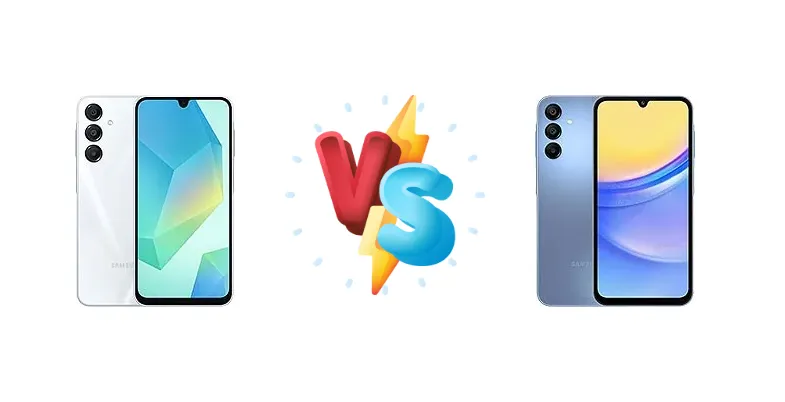
|
🏆 Quick Verdict
For most users, the Samsung Galaxy A15 5G offers a slightly better overall experience. Its superior active use battery endurance (14:31h vs 12:08h) and comparable performance from the Dimensity 6100+ chipset, combined with a potentially lower price point, make it the more practical choice. However, the A16's brighter display and potential for a more powerful chipset variant (Dimensity 6300) offer compelling alternatives.
| PHONES | ||
|---|---|---|
| Phone Names | Samsung Galaxy A16 5G | Samsung Galaxy A15 5G |
| Network | ||
|---|---|---|
| 2G bands | GSM 850 / 900 / 1800 / 1900 | GSM 850 / 900 / 1800 / 1900 |
| 3G bands | HSDPA 850 / 900 / 1700(AWS) / 1900 / 2100 | HSDPA 850 / 900 / 1700(AWS) / 1900 / 2100 |
| 4G bands | 1, 2, 3, 4, 5, 7, 8, 12, 17, 20, 28, 38, 40, 41, 66 - International | 1, 2, 3, 4, 5, 7, 8, 12, 17, 20, 26, 28, 38, 40, 41, 66 |
| 5G bands | 1, 3, 7, 8, 20, 28, 38, 40, 41, 77, 78 SA/NSA/Sub6 - International | 1, 3, 5, 7, 8, 26, 28, 40, 41, 66, 77, 78 SA/NSA/Sub6 |
| Speed | HSPA, LTE, 5G | HSPA, LTE, 5G |
| Technology | GSM / HSPA / LTE / 5G | GSM / HSPA / LTE / 5G |
| Launch | ||
|---|---|---|
| Announced | 2024, October 07 | 2023, December 11 |
| Status | Available. Released 2024, October 25 | Available. Released 2023, December 16 |
| Body | ||
|---|---|---|
| Build | Glass front, plastic back, plastic frame | Glass front, plastic back, plastic frame |
| Dimensions | 164.4 x 77.9 x 7.9 mm (6.47 x 3.07 x 0.31 in) | 160.1 x 76.8 x 8.4 mm (6.30 x 3.02 x 0.33 in) |
| SIM | · Nano-SIM· Nano-SIM + eSIM· Nano-SIM + Nano-SIM | · Nano-SIM· Nano-SIM + Nano-SIM |
| Weight | 200 g (7.05 oz) | 200 g (7.05 oz) |
| Display | ||
|---|---|---|
| Protection | Mohs level 5 | - |
| Resolution | 1080 x 2340 pixels, 19.5:9 ratio (~385 ppi density) | 1080 x 2340 pixels, 19.5:9 ratio (~396 ppi density) |
| Size | 6.7 inches, 110.2 cm2 (~86.0% screen-to-body ratio) | 6.5 inches, 103.7 cm2 (~84.3% screen-to-body ratio) |
| Type | Super AMOLED, 90Hz, 800 nits (HBM) | Super AMOLED, 90Hz, 800 nits (HBM) |
| Platform | ||
|---|---|---|
| CPU | Octa-core (2x2.4 GHz Cortex-A78 & 6x2.0 GHz Cortex-A55) or Octa-core (2x2.4 GHz Cortex-A76 & 6x2.0 GHz Cortex-A55) | Octa-core (2x2.2 GHz Cortex-A76 & 6x2.0 GHz Cortex-A55) |
| Chipset | Exynos 1330 (5 nm) or Mediatek Dimensity 6300 (6 nm) | Mediatek Dimensity 6100+ (6 nm) |
| GPU | Mali-G68 MP2 or Mali-G57 MC2 | Mali-G57 MC2 |
| OS | Android 14, up to 6 major Android upgrades, One UI 6.1 | Android 14, upgradable to Android 16, One UI 8, up to 4 major Android upgrades |
| Memory | ||
|---|---|---|
| Card slot | microSDXC (uses shared SIM slot) | microSDXC (uses shared SIM slot) |
| Internal | 128GB 4GB RAM, 128GB 6GB RAM, 128GB 8GB RAM, 256GB 6GB RAM, 256GB 8GB RAM | 64GB 4GB RAM, 128GB 4GB RAM, 128GB 6GB RAM, 128GB 8GB RAM, 256GB 8GB RAM |
| Main Camera | ||
|---|---|---|
| Features | LED flash, panorama, HDR | LED flash, panorama, HDR |
| Triple | 50 MP, f/1.8, (wide), 1/2.76", 0.64µm, AF 5 MP, f/2.2, (ultrawide), 1/5.0", 1.12µm 2 MP (macro) | 50 MP, f/1.8, (wide), AF 5 MP, f/2.2, (ultrawide) 2 MP (macro) |
| Video | 1080p@30fps, gyro-EIS | 1080p@30fps, gyro-EIS |
| Selfie camera | ||
|---|---|---|
| Single | 13 MP, f/2.0, (wide), 1/3.1", 1.12µm | 13 MP, f/2.0, (wide) |
| Video | 1080p@30fps | 1080p@30fps |
| Sound | ||
|---|---|---|
| 35mm jack | No | Yes |
| Loudspeaker | Yes | Yes |
| Comms | ||
|---|---|---|
| Bluetooth | 5.3, A2DP, LE | 5.3, A2DP, LE |
| NFC | Yes (market/region dependent) | Yes (market/region dependent) |
| Positioning | GPS, GALILEO, GLONASS, BDS, QZSS | GPS, GALILEO, GLONASS, BDS, QZSS |
| Radio | No | No |
| USB | USB Type-C 2.0 | USB Type-C 2.0 |
| WLAN | Wi-Fi 802.11 a/b/g/n/ac, dual-band, Wi-Fi Direct | Wi-Fi 802.11 a/b/g/n/ac, dual-band, Wi-Fi Direct |
| Features | ||
|---|---|---|
| Sensors | Fingerprint (side-mounted), accelerometer, gyro, compass | Fingerprint (side-mounted), accelerometer, gyro, compass |
| Battery | ||
|---|---|---|
| Charging | 25W wired | 25W wired |
| Type | 5000 mAh | 5000 mAh |
| Misc | ||
|---|---|---|
| Colors | Blue Black, Light Gray, Gold, Light Green | Brave Black, Personality Yellow, Magical Blue, Optimistic Blue |
| Models | SM-A166B, SM-A166B/DS, SM-A166P, SM-A166P/DS, SM-A166E, SM-A166E/DS, SM-A166W, SM-A166U, SM-A166U1 | SM-A156B, SM-A156B/DS, SM-A156P, SM-A156P/DS, SM-A156U, SM-A156U1, SM-A156U1/DS, SM-A156W, SM-A156P/N, SM-A156P/DSN, SM-S156VL, SM-A156M, SM-A156E, SM-A156E/DSN |
| Price | $ 115.97 / C$ 199.99 / £ 129.99 / € 136.90 / ₹ 17,150 | € 167.00 / $ 79.97 / ₹ 17,490 |
| SAR EU | 0.38 W/kg (head) 0.94 W/kg (body) | 0.80 W/kg (head) 1.46 W/kg (body) |
| EU LABEL | ||
|---|---|---|
| Battery | 43:30h endurance, 1200 cycles | - |
| Energy | Class B | - |
| Free fall | Class B (180 falls) | - |
| Repairability | Class C | - |
Samsung Galaxy A16 5G
- Brighter display for better outdoor visibility
- Potential for more powerful Dimensity 6300 chipset variant
- Slightly faster CPU clock speeds
- Shorter active use battery life
- Exynos 1330 variant may be less power efficient
- Potential for higher price
Samsung Galaxy A15 5G
- Longer active use battery life
- Efficient Dimensity 6100+ chipset
- Potentially lower price point
- Slightly dimmer display
- Slower CPU clock speeds
- Less potential for high-end chipset variant
Display Comparison
The Galaxy A16 5G boasts a brighter display, reaching 824 nits compared to the A15 5G’s 786 nits. This 38-nit difference translates to improved visibility in direct sunlight, a significant benefit for outdoor users. While both displays likely utilize PLS LCD technology (Samsung’s equivalent to IPS), the A16’s higher peak brightness is the key differentiator. We lack PWM frequency data, but both are likely to be adequate for most users, though those sensitive to flicker should investigate further. Bezels appear similar in size based on available imagery, suggesting a comparable screen-to-body ratio.
Camera Comparison
Both phones are expected to feature similar camera setups, with a primary sensor likely around 50MP. However, detailed sensor size and aperture information are unavailable. The A15 5G and A16 5G both include a 2MP macro camera, which offers limited utility due to its low resolution and fixed focus. Image processing will likely be similar, leaning towards Samsung’s typically vibrant and saturated style. Without detailed camera specs, it’s difficult to declare a clear winner; the primary sensor quality will be the deciding factor.
Performance
The chipset is where the A16 5G presents a more complex picture. Samsung offers two variants: the Exynos 1330 (5nm) and the MediaTek Dimensity 6300 (6nm). The A15 5G is equipped with the MediaTek Dimensity 6100+. The 6nm process node of both the Dimensity 6100+ and the potential Dimensity 6300 in the A16 offers better power efficiency than the 5nm Exynos 1330. However, the Exynos 1330 features Cortex-A78 cores, potentially offering a slight edge in single-core performance compared to the A15’s Cortex-A76 cores. The A15’s CPU configuration (2x2.2 GHz Cortex-A76 & 6x2.0 GHz Cortex-A55) is slightly slower on paper than the A16’s (2x2.4 GHz Cortex-A78 & 6x2.0 GHz Cortex-A55), but real-world performance will depend on software optimization and thermal throttling. Both phones likely utilize LPDDR4X RAM, limiting memory bandwidth.
Battery Life
The Galaxy A15 5G demonstrates a clear advantage in battery endurance, achieving an active use score of 14:31h compared to the A16 5G’s 12:08h. While the A16 5G has a slightly larger battery capacity (implied by the longer endurance rating of 43:30h vs 41:00h for the A15), the more efficient chipset in the A15 5G and potentially more aggressive power management contribute to its superior performance. Both phones support 25W wired charging, meaning 0-100% charge times will be comparable, likely around 1.5-2 hours.
Buying Guide
Buy the Samsung Galaxy A16 5G if you prioritize a brighter display for outdoor visibility and are willing to potentially pay a premium for the possibility of the more efficient Dimensity 6300 chipset. Buy the Samsung Galaxy A15 5G if you value longer battery life during active use and want a proven performer at a potentially lower price point, making it ideal for users who prioritize all-day usability.