
Nothing Phone (2a) Plus vs Samsung Galaxy A16 5G: A Deep Dive Comparison
| Phones Images | |||||
|---|---|---|---|---|---|
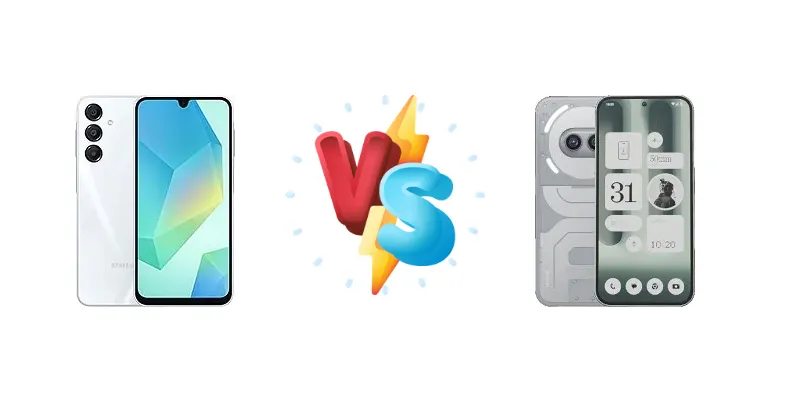
|
🏆 Quick Verdict
For most users, the Nothing Phone (2a) Plus emerges as the stronger contender. Its significantly brighter display (1097 nits vs 824 nits) and faster 50W charging (full charge in 56 minutes) offer a more refined experience, despite the Galaxy A16 5G’s impressive 43:30h battery endurance.
| PHONES | ||
|---|---|---|
| Phone Names | Samsung Galaxy A16 5G | Nothing Phone (2a) Plus |
| Network | ||
|---|---|---|
| 2G bands | GSM 850 / 900 / 1800 / 1900 | GSM 850 / 900 / 1800 / 1900 |
| 3G bands | HSDPA 850 / 900 / 1700(AWS) / 1900 / 2100 | HSDPA 800 / 850 / 900 / 1700(AWS) / 1900 / 2100 |
| 4G bands | 1, 2, 3, 4, 5, 7, 8, 12, 17, 20, 28, 38, 40, 41, 66 - International | 1, 3, 4, 5, 7, 8, 18, 19, 20, 26, 28, 38, 39, 40, 41, 42, 66 |
| 5G bands | 1, 3, 7, 8, 20, 28, 38, 40, 41, 77, 78 SA/NSA/Sub6 - International | 1, 3, 5, 7, 8, 20, 28, 38, 40, 41, 66, 77, 78 SA/NSA |
| Speed | HSPA, LTE, 5G | HSPA, LTE, 5G |
| Technology | GSM / HSPA / LTE / 5G | GSM / HSPA / LTE / 5G |
| Launch | ||
|---|---|---|
| Announced | 2024, October 07 | 2024, July 31 |
| Status | Available. Released 2024, October 25 | Available. Released 2024, August 03 |
| Body | ||
|---|---|---|
| Build | Glass front, plastic back, plastic frame | Glass front (Gorilla Glass 5), plastic frame, plastic back |
| Dimensions | 164.4 x 77.9 x 7.9 mm (6.47 x 3.07 x 0.31 in) | 161.7 x 76.3 x 8.5 mm (6.37 x 3.00 x 0.33 in) |
| SIM | · Nano-SIM· Nano-SIM + eSIM· Nano-SIM + Nano-SIM | Nano-SIM + Nano-SIM |
| Weight | 200 g (7.05 oz) | 190 g (6.70 oz) |
| Display | ||
|---|---|---|
| Protection | Mohs level 5 | Corning Gorilla Glass 5 |
| Resolution | 1080 x 2340 pixels, 19.5:9 ratio (~385 ppi density) | 1080 x 2412 pixels, 20:9 ratio (~395 ppi density) |
| Size | 6.7 inches, 110.2 cm2 (~86.0% screen-to-body ratio) | 6.7 inches, 107.5 cm2 (~87.1% screen-to-body ratio) |
| Type | Super AMOLED, 90Hz, 800 nits (HBM) | AMOLED, 1B colors, 120Hz, 2160Hz PWM, HDR10+, 700 nits (typ), 1100 nits (HBM), 1300 nits (peak) |
| Platform | ||
|---|---|---|
| CPU | Octa-core (2x2.4 GHz Cortex-A78 & 6x2.0 GHz Cortex-A55) or Octa-core (2x2.4 GHz Cortex-A76 & 6x2.0 GHz Cortex-A55) | Octa-core (2x3.0 GHz Cortex-A715 & 6x 2.0 GHz Cortex-A510) |
| Chipset | Exynos 1330 (5 nm) or Mediatek Dimensity 6300 (6 nm) | Mediatek Dimensity 7350 Pro (4 nm) |
| GPU | Mali-G68 MP2 or Mali-G57 MC2 | Mali-G610 MC4 |
| OS | Android 14, up to 6 major Android upgrades, One UI 6.1 | Android 14, up to 3 major Android upgrades, Nothing OS 3.0 |
| Memory | ||
|---|---|---|
| Card slot | microSDXC (uses shared SIM slot) | No |
| Internal | 128GB 4GB RAM, 128GB 6GB RAM, 128GB 8GB RAM, 256GB 6GB RAM, 256GB 8GB RAM | 256GB 8GB RAM, 256GB 12GB RAM |
| Main Camera | ||
|---|---|---|
| Dual | - | 50 MP, f/1.9, 24mm (wide), 1/1.57", 1.0µm, PDAF, OIS 50 MP, f/2.2, 114˚ (ultrawide), 1/2.76", 0.64µm |
| Features | LED flash, panorama, HDR | LED flash, panorama, HDR |
| Triple | 50 MP, f/1.8, (wide), 1/2.76", 0.64µm, AF 5 MP, f/2.2, (ultrawide), 1/5.0", 1.12µm 2 MP (macro) | - |
| Video | 1080p@30fps, gyro-EIS | 4K@30fps, 1080p@60/120fps, gyro-EIS |
| Selfie camera | ||
|---|---|---|
| Features | - | HDR |
| Single | 13 MP, f/2.0, (wide), 1/3.1", 1.12µm | 50 MP, f/2.2, (wide), 1/2.76" |
| Video | 1080p@30fps | 4K@30fps |
| Sound | ||
|---|---|---|
| 35mm jack | No | No |
| Loudspeaker | Yes | Yes, with stereo speakers |
| Comms | ||
|---|---|---|
| Bluetooth | 5.3, A2DP, LE | 5.3, A2DP, LE |
| NFC | Yes (market/region dependent) | Yes, 360˚ |
| Positioning | GPS, GALILEO, GLONASS, BDS, QZSS | GPS, GALILEO, GLONASS, BDS, QZSS |
| Radio | No | No |
| USB | USB Type-C 2.0 | USB Type-C 2.0, OTG |
| WLAN | Wi-Fi 802.11 a/b/g/n/ac, dual-band, Wi-Fi Direct | Wi-Fi 802.11 a/b/g/n/ac/6, dual-band, Wi-Fi Direct |
| Features | ||
|---|---|---|
| Sensors | Fingerprint (side-mounted), accelerometer, gyro, compass | Fingerprint (under display, optical), accelerometer, gyro, proximity, compass |
| Battery | ||
|---|---|---|
| Charging | 25W wired | 50W wired, 50% in 21 min, 100% in 56 min |
| Type | 5000 mAh | 5000 mAh |
| Misc | ||
|---|---|---|
| Colors | Blue Black, Light Gray, Gold, Light Green | Black, Grey |
| Models | SM-A166B, SM-A166B/DS, SM-A166P, SM-A166P/DS, SM-A166E, SM-A166E/DS, SM-A166W, SM-A166U, SM-A166U1 | A142P |
| Price | $ 115.97 / C$ 199.99 / £ 129.99 / € 136.90 / ₹ 17,150 | € 269.90 / ₹ 22,599 |
| SAR EU | 0.38 W/kg (head) 0.94 W/kg (body) | - |
| EU LABEL | ||
|---|---|---|
| Battery | 43:30h endurance, 1200 cycles | - |
| Energy | Class B | - |
| Free fall | Class B (180 falls) | - |
| Repairability | Class C | - |
Samsung Galaxy A16 5G
- Exceptional battery endurance (43:30h)
- Potentially lower price point
- High number of charge cycles (1200)
- Dimmer display (824 nits)
- Slower charging (25W)
- Less powerful chipset (Exynos 1330/Dimensity 6300)
Nothing Phone (2a) Plus
- Brighter display (1097 nits)
- Faster charging (50W, full charge in 56 min)
- More powerful chipset (Dimensity 7350 Pro)
- Slightly shorter battery endurance (16:34h active use)
- Potentially higher price
- Less information on long-term battery health
Display Comparison
The Nothing Phone (2a) Plus boasts a substantial advantage in display quality, achieving a measured peak brightness of 1097 nits compared to the Galaxy A16 5G’s 824 nits. This translates to significantly better visibility outdoors under direct sunlight. While both likely utilize OLED panels (though not explicitly stated), the Nothing Phone’s higher brightness suggests a more advanced panel. The A16 5G’s lower brightness may necessitate higher peak power draw to achieve similar perceived brightness, potentially impacting battery life. Bezels and color accuracy are not specified, but Nothing’s design language typically emphasizes a clean, immersive viewing experience.
Camera Comparison
Detailed camera specs are limited, but the focus should be on the main sensors. While both phones likely include multiple rear cameras, the quality will largely depend on the primary sensor. Without specific sensor sizes or apertures, it’s difficult to make a definitive judgment. However, the Nothing Phone (2a) Plus’s image processing algorithms are generally regarded as more sophisticated, prioritizing natural-looking images. The 2MP macro cameras found on many phones in this price range, including likely the A16 5G, offer limited practical value due to their low resolution and fixed focus.
Performance
The Nothing Phone (2a) Plus is equipped with the Mediatek Dimensity 7350 Pro (4nm), a more modern and efficient chipset than the Exynos 1330 (5nm) or Dimensity 6300 (6nm) found in the Galaxy A16 5G. The Dimensity 7350 Pro’s Cortex-A715 cores, clocked at 3.0 GHz, offer a noticeable performance uplift over the A16 5G’s Cortex-A78 (2.4 GHz) or A76 (2.4 GHz) cores. The 4nm process node of the Dimensity 7350 Pro also contributes to better thermal efficiency, reducing the likelihood of performance throttling during sustained workloads. While both phones offer 8GB of RAM (assumed based on market segment), the Nothing Phone’s superior chipset will deliver a smoother and more responsive experience, particularly in demanding applications and games.
Battery Life
The Galaxy A16 5G claims an impressive 43:30h endurance, suggesting excellent battery optimization. However, the Nothing Phone (2a) Plus counters with a significantly faster 50W charging capability, achieving a full charge in just 56 minutes. The A16 5G’s 25W charging is considerably slower. The Nothing Phone (2a) Plus also achieves a respectable 16:34h active use score, indicating that while the A16 5G may last longer on a single charge, the Nothing Phone’s faster charging mitigates this difference for many users. The A16 5G’s stated 1200 charge cycles suggest a focus on long-term battery health.
Buying Guide
Buy the Samsung Galaxy A16 5G if you prioritize maximum battery life and are on a very tight budget, accepting compromises in display quality and processing power. Buy the Nothing Phone (2a) Plus if you value a brighter, more vibrant display, significantly faster charging speeds, and a more responsive user experience, even if it means slightly less overall battery endurance.