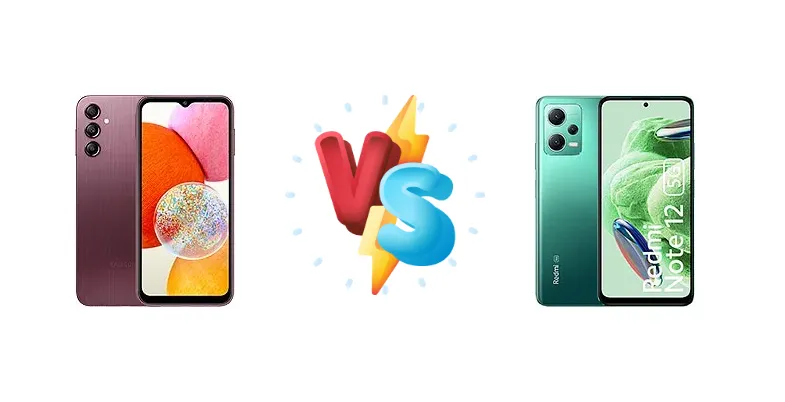
The budget smartphone market is fiercely competitive, and the Samsung Galaxy A14 and Xiaomi Redmi Note 12 are two of the top contenders. Both offer compelling features at affordable prices, but which one reigns supreme? This comprehensive comparison will break down every aspect, helping you make the right choice.
🏆 Quick Verdict
The Xiaomi Redmi Note 12 edges out the Samsung Galaxy A14 thanks to its faster charging, brighter display, and more modern chipset. While the A14 offers Samsung's brand recognition, the Note 12 provides a more well-rounded experience for the price.
| Network |
|---|
| 2G bands | GSM 850 / 900 / 1800 / 1900 | GSM 850 / 900 / 1800 / 1900 |
| 3G bands | HSDPA 850 / 900 / 2100 | HSDPA 850 / 900 / 2100 |
| 4G bands | 1, 3, 5, 7, 8, 20, 28, 38, 40, 41 | 1, 3, 5, 8, 40, 41 |
| 5G bands | - | 1, 3, 5, 8, 28, 40, 78 SA/NSA |
| Speed | HSPA, LTE | HSPA, LTE, 5G |
| Technology | GSM / HSPA / LTE | GSM / HSPA / LTE / 5G |
| Launch |
|---|
| Announced | 2023, February 28 | 2022, October 27 |
| Status | Available. Released 2023, March 27 | Available. Released 2023, January 11 |
| Body |
|---|
| Build | Glass front, plastic back, plastic frame | - |
| Dimensions | 167.7 x 78 x 9.1 mm (6.60 x 3.07 x 0.36 in) | 165.9 x 76.2 x 8 mm (6.53 x 3.00 x 0.31 in) |
| SIM | · Nano-SIM· Nano-SIM + Nano-SIM | Nano-SIM + Nano-SIM |
| Weight | 201 g (7.09 oz) | 188 g (6.63 oz) |
| | - | IP53, dust and splash resistant |
| Display |
|---|
| Protection | - | Corning Gorilla Glass 3 |
| Resolution | 1080 x 2408 pixels, 20:9 ratio (~400 ppi density) | 1080 x 2400 pixels, 20:9 ratio (~395 ppi density) |
| Size | 6.6 inches, 104.9 cm2 (~80.2% screen-to-body ratio) | 6.67 inches, 107.4 cm2 (~85.0% screen-to-body ratio) |
| Type | PLS LCD | AMOLED, 120Hz, 1200 nits (peak) |
| Platform |
|---|
| CPU | Octa-core (2x2.0 GHz Cortex-A75 & 6x1.8 GHz Cortex-A55) - Version AOcta-core (4x2.0 GHz Cortex-A55 & 4x2.0 GHz Cortex-A55) - Version B | Octa-core (2x2.0 GHz Cortex-A78 & 6x1.8 GHz Cortex-A55) |
| Chipset | Mediatek MT6769 Helio G80 (12 nm) - Version AExynos 850 (8 nm) - Version B | Qualcomm SM4375 Snapdragon 4 Gen 1 (6 nm) |
| GPU | Mali-G52 MC2 | Adreno 619 |
| OS | Android 13, upgradable to Android 15, One UI 7 | Android 12, MIUI 14 (International), MIUI 13 (India) |
| Memory |
|---|
| Card slot | microSDXC (dedicated slot) | microSDXC (uses shared SIM slot) |
| Internal | 64GB 4GB RAM, 128GB 4GB RAM, 128GB 6GB RAM | 128GB 4GB RAM, 128GB 6GB RAM, 256GB 8GB RAM |
| | - | UFS 2.2 |
| Main Camera |
|---|
| Features | LED flash, panorama, HDR | Dual-LED dual-tone flash, HDR, panorama |
| Single | 13 MP, f/2.0, (wide) | - |
| Triple | 50 MP, f/1.8, 26mm (wide), 1/2.75", 0.64µm, PDAF
5 MP, f/2.2, 17mm (ultrawide), 1/5.0", 1.12µm
2 MP (macro) | 48 MP, f/1.8, (wide), PDAF
8 MP, f/2.2, 120˚ (ultrawide), 1/4.0", 1.12µm
2 MP (macro) |
| Video | 1080p@30fps | 1080p@30fps |
| Selfie camera |
|---|
| Features | - | HDR |
| Single | 13 MP, f/2.0, 26mm (wide), 1/3.1", 1.12µm | 13 MP, f/2.5, (wide), 1/3.0" |
| Video | 1080p@30fps | 1080p@30fps |
| Sound |
|---|
| 3.5mm jack | Yes | Yes |
| 35mm jack | Yes | Yes |
| Loudspeaker | Yes | Yes |
| | - | 24-bit/192kHz audio |
| Comms |
|---|
| Bluetooth | 5.1 or 5.3, A2DP, LE | 5.1, A2DP, LE |
| Infrared port | - | Yes |
| NFC | Yes (market/region dependent) | Yes (market/region dependent) |
| Positioning | GPS, GALILEO, GLONASS, BDS, QZSS | GPS, GLONASS |
| Radio | Unspecified | Unspecified |
| USB | USB Type-C 2.0 | USB Type-C 2.0, OTG |
| WLAN | Wi-Fi 802.11 a/b/g/n/ac, dual-band, Wi-Fi Direct | Wi-Fi 802.11 a/b/g/n/ac, dual-band |
| Features |
|---|
| Sensors | Fingerprint (side-mounted), accelerometer, proximity, compass | Fingerprint (side-mounted), accelerometer, gyro, proximity, compass |
| Battery |
|---|
| Charging | 15W wired | 33W wired, 50% in 22 min |
| Type | Li-Po 5000 mAh | Li-Po 5000 mAh |
| Misc |
|---|
| Colors | Black, Dark Red, Silver, Green | Frosted Green, Matte Black, Mystique Blue |
| Models | SM-A145F, SM-A145F/DSN, SM-A145M, SM-A145M/DS, SM-A145P, SM-A145R | 22111317I, 22111317G |
| Price | € 85.76 / $ 147.60 / £ 79.95 | € 151.99 / $ 219.99 / ₹ 11,999 |
| SAR | - | 1.09 W/kg (head) 1.05 W/kg (body) |
| SAR EU | 0.46 W/kg (head) 1.37 W/kg (body) | 0.68 W/kg (head) 0.91 W/kg (body) |
| Tests |
|---|
| Battery life | - |
Endurance rating 101h
|
| Camera | - |
Photo / Video |
| Display | - |
Contrast ratio: Infinite (nominal) |
| Loudspeaker | - |
-28.0 LUFS (Good)
|
| Performance | - |
AnTuTu: 360745 (v9)
GeekBench: 1998 (v5.1), 2017 (v6) |
Samsung Galaxy A14
- Samsung Brand Recognition
- Familiar One UI
- Potentially better software support (Samsung)
- Slower Charging
- Less Powerful Processor
- Likely Dimmer Display
- Older Chipset
Xiaomi Redmi Note 12
- Faster Charging (33W)
- Brighter Display
- More Powerful Processor (Snapdragon 4 Gen 1)
- Excellent Battery Life
- Xiaomi's MIUI can be polarizing
- Potential for less frequent software updates compared to Samsung
Display Comparison
The Redmi Note 12 boasts a significantly brighter display at 706 nits compared to the A14's likely lower brightness (spec not provided, but generally lower than Redmi). The Redmi's 'infinite' contrast ratio suggests excellent image quality, while the A14's display, while likely adequate, won't offer the same visual pop. Both likely use LCD panels.
Camera Comparison
Both phones feature Photo/Video capabilities, but detailed camera specs are missing. Generally, Xiaomi tends to offer slightly better camera performance in this price range, but Samsung's image processing can be appealing to some. Real-world testing would be needed for a definitive comparison.
Performance
The Redmi Note 12's Snapdragon 4 Gen 1 (6nm) offers a noticeable performance advantage over the A14's Mediatek Helio G80 (12nm) or Exynos 850 (8nm). The Cortex-A78 cores in the Snapdragon provide better single-core performance, and the 6nm process offers improved efficiency. Expect smoother multitasking and gaming on the Redmi Note 12.
Battery Life
The Redmi Note 12 shines in battery life, boasting an impressive endurance rating of 101 hours and active use lasting 10:58 hours. The A14's battery life is likely good, but not as exceptional as the Redmi Note 12. The Redmi's 33W charging is also a significant advantage over the A14's 15W.
Buying Guide
Who should buy the Samsung Galaxy A14? Users loyal to the Samsung ecosystem and those prioritizing a familiar UI. Who should buy the Xiaomi Redmi Note 12? Value-seekers looking for a brighter display, faster charging, and a more powerful processor.
Frequently Asked Questions
❓ Which phone has better performance?
The Xiaomi Redmi Note 12 has a more modern and powerful Snapdragon 4 Gen 1 chipset, offering better performance than the Samsung Galaxy A14's Mediatek Helio G80 or Exynos 850.
❓ Is the Samsung Galaxy A14 worth buying?
The A14 is a decent option for Samsung loyalists who prefer the One UI interface. However, the Redmi Note 12 generally offers better value for money with its superior performance and charging speed.