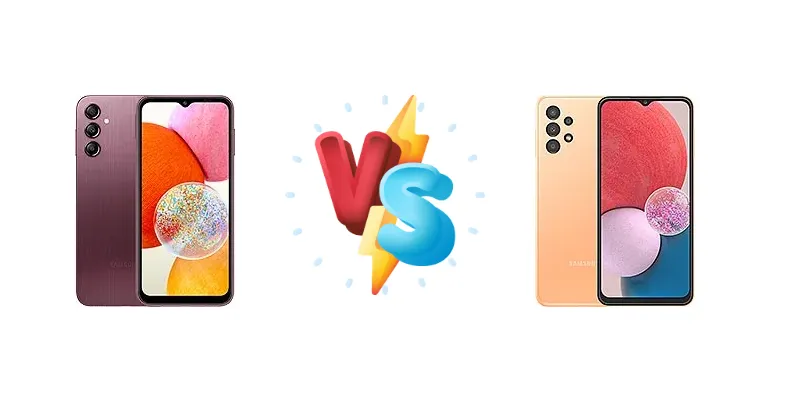
The Samsung Galaxy A series consistently delivers excellent value in the budget smartphone market. The A13 was a popular choice, but the newer A14 aims to improve upon it. Let's dive into a head-to-head comparison to see which phone reigns supreme.
🏆 Quick Verdict
The Galaxy A14 offers a slightly improved chipset and potentially a better display, depending on the version. However, the A13 boasts exceptional battery life and a proven track record. For most users, the A14 is a worthwhile upgrade, but the A13 remains a strong contender, especially if battery is your top priority.
| Network |
|---|
| 2G bands | GSM 850 / 900 / 1800 / 1900 | GSM 850 / 900 / 1800 / 1900 |
| 3G bands | HSDPA 850 / 900 / 2100 | HSDPA 850 / 900 / 2100 |
| 4G bands | 1, 3, 5, 7, 8, 20, 28, 38, 40, 41 | 1, 3, 5, 7, 8, 20, 28, 38, 40, 41 |
| Speed | HSPA, LTE | HSPA, LTE |
| Technology | GSM / HSPA / LTE | GSM / HSPA / LTE |
| Launch |
|---|
| Announced | 2023, February 28 | 2022, March 04 |
| Status | Available. Released 2023, March 27 | Available. Released 2022, March 23 |
| Body |
|---|
| Build | Glass front, plastic back, plastic frame | Glass front (Gorilla Glass 5), plastic frame, plastic back |
| Dimensions | 167.7 x 78 x 9.1 mm (6.60 x 3.07 x 0.36 in) | 165.1 x 76.4 x 8.8 mm (6.5 x 3.01 x 0.35 in) |
| SIM | · Nano-SIM· Nano-SIM + Nano-SIM | · Nano-SIM· Nano-SIM + Nano-SIM |
| Weight | 201 g (7.09 oz) | 195 g (6.88 oz) |
| Display |
|---|
| Protection | - | Corning Gorilla Glass 5 |
| Resolution | 1080 x 2408 pixels, 20:9 ratio (~400 ppi density) | 1080 x 2408 pixels, 20:9 ratio (~400 ppi density) |
| Size | 6.6 inches, 104.9 cm2 (~80.2% screen-to-body ratio) | 6.6 inches, 104.9 cm2 (~83.2% screen-to-body ratio) |
| Type | PLS LCD | PLS LCD |
| Platform |
|---|
| CPU | Octa-core (2x2.0 GHz Cortex-A75 & 6x1.8 GHz Cortex-A55) - Version AOcta-core (4x2.0 GHz Cortex-A55 & 4x2.0 GHz Cortex-A55) - Version B | Octa-core (4x2.0 GHz Cortex-A55 & 4x2.0 GHz Cortex-A55) |
| Chipset | Mediatek MT6769 Helio G80 (12 nm) - Version AExynos 850 (8 nm) - Version B | Exynos 850 (8 nm) |
| GPU | Mali-G52 MC2 | Mali-G52 |
| OS | Android 13, upgradable to Android 15, One UI 7 | Android 12, upgradable to Android 14, One UI 6.1 |
| Memory |
|---|
| Card slot | microSDXC (dedicated slot) | microSDXC (dedicated slot) |
| Internal | 64GB 4GB RAM, 128GB 4GB RAM, 128GB 6GB RAM | 32GB 3GB RAM, 32GB 4GB RAM, 64GB 4GB RAM, 128GB 3GB RAM, 128GB 4GB RAM, 128GB 6GB RAM |
| | - | eMMC 5.1 |
| Main Camera |
|---|
| Features | LED flash, panorama, HDR | LED flash, panorama, HDR |
| Quad | - | 50 MP, f/1.8, (wide), PDAF
5 MP, f/2.2, 123˚ (ultrawide), 1/5.0", 1.12µm
2 MP (macro)
Auxiliary lens |
| Single | 13 MP, f/2.0, (wide) | 8 MP, f/2.2, (wide) |
| Triple | 50 MP, f/1.8, 26mm (wide), 1/2.75", 0.64µm, PDAF
5 MP, f/2.2, 17mm (ultrawide), 1/5.0", 1.12µm
2 MP (macro) | - |
| Video | 1080p@30fps | 1080p@30fps |
| Selfie camera |
|---|
| Single | 13 MP, f/2.0, 26mm (wide), 1/3.1", 1.12µm | 8 MP, f/2.2, (wide) |
| Video | 1080p@30fps | 1080p@30fps |
| Sound |
|---|
| 3.5mm jack | Yes | Yes |
| 35mm jack | Yes | Yes |
| Loudspeaker | Yes | Yes |
| Comms |
|---|
| Bluetooth | 5.1 or 5.3, A2DP, LE | 5.0, A2DP, LE |
| NFC | Yes (market/region dependent) | Yes (market/region dependent) |
| Positioning | GPS, GALILEO, GLONASS, BDS, QZSS | GPS, GLONASS, GALILEO, BDS |
| Radio | Unspecified | No |
| USB | USB Type-C 2.0 | USB Type-C 2.0, OTG |
| WLAN | Wi-Fi 802.11 a/b/g/n/ac, dual-band, Wi-Fi Direct | Wi-Fi 802.11 a/b/g/n/ac, dual-band, Wi-Fi Direct |
| Features |
|---|
| Sensors | Fingerprint (side-mounted), accelerometer, proximity, compass | Fingerprint (side-mounted), accelerometer, compass |
| | - | Virtual proximity sensing |
| Battery |
|---|
| Charging | 15W wired | 15W wired |
| Type | Li-Po 5000 mAh | Li-Po 5000 mAh |
| Misc |
|---|
| Colors | Black, Dark Red, Silver, Green | Black, White, Peach, Blue |
| Models | SM-A145F, SM-A145F/DSN, SM-A145M, SM-A145M/DS, SM-A145P, SM-A145R | SM-A135F, SM-A135F/DS, SM-A135M, SM-A135U, SM-A135U1, SM-A135N |
| Price | € 85.76 / $ 147.60 / £ 79.95 | € 94.99 / $ 129.99 / £ 89.00 |
| SAR | - | 0.49 W/kg (head) |
| SAR EU | 0.46 W/kg (head) 1.37 W/kg (body) | 0.37 W/kg (head) 1.39 W/kg (body) |
| Tests |
|---|
| Battery life | - |
Endurance rating 114h
|
| Camera | - |
Photo / Video |
| Display | - |
Contrast ratio: 1324:1 (nominal) |
| Loudspeaker | - |
-29.7 LUFS (Average)
|
| Performance | - |
AnTuTu: 122822 (v8), 136286 (v9)
GeekBench: 588 (v5.1)
GFXBench: 5.2fps (ES 3.1 onscreen) |
Samsung Galaxy A14
- Potentially brighter display
- Slightly improved chipset (Helio G80 version)
- Modern design
- Improved main camera sensor (expected)
- Battery life may not match A13
- Helio G80 version may lack 5G connectivity
Samsung Galaxy A13
- Exceptional battery life
- Proven reliability
- Potentially lower price
- Good display quality
- Older chipset
- Less modern design
- Camera performance slightly behind A14 (expected)
Display Comparison
The Galaxy A14 generally features a larger 6.6-inch display compared to the A13's 6.6-inch screen. Both offer a 1080 x 2408 resolution. The A14's display brightness is expected to be slightly higher, potentially offering better outdoor visibility. The A13's contrast ratio of 1324:1 is impressive, and the A14 should maintain a similar level of quality.
Camera Comparison
Both phones feature a multi-lens camera system. The A14 is expected to have a slightly improved main sensor, potentially resulting in better low-light performance and more detailed photos. Video recording capabilities are similar on both devices, typically supporting up to 1080p resolution.
Performance
The A14 has two chipset options: a Mediatek Helio G80 or an Exynos 850. The Helio G80 version offers a slight edge in gaming performance due to its GPU. The Exynos 850 version in the A14 is comparable to the A13's Exynos 850, providing smooth everyday performance for tasks like browsing and social media. The A14's CPU improvements are marginal.
Battery Life
The Galaxy A13 is renowned for its exceptional battery life, boasting an endurance rating of 114 hours. The A14's battery capacity is similar, but the slightly more efficient chipset in the A13 could give it a slight advantage in real-world usage. Expect the A14 to still offer solid battery life, but potentially not quite as impressive as the A13.
Buying Guide
Who should buy the Samsung Galaxy A14? Users seeking a modest performance boost and potentially a brighter display. Who should buy the Samsung Galaxy A13? Those prioritizing exceptional battery life and a reliable, proven device at a potentially lower price point.
Frequently Asked Questions
❓ Is the Galaxy A14 worth the upgrade from the A13?
It depends on your priorities. If you want a slightly better chipset and potentially a brighter display, the A14 is a good upgrade. If battery life is your top concern, the A13 remains an excellent choice.
❓ What are the chipset options for the Galaxy A14?
The Galaxy A14 comes in two versions: one with a Mediatek Helio G80 chipset and another with an Exynos 850 chipset.