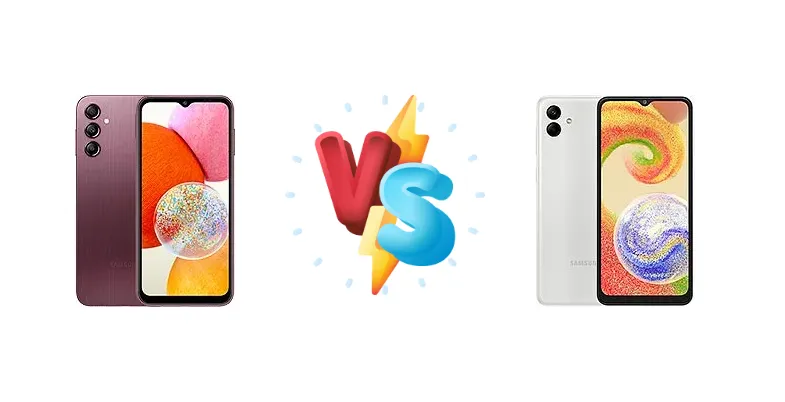
Looking for an affordable Samsung smartphone? The Galaxy A14 and A04 are both strong contenders in the budget segment. But which one offers the best value for your money? This comprehensive comparison will help you decide.
🏆 Quick Verdict
The Galaxy A14 is the clear winner, offering a significantly more powerful chipset, potentially better camera capabilities, and a more modern design. While the A04 is cheaper, the A14's performance boost makes it the better long-term investment for most users.
| Network |
|---|
| 2G bands | GSM 850 / 900 / 1800 / 1900 | GSM 850 / 900 / 1800 / 1900 |
| 3G bands | HSDPA 850 / 900 / 2100 | HSDPA 850 / 900 / 2100 |
| 4G bands | 1, 3, 5, 7, 8, 20, 28, 38, 40, 41 | 1, 3, 5, 7, 8, 20, 28, 38, 40, 41 |
| Speed | HSPA, LTE | HSPA 42.2/5.76 Mbps, LTE Cat4 150/50 Mbps |
| Technology | GSM / HSPA / LTE | GSM / HSPA / LTE |
| Launch |
|---|
| Announced | 2023, February 28 | 2022, August 24 |
| Status | Available. Released 2023, March 27 | Available. Released 2022, October 10 |
| Body |
|---|
| Build | Glass front, plastic back, plastic frame | Glass front, plastic back, plastic frame |
| Dimensions | 167.7 x 78 x 9.1 mm (6.60 x 3.07 x 0.36 in) | 164.4 x 76.3 x 9.1 mm (6.47 x 3.00 x 0.36 in) |
| SIM | · Nano-SIM· Nano-SIM + Nano-SIM | · Nano-SIM· Nano-SIM + Nano-SIM |
| Weight | 201 g (7.09 oz) | 192 g (6.77 oz) |
| Display |
|---|
| Resolution | 1080 x 2408 pixels, 20:9 ratio (~400 ppi density) | 720 x 1600 pixels, 20:9 ratio (~270 ppi density) |
| Size | 6.6 inches, 104.9 cm2 (~80.2% screen-to-body ratio) | 6.5 inches, 102.0 cm2 (~81.3% screen-to-body ratio) |
| Type | PLS LCD | PLS LCD |
| Platform |
|---|
| CPU | Octa-core (2x2.0 GHz Cortex-A75 & 6x1.8 GHz Cortex-A55) - Version AOcta-core (4x2.0 GHz Cortex-A55 & 4x2.0 GHz Cortex-A55) - Version B | Octa-core (4x2.3 GHz Cortex-A53 & 4x1.8 GHz Cortex-A53) |
| Chipset | Mediatek MT6769 Helio G80 (12 nm) - Version AExynos 850 (8 nm) - Version B | Mediatek MT6765 Helio P35 (12 nm) |
| GPU | Mali-G52 MC2 | PowerVR GE8320 |
| OS | Android 13, upgradable to Android 15, One UI 7 | Android 12, upgradable to Android 13, One UI Core 5.0 |
| Memory |
|---|
| Card slot | microSDXC (dedicated slot) | microSDXC (dedicated slot) |
| Internal | 64GB 4GB RAM, 128GB 4GB RAM, 128GB 6GB RAM | 32GB 3GB RAM, 32GB 4GB RAM, 64GB 3GB RAM, 64GB 4GB RAM, 64GB 6GB RAM, 128GB 4GB RAM, 128GB 8GB RAM |
| | - | eMMC 5.1 |
| Main Camera |
|---|
| Dual | - | 50 MP, f/1.8, 25mm (wide), 1/2.51", 0.7µm, AF
Auxiliary lens |
| Features | LED flash, panorama, HDR | LED flash |
| Single | 13 MP, f/2.0, (wide) | 5 MP, f/2.2 |
| Triple | 50 MP, f/1.8, 26mm (wide), 1/2.75", 0.64µm, PDAF
5 MP, f/2.2, 17mm (ultrawide), 1/5.0", 1.12µm
2 MP (macro) | - |
| Video | 1080p@30fps | 1080p@30fps |
| Selfie camera |
|---|
| Single | 13 MP, f/2.0, 26mm (wide), 1/3.1", 1.12µm | 5 MP, f/2.2, 28mm (wide), 1/5", 1.12µm |
| Video | 1080p@30fps | Yes |
| Sound |
|---|
| 3.5mm jack | Yes | Yes |
| 35mm jack | Yes | Yes |
| Loudspeaker | Yes | Yes |
| Comms |
|---|
| Bluetooth | 5.1 or 5.3, A2DP, LE | 5.0, A2DP, LE |
| NFC | Yes (market/region dependent) | No |
| Positioning | GPS, GALILEO, GLONASS, BDS, QZSS | GPS, GLONASS, GALILEO, BDS |
| Radio | Unspecified | Unspecified |
| USB | USB Type-C 2.0 | USB Type-C 2.0 |
| WLAN | Wi-Fi 802.11 a/b/g/n/ac, dual-band, Wi-Fi Direct | Wi-Fi 802.11 a/b/g/n/ac, dual-band, Wi-Fi Direct |
| Features |
|---|
| Sensors | Fingerprint (side-mounted), accelerometer, proximity, compass | Accelerometer, proximity |
| Battery |
|---|
| Charging | 15W wired | - |
| Type | Li-Po 5000 mAh | Li-Po 5000 mAh |
| Misc |
|---|
| Colors | Black, Dark Red, Silver, Green | Black, Green, White, Copper |
| Models | SM-A145F, SM-A145F/DSN, SM-A145M, SM-A145M/DS, SM-A145P, SM-A145R | SM-A045F, SM-A045F/DS, SM-A045M |
| Price | € 85.76 / $ 147.60 / £ 79.95 | About 70 EUR |
| SAR EU | 0.46 W/kg (head) 1.37 W/kg (body) | 0.32 W/kg (head) 1.10 W/kg (body) |
Samsung Galaxy A14
- More powerful chipset
- Potentially better camera
- Modern design
- Likely higher refresh rate display
- Better multitasking
- Higher price
- 15W charging is relatively slow
Samsung Galaxy A04
- Lower price
- Decent battery life
- Large display
- Underpowered chipset
- Basic camera
- Slower performance
- Likely 60Hz display
Display Comparison
Both phones feature large displays, likely around 6.5 inches, but the A14 is expected to have a slightly higher resolution and potentially a more vibrant panel. The A14 may also offer a higher refresh rate (90Hz) for smoother scrolling, while the A04 likely sticks to a standard 60Hz.
Camera Comparison
The A14 is expected to have a more versatile camera system with higher resolution sensors and potentially more advanced features like optical image stabilization (OIS). While specific megapixel counts are needed for a definitive comparison, the A14's chipset generally supports better image processing. The A04's camera is adequate for casual snapshots.
Performance
The A14 boasts a significantly more powerful Mediatek Helio G80 chipset (or Exynos 850 depending on the version) compared to the A04's Helio P35. This translates to noticeably faster app loading times, smoother multitasking, and better gaming performance on the A14. The A04 will handle basic tasks adequately, but struggles with demanding applications.
Battery Life
Both phones likely feature a 5000mAh battery, offering all-day battery life under moderate usage. However, the A14's more efficient chipset (especially the Exynos version) might provide slightly better battery endurance.
Buying Guide
The Samsung Galaxy A14 is ideal for users who prioritize performance, a smoother user experience, and potentially better camera quality. The Galaxy A04 is a good choice for those on a very tight budget who primarily need a basic smartphone for calls, texts, and light social media use.
Frequently Asked Questions
❓ Is the Galaxy A14 worth the extra money?
Yes, the A14's improved performance and potentially better camera make it a worthwhile upgrade if your budget allows.
❓ Can the Galaxy A04 handle basic apps?
Yes, the A04 can handle basic apps like WhatsApp, Facebook, and web browsing, but it may struggle with more demanding games or apps.