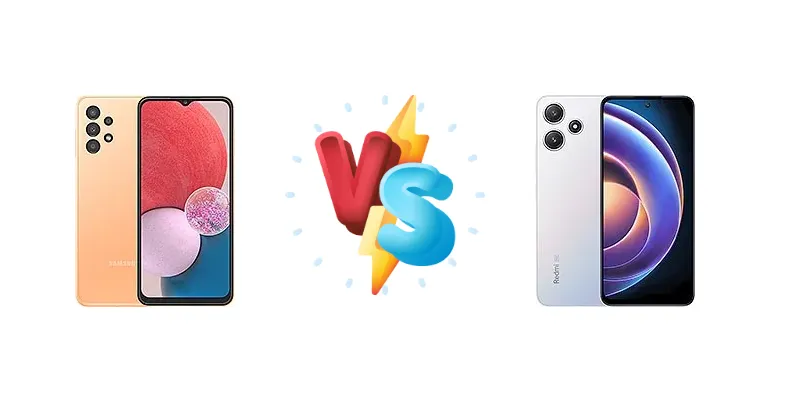
The Samsung Galaxy A13 and Xiaomi Redmi Note 12R represent compelling options in the crowded budget smartphone market. While both aim to deliver essential features at an accessible price, they take different approaches to achieving this. The A13 relies on Samsung’s established brand and a mature chipset, while the Redmi Note 12R introduces Qualcomm’s newer, more efficient Snapdragon 4 Gen 2. This comparison will dissect their key differences to determine which device offers the best value.
🏆 Quick Verdict
For most users, the Xiaomi Redmi Note 12R emerges as the stronger contender. Its Snapdragon 4 Gen 2 chipset, built on a 4nm process, provides a noticeable performance advantage and improved efficiency over the Galaxy A13’s older Exynos 850. While the A13 boasts a slightly higher endurance rating, the 12R’s faster charging and modern architecture make it the better all-around choice.
| Network |
|---|
| 2G bands | GSM 850 / 900 / 1800 / 1900 | GSM 850 / 900 / 1800 / 1900 |
| 3G bands | HSDPA 850 / 900 / 2100 | HSDPA 850 / 900 / 2100 |
| 4G bands | 1, 3, 5, 7, 8, 20, 28, 38, 40, 41 | 1, 3, 5, 8, 34, 38, 39, 40, 41 |
| 5G bands | - | 1, 5, 8, 28, 41, 78 SA/NSA |
| Speed | HSPA, LTE | HSPA, LTE, 5G |
| Technology | GSM / HSPA / LTE | GSM / CDMA / HSPA / EVDO / LTE / 5G |
| Launch |
|---|
| Announced | 2022, March 04 | 2023, June 28 |
| Status | Available. Released 2022, March 23 | Available. Released 2023, June 28 |
| Body |
|---|
| Build | Glass front (Gorilla Glass 5), plastic frame, plastic back | Glass front, plastic frame, glass back |
| Dimensions | 165.1 x 76.4 x 8.8 mm (6.5 x 3.01 x 0.35 in) | 168.6 x 76.3 x 8.2 mm (6.64 x 3.00 x 0.32 in) |
| SIM | · Nano-SIM· Nano-SIM + Nano-SIM | Nano-SIM + Nano-SIM |
| Weight | 195 g (6.88 oz) | 199 g (7.02 oz) |
| Display |
|---|
| Protection | Corning Gorilla Glass 5 | - |
| Resolution | 1080 x 2408 pixels, 20:9 ratio (~400 ppi density) | 1080 x 2460 pixels (~396 ppi density) |
| Size | 6.6 inches, 104.9 cm2 (~83.2% screen-to-body ratio) | 6.79 inches, 109.5 cm2 (~85.1% screen-to-body ratio) |
| Type | PLS LCD | IPS LCD, 90Hz, 550 nits |
| Platform |
|---|
| CPU | Octa-core (4x2.0 GHz Cortex-A55 & 4x2.0 GHz Cortex-A55) | Octa-core (2x2.2 GHz Cortex-A78 & 6x1.95 GHz Cortex-A55) |
| Chipset | Exynos 850 (8 nm) | Qualcomm SM4450 Snapdragon 4 Gen 2 (4 nm) |
| GPU | Mali-G52 | Adreno 613 |
| OS | Android 12, upgradable to Android 14, One UI 6.1 | Android 13, MIUI 14 |
| Memory |
|---|
| Card slot | microSDXC (dedicated slot) | microSDXC (uses shared SIM slot) |
| Internal | 32GB 3GB RAM, 32GB 4GB RAM, 64GB 4GB RAM, 128GB 3GB RAM, 128GB 4GB RAM, 128GB 6GB RAM | 128GB 4GB RAM, 128GB 6GB RAM, 128GB 8GB RAM, 256GB 8GB RAM |
| | eMMC 5.1 | - |
| Main Camera |
|---|
| Dual | - | 50 MP, f/1.8, (wide), PDAF
2 MP (macro) |
| Features | LED flash, panorama, HDR | LED flash, HDR |
| Quad | 50 MP, f/1.8, (wide), PDAF
5 MP, f/2.2, 123˚ (ultrawide), 1/5.0", 1.12µm
2 MP (macro)
Auxiliary lens | - |
| Single | 8 MP, f/2.2, (wide) | - |
| Video | 1080p@30fps | 1080p@30fps |
| Selfie camera |
|---|
| Features | - | HDR |
| Single | 8 MP, f/2.2, (wide) | 5 MP, f/2.2, (wide), 1/5.0", 1.12µm |
| Video | 1080p@30fps | 1080p@30fps |
| Sound |
|---|
| 3.5mm jack | Yes | - |
| 35mm jack | Yes | Yes |
| Loudspeaker | Yes | Yes |
| Comms |
|---|
| Bluetooth | 5.0, A2DP, LE | 5.3, A2DP, LE |
| Infrared port | - | Yes |
| NFC | Yes (market/region dependent) | Yes (market/region dependent) |
| Positioning | GPS, GLONASS, GALILEO, BDS | GPS, GLONASS, GALILEO, BDS |
| Radio | No | No |
| USB | USB Type-C 2.0, OTG | USB Type-C |
| WLAN | Wi-Fi 802.11 a/b/g/n/ac, dual-band, Wi-Fi Direct | Wi-Fi 802.11 a/b/g/n/ac, dual-band |
| Features |
|---|
| Sensors | Fingerprint (side-mounted), accelerometer, compass | Fingerprint (side-mounted), accelerometer, compass |
| | Virtual proximity sensing | - |
| Battery |
|---|
| Charging | 15W wired | 18W wired, PD |
| Type | Li-Po 5000 mAh | Li-Po 5000 mAh |
| Misc |
|---|
| Colors | Black, White, Peach, Blue | Black, Blue, Silver |
| Models | SM-A135F, SM-A135F/DS, SM-A135M, SM-A135U, SM-A135U1, SM-A135N | 23076RA4BC |
| Price | € 94.99 / $ 129.99 / £ 89.00 | About 150 EUR |
| SAR | 0.49 W/kg (head) | - |
| SAR EU | 0.37 W/kg (head) 1.39 W/kg (body) | - |
| Tests |
|---|
| Battery life |
Endurance rating 114h
| - |
| Camera |
Photo / Video | - |
| Display |
Contrast ratio: 1324:1 (nominal) | - |
| Loudspeaker |
-29.7 LUFS (Average)
| - |
| Performance |
AnTuTu: 122822 (v8), 136286 (v9)
GeekBench: 588 (v5.1)
GFXBench: 5.2fps (ES 3.1 onscreen) | - |
Samsung Galaxy A13
- Established Samsung brand reputation
- Solid battery endurance (114h)
- Potentially longer software support
- Older Exynos 850 chipset
- Slower 15W charging
- Display may lack vibrancy
Xiaomi Redmi Note 12R
- More efficient Snapdragon 4 Gen 2 (4nm)
- Faster 18W charging with PD
- Improved CPU performance with Cortex-A78 cores
- Less established brand in some markets
- MIUI software may not appeal to all users
- Camera performance details are unknown
Display Comparison
The Samsung Galaxy A13 features a display capable of reaching 587 nits of peak brightness, paired with a 1324:1 contrast ratio. While adequate for indoor use, this brightness level may struggle in direct sunlight. The Redmi Note 12R’s display specifications are not provided, but given its market positioning, it likely offers similar brightness. However, the key difference lies in the underlying technology; the A13’s older panel may lack the color accuracy and viewing angles of newer displays. Without further data on the Redmi Note 12R’s panel type, it’s difficult to definitively declare a winner, but the newer device has the potential for a superior visual experience.
Camera Comparison
Both devices are listed as having Photo/Video capabilities, but specific details are lacking. Given the budget nature of both phones, we can expect modest camera performance. The absence of information regarding sensor size and aperture makes a direct comparison difficult. However, it’s likely both phones rely on similar, relatively small sensors. The inclusion of a 2MP macro camera on either device is largely a marketing gimmick and offers limited practical value. Image processing will likely be the differentiating factor, with Samsung potentially offering more refined software algorithms, but the Redmi Note 12R’s newer image signal processor (ISP) within the Snapdragon 4 Gen 2 could provide improved dynamic range and noise reduction.
Performance
The core of the difference between these two phones lies in their chipsets. The Samsung Galaxy A13 utilizes the Exynos 850, an 8nm processor with an octa-core configuration (4x2.0 GHz Cortex-A55 & 4x2.0 GHz Cortex-A55). The Xiaomi Redmi Note 12R, however, is powered by the Qualcomm SM4450 Snapdragon 4 Gen 2, a more modern 4nm chip with an octa-core setup (2x2.2 GHz Cortex-A78 & 6x1.95 GHz Cortex-A55). The 4nm process of the Snapdragon 4 Gen 2 translates to significantly improved power efficiency and thermal management. Furthermore, the inclusion of Cortex-A78 cores in the 12R provides a substantial performance boost in CPU-intensive tasks compared to the A13’s all-Cortex-A55 configuration. This means faster app loading times, smoother multitasking, and a more responsive overall experience on the Redmi Note 12R.
Battery Life
The Samsung Galaxy A13 boasts an endurance rating of 114 hours, indicating solid battery life. However, the Redmi Note 12R compensates for any potential battery capacity difference with its 18W wired charging, which also supports Power Delivery (PD). The A13 is limited to 15W charging. This faster charging speed on the 12R means less time tethered to a wall outlet, a significant convenience factor. While the A13’s endurance rating is respectable, the 12R’s combination of efficient chipset and faster charging provides a more practical and user-friendly experience.
Buying Guide
Buy the Samsung Galaxy A13 if you prioritize brand recognition, a proven (though older) platform, and potentially longer software support from Samsung. Buy the Xiaomi Redmi Note 12R if you value performance, efficiency, and faster charging, and are comfortable with Xiaomi’s MIUI software experience. The 12R is the better choice for users who frequently multitask, play mobile games, or simply want a snappier user experience.
Frequently Asked Questions
❓ Does the Exynos 850 in the Galaxy A13 overheat during prolonged gaming sessions?
The Exynos 850 is known to exhibit some throttling under sustained load. While it won't necessarily overheat to the point of being unusable, users may experience frame rate drops and reduced performance during extended gaming sessions. The Snapdragon 4 Gen 2 in the Redmi Note 12R, with its 4nm process, is significantly more efficient and less prone to throttling.
❓ Is the 18W charging on the Redmi Note 12R significantly faster than the 15W charging on the Galaxy A13 in real-world use?
Yes, the 18W charging with Power Delivery on the Redmi Note 12R will noticeably reduce charging times compared to the Galaxy A13’s 15W charging. While the difference may not be dramatic, it translates to a quicker top-up when you're short on time. The inclusion of PD also ensures compatibility with a wider range of chargers.
❓ How does Xiaomi's MIUI software compare to Samsung's One UI in terms of bloatware and user experience?
MIUI is generally known for being more heavily customized and including more pre-installed apps (bloatware) than Samsung's One UI. One UI is often praised for its cleaner interface and more intuitive user experience. However, MIUI offers a wide range of customization options, which may appeal to some users. Both interfaces have improved over time, but One UI generally provides a more polished and streamlined experience out of the box.