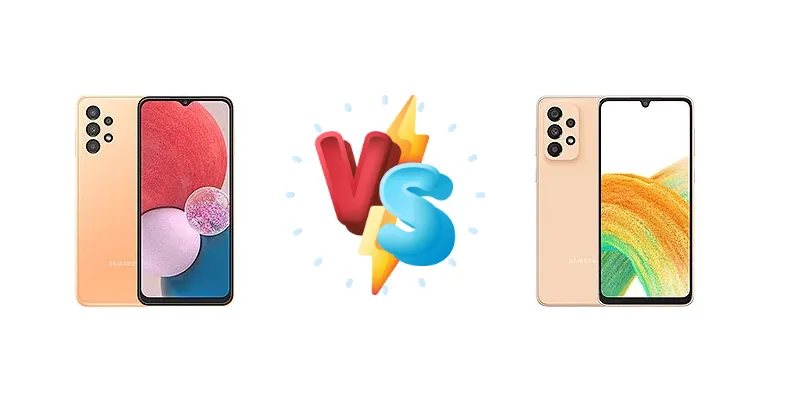
Samsung's A-series offers a compelling range of affordable smartphones. The Galaxy A13 and A33 5G represent two distinct points within that range, catering to different priorities. The A13 focuses on maximizing battery life and affordability, while the A33 5G steps up the performance and display quality with a more modern chipset and faster charging. This comparison will dissect the key differences to help you determine which device best suits your needs.
🏆 Quick Verdict
For most users, the Samsung Galaxy A33 5G is the better choice. Its Exynos 1280 chipset delivers significantly improved performance, and the brighter 728-nit display offers a superior viewing experience. While the A13 boasts slightly better endurance, the A33's faster charging and overall refinement justify the price difference.
| Network |
|---|
| 2G bands | GSM 850 / 900 / 1800 / 1900 | GSM 850 / 900 / 1800 / 1900 |
| 3G bands | HSDPA 850 / 900 / 2100 | HSDPA 850 / 900 / 1700(AWS) / 1900 / 2100 |
| 4G bands | 1, 3, 5, 7, 8, 20, 28, 38, 40, 41 | 1, 2, 3, 4, 5, 7, 8, 12, 17, 20, 26, 28, 32, 38, 40, 41, 66 |
| 5G bands | - | 1, 3, 5, 7, 8, 20, 28, 38, 40, 41, 66, 78 SA/NSA/Sub6 |
| Speed | HSPA, LTE | HSPA, LTE, 5G |
| Technology | GSM / HSPA / LTE | GSM / HSPA / LTE / 5G |
| Launch |
|---|
| Announced | 2022, March 04 | 2022, March 17 |
| Status | Available. Released 2022, March 23 | Available. Released 2022, April 20 |
| Body |
|---|
| Build | Glass front (Gorilla Glass 5), plastic frame, plastic back | Glass front (Gorilla Glass 5), plastic frame, plastic back |
| Dimensions | 165.1 x 76.4 x 8.8 mm (6.5 x 3.01 x 0.35 in) | 159.7 x 74 x 8.1 mm (6.29 x 2.91 x 0.32 in) |
| SIM | · Nano-SIM· Nano-SIM + Nano-SIM | · Nano-SIM· Nano-SIM + Nano-SIM |
| Weight | 195 g (6.88 oz) | 186 g (6.56 oz) |
| | - | IP67 dust/water resistant (up to 1m for 30 min) |
| Display |
|---|
| Protection | Corning Gorilla Glass 5 | Corning Gorilla Glass 5 |
| Resolution | 1080 x 2408 pixels, 20:9 ratio (~400 ppi density) | 1080 x 2400 pixels, 20:9 ratio (~411 ppi density) |
| Size | 6.6 inches, 104.9 cm2 (~83.2% screen-to-body ratio) | 6.4 inches, 98.9 cm2 (~83.7% screen-to-body ratio) |
| Type | PLS LCD | Super AMOLED, 90Hz |
| Platform |
|---|
| CPU | Octa-core (4x2.0 GHz Cortex-A55 & 4x2.0 GHz Cortex-A55) | Octa-core (2x2.4 GHz Cortex-A78 & 6x2.0 GHz Cortex-A55) |
| Chipset | Exynos 850 (8 nm) | Exynos 1280 (5 nm) |
| GPU | Mali-G52 | Mali-G68 |
| OS | Android 12, upgradable to Android 14, One UI 6.1 | Android 12, up to 4 major Android upgrades, One UI 8 |
| Memory |
|---|
| Card slot | microSDXC (dedicated slot) | microSDXC (uses shared SIM slot) |
| Internal | 32GB 3GB RAM, 32GB 4GB RAM, 64GB 4GB RAM, 128GB 3GB RAM, 128GB 4GB RAM, 128GB 6GB RAM | 128GB 4GB RAM, 128GB 6GB RAM, 128GB 8GB RAM, 256GB 8GB RAM |
| | eMMC 5.1 | - |
| Main Camera |
|---|
| Features | LED flash, panorama, HDR | LED flash, panorama, HDR |
| Quad | 50 MP, f/1.8, (wide), PDAF
5 MP, f/2.2, 123˚ (ultrawide), 1/5.0", 1.12µm
2 MP (macro)
Auxiliary lens | 48 MP, f/1.8, 26mm (wide), 1/2.0", 0.8µm, PDAF, OIS
8 MP, f/2.2, 123˚, (ultrawide), 1/4.0", 1.12µm
5 MP (macro)
Auxiliary lens |
| Single | 8 MP, f/2.2, (wide) | 13 MP, f/2.2, (wide), 1/3.1", 1.12µm |
| Video | 1080p@30fps | 4K@30fps, 1080p@30/60fps |
| Selfie camera |
|---|
| Single | 8 MP, f/2.2, (wide) | 13 MP, f/2.2, (wide), 1/3.1", 1.12µm |
| Video | 1080p@30fps | 4K@30fps, 1080p@30fps |
| Sound |
|---|
| 3.5mm jack | Yes | No |
| 35mm jack | Yes | No |
| Loudspeaker | Yes | Yes, with stereo speakers |
| Comms |
|---|
| Bluetooth | 5.0, A2DP, LE | 5.1, A2DP, LE |
| NFC | Yes (market/region dependent) | Yes (market/region dependent) |
| Positioning | GPS, GLONASS, GALILEO, BDS | GPS, GLONASS, GALILEO, BDS |
| Radio | No | No |
| USB | USB Type-C 2.0, OTG | USB Type-C 2.0, OTG |
| WLAN | Wi-Fi 802.11 a/b/g/n/ac, dual-band, Wi-Fi Direct | Wi-Fi 802.11 a/b/g/n/ac, dual-band, Wi-Fi Direct |
| Features |
|---|
| Sensors | Fingerprint (side-mounted), accelerometer, compass | Fingerprint (under display, optical), accelerometer, gyro, compass |
| | Virtual proximity sensing | Virtual proximity sensing |
| Battery |
|---|
| Charging | 15W wired | 25W wired |
| Type | Li-Po 5000 mAh | Li-Po 5000 mAh |
| Misc |
|---|
| Colors | Black, White, Peach, Blue | Black, White, Blue, Peach |
| Models | SM-A135F, SM-A135F/DS, SM-A135M, SM-A135U, SM-A135U1, SM-A135N | SM-A336E, SM-A336B, SM-A336B/DS, SM-A336B/DSN, SM-A336E/DS, SM-A336M, SM-A3360 |
| Price | € 94.99 / $ 129.99 / £ 89.00 | £ 174.99 / € 187.50 / ₹ 21,999 |
| SAR | 0.49 W/kg (head) | 0.35 W/kg (head) |
| SAR EU | 0.37 W/kg (head) 1.39 W/kg (body) | 0.57 W/kg (head) 1.59 W/kg (body) |
| Tests |
|---|
| Battery life |
Endurance rating 114h
|
Endurance rating 104h
|
| Camera |
Photo / Video |
Photo / Video |
| Display |
Contrast ratio: 1324:1 (nominal) |
Contrast ratio: Infinite (nominal) |
| Loudspeaker |
-29.7 LUFS (Average)
|
-26.5 LUFS (Good)
|
| Performance |
AnTuTu: 122822 (v8), 136286 (v9)
GeekBench: 588 (v5.1)
GFXBench: 5.2fps (ES 3.1 onscreen) |
AnTuTu: 354420 (v8), 394918 (v9)
GeekBench: 1900 (v5.1)
GFXBench: 20fps (ES 3.1 onscreen) |
Samsung Galaxy A13
- Longer battery endurance (114h)
- More affordable price point
- Acceptable display for basic use
- Slower processor (Exynos 850)
- Dimmer display (587 nits)
- Slower charging (15W)
Samsung Galaxy A33 5G
- Faster processor (Exynos 1280)
- Brighter and more vibrant display (728 nits)
- Faster charging (25W)
- Slightly shorter battery endurance (104h)
- Higher price tag
- May experience more heat under heavy load
Display Comparison
The Samsung Galaxy A33 5G boasts a noticeably brighter display, reaching 728 nits compared to the A13’s 587 nits. This translates to better visibility outdoors and a more vibrant image. While the A13 has a measured contrast ratio of 1324:1, the A33 claims an 'Infinite' contrast ratio, likely due to its AMOLED panel, offering deeper blacks and more dynamic colors. The A33’s panel technology is a significant upgrade, providing a more immersive viewing experience for videos and games. The A13’s LCD, while adequate, lacks the punch and color accuracy of the A33’s AMOLED.
Camera Comparison
Both phones feature a 'Photo / Video' camera setup, but details beyond that are lacking. However, given Samsung’s typical approach, the A33 5G likely benefits from more advanced image processing algorithms and potentially a larger main sensor. The A33’s more powerful chipset also aids in faster image processing and better low-light performance. It’s reasonable to assume the A33 offers a more refined camera experience, despite the lack of specific sensor details. The A13’s camera is likely adequate for casual snapshots, but will struggle in challenging lighting conditions.
Performance
The core difference between these two phones lies in their chipsets. The Galaxy A33 5G is powered by the Exynos 1280 (5nm), a substantial upgrade over the A13’s Exynos 850 (8nm). The 5nm fabrication process allows for greater transistor density and improved power efficiency, resulting in better performance and reduced heat. The A33’s CPU configuration – 2x2.4 GHz Cortex-A78 & 6x2.0 GHz Cortex-A55 – is also more powerful than the A13’s all-Cortex-A55 setup. This translates to faster app loading times, smoother multitasking, and a more responsive user interface. While both phones are capable of handling everyday tasks, the A33 5G will excel in more demanding scenarios like gaming and video editing.
Battery Life
The Samsung Galaxy A13 boasts an endurance rating of 114 hours, slightly exceeding the A33 5G’s 104 hours. However, this difference is offset by the A33’s significantly faster 25W wired charging, compared to the A13’s 15W charging. This means the A33 can replenish its battery much quicker, minimizing downtime. While the A13 may last a bit longer on a single charge, the A33’s faster charging and more efficient chipset provide a more convenient and practical battery experience.
Buying Guide
Buy the Samsung Galaxy A13 if you prioritize absolute battery life and are on a very tight budget. It's ideal for users who primarily browse the web, use social media, and make occasional calls. Buy the Samsung Galaxy A33 5G if you value a smoother user experience, enjoy mobile gaming, or frequently consume multimedia content. The A33's faster processor and brighter screen make it a more versatile and enjoyable device.
Frequently Asked Questions
❓ Does the Exynos 1280 in the A33 5G overheat during prolonged gaming sessions?
While the Exynos 1280 is a capable chip, it can generate heat under sustained load. However, Samsung's thermal management system generally prevents significant throttling, allowing for reasonably consistent performance during gaming. The 5nm process helps mitigate heat compared to the A13's 8nm chip.
❓ Is the 2MP macro camera on either phone actually useful for taking detailed close-up photos?
Generally, 2MP macro cameras on budget phones offer limited detail and image quality. They are often included for marketing purposes but rarely deliver impressive results. Expect soft images and limited dynamic range. The A33's more powerful image processing might yield slightly better macro shots, but don't expect professional-level results.
❓ Can the Samsung Galaxy A33 5G reliably maintain 60fps in demanding games like PUBG Mobile?
The A33 5G should be able to maintain 60fps in PUBG Mobile at medium to high graphics settings. However, achieving consistently smooth frame rates may require adjusting the settings based on the specific game and your preferences. The Exynos 1280 provides a significant performance boost over the A13, making it a more suitable choice for gaming.
❓ How long does it realistically take to fully charge the Samsung Galaxy A33 5G with the 25W charger?
With the included 25W charger, the Samsung Galaxy A33 5G should fully charge from 0% to 100% in approximately 1 hour and 30 minutes to 2 hours, depending on usage during charging. This is considerably faster than the A13's 15W charging, which will take significantly longer.