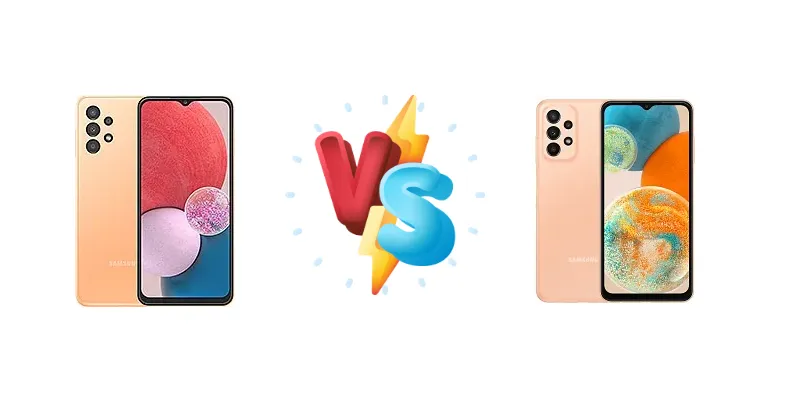
Samsung's Galaxy A series dominates the budget smartphone market, but choosing between models can be tricky. The Galaxy A13 and A23 5G represent distinct approaches: the A13 prioritizes longevity and affordability, while the A23 5G adds 5G connectivity and a more modern chipset. This comparison dives deep into the specifications to determine which phone delivers the best value.
🏆 Quick Verdict
For most users, the Samsung Galaxy A23 5G is the better choice. Its Snapdragon 695 chipset offers a noticeable performance boost over the A13’s Exynos 850, and the faster 25W charging significantly reduces downtime. While the A13 boasts comparable battery endurance, the A23 5G’s added features justify the slight price premium.
| Network |
|---|
| 2G bands | GSM 850 / 900 / 1800 / 1900 | GSM 850 / 900 / 1800 / 1900 |
| 3G bands | HSDPA 850 / 900 / 2100 | HSDPA 850 / 900 / 1700(AWS) / 1900 / 2100 |
| 4G bands | 1, 3, 5, 7, 8, 20, 28, 38, 40, 41 | 1, 2, 3, 4, 5, 7, 8, 12, 17, 20, 26, 28, 32, 38, 40, 41, 66 - International |
| 5G bands | - | 1, 3, 7, 8, 20, 28, 38, 40, 41, 77, 78 SA/NSA/Sub6 - International |
| Speed | HSPA, LTE | HSPA, LTE, 5G |
| Technology | GSM / HSPA / LTE | GSM / HSPA / LTE / 5G |
| | - | 2, 5, 30, 66, 77 SA/NSA/Sub6/mmWave - USA |
| Launch |
|---|
| Announced | 2022, March 04 | 2022, August 05 |
| Status | Available. Released 2022, March 23 | Available. Released 2022, September 02 |
| Body |
|---|
| Build | Glass front (Gorilla Glass 5), plastic frame, plastic back | Glass front (Gorilla Glass 5), plastic frame, plastic back |
| Dimensions | 165.1 x 76.4 x 8.8 mm (6.5 x 3.01 x 0.35 in) | 165.4 x 76.9 x 8.4 mm (6.51 x 3.03 x 0.33 in) |
| SIM | · Nano-SIM· Nano-SIM + Nano-SIM | · Nano-SIM· Nano-SIM + Nano-SIM |
| Weight | 195 g (6.88 oz) | 197 g (6.95 oz) |
| Display |
|---|
| Protection | Corning Gorilla Glass 5 | Corning Gorilla Glass 5 |
| Resolution | 1080 x 2408 pixels, 20:9 ratio (~400 ppi density) | 1080 x 2408 pixels, 20:9 ratio (~400 ppi density) |
| Size | 6.6 inches, 104.9 cm2 (~83.2% screen-to-body ratio) | 6.6 inches, 104.9 cm2 (~82.5% screen-to-body ratio) |
| Type | PLS LCD | PLS LCD, 120Hz |
| Platform |
|---|
| CPU | Octa-core (4x2.0 GHz Cortex-A55 & 4x2.0 GHz Cortex-A55) | Octa-core (2x2.2 GHz Kryo 660 Gold & 6x1.7 GHz Kryo 660 Silver) |
| Chipset | Exynos 850 (8 nm) | Qualcomm SM6375 Snapdragon 695 5G (6 nm) |
| GPU | Mali-G52 | Adreno 619 |
| OS | Android 12, upgradable to Android 14, One UI 6.1 | Android 12, upgradable to Android 14, One UI 6 |
| Memory |
|---|
| Card slot | microSDXC (dedicated slot) | microSDXC (dedicated slot) |
| Internal | 32GB 3GB RAM, 32GB 4GB RAM, 64GB 4GB RAM, 128GB 3GB RAM, 128GB 4GB RAM, 128GB 6GB RAM | 64GB 4GB RAM, 64GB 6GB RAM, 128GB 4GB RAM, 128GB 6GB RAM, 128GB 8GB RAM |
| | eMMC 5.1 | - |
| Main Camera |
|---|
| Features | LED flash, panorama, HDR | LED flash, panorama, HDR |
| Quad | 50 MP, f/1.8, (wide), PDAF
5 MP, f/2.2, 123˚ (ultrawide), 1/5.0", 1.12µm
2 MP (macro)
Auxiliary lens | 50 MP, f/1.8, 26mm (wide), 1/2.76", 0.64µm, PDAF, OIS
5 MP, f/2.2, 13mm, 123˚ (ultrawide), 1/5.0", 1.12µm
2 MP (macro)
Auxiliary lens |
| Single | 8 MP, f/2.2, (wide) | - |
| Video | 1080p@30fps | 1080p@30fps |
| Selfie camera |
|---|
| Single | 8 MP, f/2.2, (wide) | 8 MP, f/2.0, 25mm (wide), 1/4.0", 1.12µm - USA
8 MP, f/2.2, 25mm (wide), 1/4.0", 1.12µm - International |
| Video | 1080p@30fps | 1080p@30fps |
| Sound |
|---|
| 3.5mm jack | Yes | Yes |
| 35mm jack | Yes | Yes |
| Loudspeaker | Yes | Yes |
| Comms |
|---|
| Bluetooth | 5.0, A2DP, LE | 5.1, A2DP, LE |
| NFC | Yes (market/region dependent) | Yes |
| Positioning | GPS, GLONASS, GALILEO, BDS | GPS, GLONASS, GALILEO, BDS |
| Radio | No | FM radio (market/region dependent) |
| USB | USB Type-C 2.0, OTG | USB Type-C 2.0 |
| WLAN | Wi-Fi 802.11 a/b/g/n/ac, dual-band, Wi-Fi Direct | Wi-Fi 802.11 a/b/g/n/ac, dual-band, Wi-Fi Direct |
| Features |
|---|
| Sensors | Fingerprint (side-mounted), accelerometer, compass | Fingerprint (side-mounted), accelerometer, gyro, compass, barometer (USA only) |
| | Virtual proximity sensing | Virtual proximity sensing |
| Battery |
|---|
| Charging | 15W wired | 25W wired |
| Type | Li-Po 5000 mAh | Li-Po 5000 mAh |
| Misc |
|---|
| Colors | Black, White, Peach, Blue | Black, White, Peach, Blue |
| Models | SM-A135F, SM-A135F/DS, SM-A135M, SM-A135U, SM-A135U1, SM-A135N | SM-A236U, SM-A236U1, SM-A236B, SM-A236B/DS, SM-A236B/DSN, SM-A236E, SM-S236DL |
| Price | € 94.99 / $ 129.99 / £ 89.00 | $ 84.44 / £ 129.00 / € 125.28 / ₹ 21,000 |
| SAR | 0.49 W/kg (head) | 0.68 W/kg (head) 0.57 W/kg (body) |
| SAR EU | 0.37 W/kg (head) 1.39 W/kg (body) | 1.49 W/kg (head) 1.25 W/kg (body) |
| Tests |
|---|
| Battery life |
Endurance rating 114h
|
Endurance rating 138h
|
| Camera |
Photo / Video |
Photo / Video |
| Display |
Contrast ratio: 1324:1 (nominal) |
Contrast ratio: 1328:1 (nominal) |
| Loudspeaker |
-29.7 LUFS (Average)
|
-25.9 LUFS (Very good)
|
| Performance |
AnTuTu: 122822 (v8), 136286 (v9)
GeekBench: 588 (v5.1)
GFXBench: 5.2fps (ES 3.1 onscreen) |
AnTuTu: 318821 (v9)
GeekBench: 1940 (v5.1)
GFXBench: 16fps (ES 3.1 onscreen) |
Samsung Galaxy A13
- Slightly brighter display for outdoor visibility
- Longer battery endurance rating
- More affordable price point
- Less powerful Exynos 850 chipset
- Slower 15W charging
- Lacks 5G connectivity
Samsung Galaxy A23 5G
- Faster Snapdragon 695 chipset for smoother performance
- 25W fast charging for quicker top-ups
- 5G connectivity for faster data speeds
- Slightly dimmer display
- Higher price compared to the A13
- Slightly lower battery endurance rating
Display Comparison
Both the Galaxy A13 and A23 5G feature displays with a 1324:1 and 1328:1 contrast ratio respectively, indicating similar levels of black depth and overall image quality. However, the A13 edges out the A23 5G in peak brightness, reaching 587 nits compared to the A23 5G’s 508 nits. This means the A13 will be slightly more visible in direct sunlight. Both displays likely utilize PLS LCD technology, common in this price bracket, and lack high refresh rates, focusing on power efficiency over smoothness.
Camera Comparison
Both phones feature a 'Photo / Video' camera setup, but detailed sensor information is missing. Given the price point, expect similar image quality in good lighting conditions. The A23 5G’s Snapdragon ISP likely offers slightly better image processing capabilities, potentially resulting in improved dynamic range and noise reduction. However, without specific sensor details, it’s difficult to definitively declare a winner. The inclusion of a 2MP macro camera on both devices is largely a marketing tactic, offering limited practical benefit due to the small sensor size and lack of optical image stabilization (OIS).
Performance
The core difference lies in the chipsets. The A23 5G’s Qualcomm Snapdragon 695 (6nm) is a significant upgrade over the A13’s Exynos 850 (8nm). The 6nm process node allows for greater transistor density and improved power efficiency, translating to better sustained performance and less heat generation. The A23 5G’s CPU configuration – 2x2.2 GHz Kryo 660 Gold & 6x1.7 GHz Kryo 660 Silver – offers a more balanced approach than the A13’s Octa-core (4x2.0 GHz Cortex-A55 & 4x2.0 GHz Cortex-A55), which relies solely on efficiency cores. This means the A23 5G will handle multitasking and demanding apps more smoothly.
Battery Life
The A23 5G boasts an endurance rating of 138 hours, a notable improvement over the A13’s 114 hours. This translates to longer usage between charges, despite the A23 5G’s more powerful processor. The A23 5G also supports 25W wired charging, a significant advantage over the A13’s slower 15W charging. This means the A23 5G can replenish its battery much faster, minimizing downtime. While the A13’s larger battery capacity might offer slightly longer screen-on time in specific scenarios, the A23 5G’s efficiency and faster charging provide a more convenient overall experience.
Buying Guide
Buy the Samsung Galaxy A13 if you prioritize maximum battery life and are on an extremely tight budget, and 5G connectivity isn't a necessity. It's ideal for users who primarily browse, text, and make calls. Buy the Samsung Galaxy A23 5G if you want a more future-proof device with 5G support, faster charging, and improved performance for light gaming and multitasking. It’s the better option for users who want a phone that can handle a bit more.
Frequently Asked Questions
❓ Does the Exynos 850 in the A13 overheat during prolonged gaming sessions?
The Exynos 850 is a relatively efficient chip, but it can experience some throttling during extended gaming. While it won't shut down, you may notice frame rate drops after 30-45 minutes of demanding gameplay. The A23 5G’s Snapdragon 695, with its more efficient 6nm process, handles heat better.
❓ Is the 5G connectivity on the A23 5G actually useful, or is it just a marketing feature?
The usefulness of 5G depends on your location and carrier coverage. If you live in an area with robust 5G infrastructure, you'll experience significantly faster download and upload speeds compared to 4G LTE. However, if 5G coverage is limited, the benefit will be minimal. It also future-proofs the device for wider 5G availability.
❓ Are the camera differences between the A13 and A23 5G noticeable in everyday photos?
In good lighting conditions, the differences will be subtle. The A23 5G’s image processing might produce slightly more vibrant and detailed photos, but the overall quality will be comparable. The A23 5G may perform better in low-light scenarios due to its potentially more advanced ISP.
❓ How long does it realistically take to fully charge the A23 5G with the 25W charger?
Using the included 25W charger, the Samsung Galaxy A23 5G can typically charge from 0% to 100% in approximately 1 hour and 30 minutes. This is a significant improvement over the A13’s 15W charging, which can take over 2 hours for a full charge.