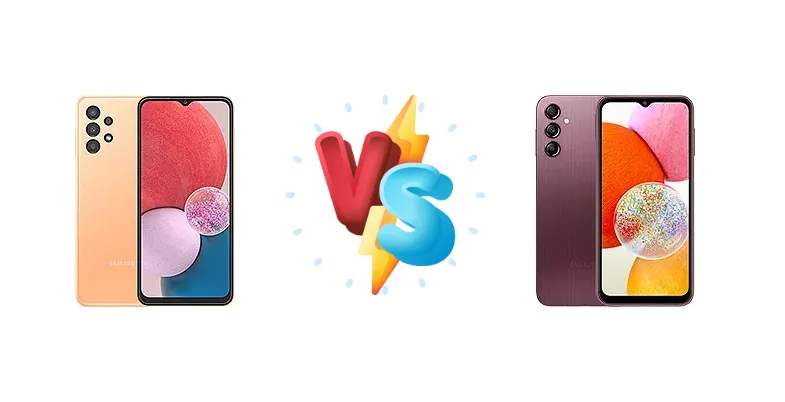
The Samsung Galaxy A series consistently delivers excellent value in the budget smartphone market. The A13 and A14 are two popular contenders, but which one offers the best bang for your buck? This comprehensive comparison will delve into their key features to help you make an informed decision.
🏆 Quick Verdict
The Galaxy A14 generally edges out the A13 thanks to its improved CPU and potentially better camera capabilities. While the A13 boasts impressive battery life, the A14's upgrades in processing power and design make it the slightly better choice for most users, especially considering similar pricing.
| Network |
|---|
| 2G bands | GSM 850 / 900 / 1800 / 1900 | GSM 850 / 900 / 1800 / 1900 |
| 3G bands | HSDPA 850 / 900 / 2100 | HSDPA 850 / 900 / 2100 |
| 4G bands | 1, 3, 5, 7, 8, 20, 28, 38, 40, 41 | 1, 3, 5, 7, 8, 20, 28, 38, 40, 41 |
| Speed | HSPA, LTE | HSPA, LTE |
| Technology | GSM / HSPA / LTE | GSM / HSPA / LTE |
| Launch |
|---|
| Announced | 2022, March 04 | 2023, February 28 |
| Status | Available. Released 2022, March 23 | Available. Released 2023, March 27 |
| Body |
|---|
| Build | Glass front (Gorilla Glass 5), plastic frame, plastic back | Glass front, plastic back, plastic frame |
| Dimensions | 165.1 x 76.4 x 8.8 mm (6.5 x 3.01 x 0.35 in) | 167.7 x 78 x 9.1 mm (6.60 x 3.07 x 0.36 in) |
| SIM | · Nano-SIM· Nano-SIM + Nano-SIM | · Nano-SIM· Nano-SIM + Nano-SIM |
| Weight | 195 g (6.88 oz) | 201 g (7.09 oz) |
| Display |
|---|
| Protection | Corning Gorilla Glass 5 | - |
| Resolution | 1080 x 2408 pixels, 20:9 ratio (~400 ppi density) | 1080 x 2408 pixels, 20:9 ratio (~400 ppi density) |
| Size | 6.6 inches, 104.9 cm2 (~83.2% screen-to-body ratio) | 6.6 inches, 104.9 cm2 (~80.2% screen-to-body ratio) |
| Type | PLS LCD | PLS LCD |
| Platform |
|---|
| CPU | Octa-core (4x2.0 GHz Cortex-A55 & 4x2.0 GHz Cortex-A55) | Octa-core (2x2.0 GHz Cortex-A75 & 6x1.8 GHz Cortex-A55) - Version AOcta-core (4x2.0 GHz Cortex-A55 & 4x2.0 GHz Cortex-A55) - Version B |
| Chipset | Exynos 850 (8 nm) | Mediatek MT6769 Helio G80 (12 nm) - Version AExynos 850 (8 nm) - Version B |
| GPU | Mali-G52 | Mali-G52 MC2 |
| OS | Android 12, upgradable to Android 14, One UI 6.1 | Android 13, upgradable to Android 15, One UI 7 |
| Memory |
|---|
| Card slot | microSDXC (dedicated slot) | microSDXC (dedicated slot) |
| Internal | 32GB 3GB RAM, 32GB 4GB RAM, 64GB 4GB RAM, 128GB 3GB RAM, 128GB 4GB RAM, 128GB 6GB RAM | 64GB 4GB RAM, 128GB 4GB RAM, 128GB 6GB RAM |
| | eMMC 5.1 | - |
| Main Camera |
|---|
| Features | LED flash, panorama, HDR | LED flash, panorama, HDR |
| Quad | 50 MP, f/1.8, (wide), PDAF
5 MP, f/2.2, 123˚ (ultrawide), 1/5.0", 1.12µm
2 MP (macro)
Auxiliary lens | - |
| Single | 8 MP, f/2.2, (wide) | 13 MP, f/2.0, (wide) |
| Triple | - | 50 MP, f/1.8, 26mm (wide), 1/2.75", 0.64µm, PDAF
5 MP, f/2.2, 17mm (ultrawide), 1/5.0", 1.12µm
2 MP (macro) |
| Video | 1080p@30fps | 1080p@30fps |
| Selfie camera |
|---|
| Single | 8 MP, f/2.2, (wide) | 13 MP, f/2.0, 26mm (wide), 1/3.1", 1.12µm |
| Video | 1080p@30fps | 1080p@30fps |
| Sound |
|---|
| 3.5mm jack | Yes | Yes |
| 35mm jack | Yes | Yes |
| Loudspeaker | Yes | Yes |
| Comms |
|---|
| Bluetooth | 5.0, A2DP, LE | 5.1 or 5.3, A2DP, LE |
| NFC | Yes (market/region dependent) | Yes (market/region dependent) |
| Positioning | GPS, GLONASS, GALILEO, BDS | GPS, GALILEO, GLONASS, BDS, QZSS |
| Radio | No | Unspecified |
| USB | USB Type-C 2.0, OTG | USB Type-C 2.0 |
| WLAN | Wi-Fi 802.11 a/b/g/n/ac, dual-band, Wi-Fi Direct | Wi-Fi 802.11 a/b/g/n/ac, dual-band, Wi-Fi Direct |
| Features |
|---|
| Sensors | Fingerprint (side-mounted), accelerometer, compass | Fingerprint (side-mounted), accelerometer, proximity, compass |
| | Virtual proximity sensing | - |
| Battery |
|---|
| Charging | 15W wired | 15W wired |
| Type | Li-Po 5000 mAh | Li-Po 5000 mAh |
| Misc |
|---|
| Colors | Black, White, Peach, Blue | Black, Dark Red, Silver, Green |
| Models | SM-A135F, SM-A135F/DS, SM-A135M, SM-A135U, SM-A135U1, SM-A135N | SM-A145F, SM-A145F/DSN, SM-A145M, SM-A145M/DS, SM-A145P, SM-A145R |
| Price | € 94.99 / $ 129.99 / £ 89.00 | € 85.76 / $ 147.60 / £ 79.95 |
| SAR | 0.49 W/kg (head) | - |
| SAR EU | 0.37 W/kg (head) 1.39 W/kg (body) | 0.46 W/kg (head) 1.37 W/kg (body) |
| Tests |
|---|
| Battery life |
Endurance rating 114h
| - |
| Camera |
Photo / Video | - |
| Display |
Contrast ratio: 1324:1 (nominal) | - |
| Loudspeaker |
-29.7 LUFS (Average)
| - |
| Performance |
AnTuTu: 122822 (v8), 136286 (v9)
GeekBench: 588 (v5.1)
GFXBench: 5.2fps (ES 3.1 onscreen) | - |
Samsung Galaxy A13
- Exceptional battery life
- Reliable performance
- Good value for money
- Large display
- Older chipset
- Less modern design
- Potentially slower performance compared to A14
Samsung Galaxy A14
- Improved chipset (Helio G80)
- Potentially better camera
- More modern design
- Likely 90Hz display
- Battery life may be slightly less than A13
- 15W charging is slow
- Performance varies depending on chipset version
Display Comparison
Both phones feature large displays, but the A14 is expected to have a slightly improved panel with a higher refresh rate (likely 90Hz vs A13's 60Hz). The A13's contrast ratio of 1324:1 is impressive, and its 587 nits brightness is respectable, but the A14's display should offer a smoother visual experience.
Camera Comparison
While specific camera specs are not fully detailed, the A14 is generally expected to offer improvements in image processing and potentially a higher resolution main sensor. Both phones likely feature a versatile multi-lens setup, but the A14's newer chipset should contribute to better low-light performance and overall image quality.
Performance
The A14's Mediatek Helio G80 chipset (Version A) represents a significant upgrade over the A13's Exynos 850. The A14's Cortex-A75 cores provide a boost in performance for demanding tasks and multitasking. Version B of the A14 retains the A13's CPU, diminishing the performance advantage.
Battery Life
The A13's endurance rating of 114 hours is outstanding, suggesting exceptional battery life. The A14 is expected to maintain good battery life, though potentially slightly less than the A13 due to the more power-hungry chipset. Both phones feature 15W wired charging.
Buying Guide
Who should buy the Samsung Galaxy A13? Users prioritizing exceptional battery life and a proven, reliable experience on a tight budget. Who should buy the Samsung Galaxy A14? Those seeking a slightly faster processor, a more modern design, and potentially improved camera performance, even within the budget category.
Frequently Asked Questions
❓ Is the Galaxy A14 worth the upgrade from the A13?
Generally, yes. The A14 offers a more modern chipset and potentially better camera performance, making it a worthwhile upgrade, especially if you value speed and image quality.
❓ Which phone has better battery life?
The Galaxy A13 is known for its exceptional battery life, exceeding the A14's expected performance.