
Google Pixel 6a vs. Samsung Galaxy A13: A Detailed Comparison
| Phones Images | |||||
|---|---|---|---|---|---|
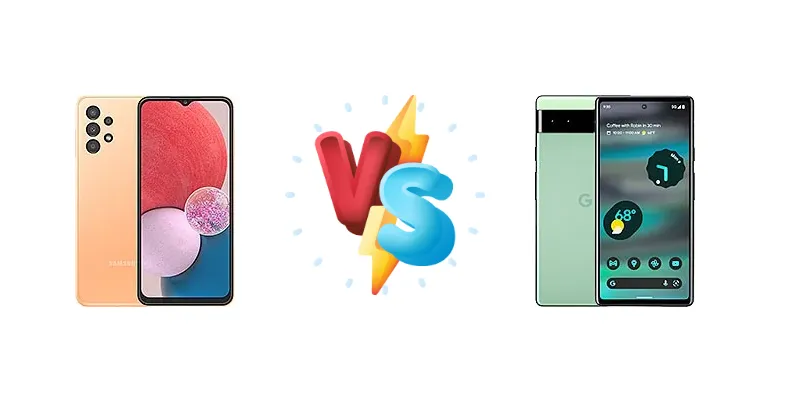
|
🏆 Quick Verdict
For most users, the Google Pixel 6a is the superior choice. While the Galaxy A13 boasts significantly better battery endurance, the Pixel 6a’s vastly more powerful Tensor chip and superior camera capabilities deliver a smoother, more versatile user experience justifying the price difference.
| PHONES | ||
|---|---|---|
| Phone Names | Samsung Galaxy A13 | Google Pixel 6a |
| Network | ||
|---|---|---|
| 2G bands | GSM 850 / 900 / 1800 / 1900 | GSM 850 / 900 / 1800 / 1900 |
| 3G bands | HSDPA 850 / 900 / 2100 | HSDPA 800 / 850 / 900 / 1700(AWS) / 1900 / 2100 |
| 4G bands | 1, 3, 5, 7, 8, 20, 28, 38, 40, 41 | 1, 2, 3, 4, 5, 7, 8, 12, 13, 14, 17, 18, 19, 20, 25, 26, 28, 29, 30, 38, 39, 40, 41, 42, 48, 66, 71 - GX7AS, GB62Z (USA/Canada) |
| 5G bands | - | 1, 2, 3, 5, 7, 8, 12, 20, 25, 28, 30, 38, 40, 41, 48, 66, 71, 77, 78 SA/NSA/Sub6 - GX7AS (USA/Canada) |
| Speed | HSPA, LTE | HSPA, LTE, 5G |
| Technology | GSM / HSPA / LTE | GSM / HSPA / LTE / 5G |
| - | 1, 2, 3, 5, 7, 8, 12, 20, 25, 28, 30, 40, 48, 66, 71, 77, 78 SA/NSA/Sub6 - G1AZG (International) | |
| Launch | ||
|---|---|---|
| Announced | 2022, March 04 | 2022, May 11 |
| Status | Available. Released 2022, March 23 | Available. Released 2022, July 21 |
| Body | ||
|---|---|---|
| Build | Glass front (Gorilla Glass 5), plastic frame, plastic back | Glass front (Gorilla Glass 3), aluminum frame, plastic back |
| Dimensions | 165.1 x 76.4 x 8.8 mm (6.5 x 3.01 x 0.35 in) | 152.2 x 71.8 x 8.9 mm (5.99 x 2.83 x 0.35 in) |
| SIM | · Nano-SIM· Nano-SIM + Nano-SIM | Nano-SIM + eSIM |
| Weight | 195 g (6.88 oz) | 178 g (6.28 oz) |
| - | IP67 dust/water resistant (up to 1m for 30 min) | |
| Display | ||
|---|---|---|
| Protection | Corning Gorilla Glass 5 | Corning Gorilla Glass 3 |
| Resolution | 1080 x 2408 pixels, 20:9 ratio (~400 ppi density) | 1080 x 2400 pixels, 20:9 ratio (~429 ppi density) |
| Size | 6.6 inches, 104.9 cm2 (~83.2% screen-to-body ratio) | 6.1 inches, 90.7 cm2 (~83.0% screen-to-body ratio) |
| Type | PLS LCD | OLED, HDR |
| - | Always-on display | |
| Platform | ||
|---|---|---|
| CPU | Octa-core (4x2.0 GHz Cortex-A55 & 4x2.0 GHz Cortex-A55) | Octa-core (2x2.80 GHz Cortex-X1 & 2x2.25 GHz Cortex-A76 & 4x1.80 GHz Cortex-A55) |
| Chipset | Exynos 850 (8 nm) | Google Tensor (5 nm) |
| GPU | Mali-G52 | Mali-G78 MP20 |
| OS | Android 12, upgradable to Android 14, One UI 6.1 | Android 12, upgradable to Android 15, up to 5 major Android upgrades |
| Memory | ||
|---|---|---|
| Card slot | microSDXC (dedicated slot) | No |
| Internal | 32GB 3GB RAM, 32GB 4GB RAM, 64GB 4GB RAM, 128GB 3GB RAM, 128GB 4GB RAM, 128GB 6GB RAM | 128GB 6GB RAM |
| eMMC 5.1 | UFS 3.1 | |
| Main Camera | ||
|---|---|---|
| Dual | - | 12.2 MP, f/1.7, 27mm, (wide), 1/2.55", 1.4µm, dual pixel PDAF, OIS 12 MP, f/2.2, 17mm, 114˚ (ultrawide), 1.25µm |
| Features | LED flash, panorama, HDR | Dual-LED flash, Pixel Shift, Auto-HDR, panorama |
| Quad | 50 MP, f/1.8, (wide), PDAF 5 MP, f/2.2, 123˚ (ultrawide), 1/5.0", 1.12µm 2 MP (macro) Auxiliary lens | - |
| Single | 8 MP, f/2.2, (wide) | 8 MP, f/2.0, 24mm (wide), 1.12µm |
| Video | 1080p@30fps | 4K@30/60fps, 1080p@30/60/120/240fps; gyro-EIS, OIS |
| Selfie camera | ||
|---|---|---|
| Features | - | HDR, panorama |
| Single | 8 MP, f/2.2, (wide) | 8 MP, f/2.0, 24mm (wide), 1.12µm |
| Video | 1080p@30fps | 1080p@30fps |
| Sound | ||
|---|---|---|
| 3.5mm jack | Yes | No |
| 35mm jack | Yes | No |
| Loudspeaker | Yes | Yes, with stereo speakers |
| Comms | ||
|---|---|---|
| Bluetooth | 5.0, A2DP, LE | 5.2, A2DP, LE |
| NFC | Yes (market/region dependent) | Yes |
| Positioning | GPS, GLONASS, GALILEO, BDS | GPS, GLONASS, GALILEO, QZSS |
| Radio | No | No |
| USB | USB Type-C 2.0, OTG | USB Type-C 3.1 |
| WLAN | Wi-Fi 802.11 a/b/g/n/ac, dual-band, Wi-Fi Direct | Wi-Fi 802.11 a/b/g/n/ac/6e, dual-band, Wi-Fi Direct |
| Features | ||
|---|---|---|
| Sensors | Fingerprint (side-mounted), accelerometer, compass | Fingerprint (under display, optical), accelerometer, gyro, proximity, compass, barometer |
| Virtual proximity sensing | - | |
| Battery | ||
|---|---|---|
| Charging | 15W wired | 18W wired, PD3.0 |
| Type | Li-Po 5000 mAh | Li-Po 4410 mAh |
| Misc | ||
|---|---|---|
| Colors | Black, White, Peach, Blue | Chalk, Charcoal, Sage |
| Models | SM-A135F, SM-A135F/DS, SM-A135M, SM-A135U, SM-A135U1, SM-A135N | GX7AS, GB62Z, G1AZG, GB17L |
| Price | € 94.99 / $ 129.99 / £ 89.00 | $ 138.99 / C$ 228.74 / ₹ 23,999 |
| SAR | 0.49 W/kg (head) | - |
| SAR EU | 0.37 W/kg (head) 1.39 W/kg (body) | - |
| Tests | ||
|---|---|---|
| Battery life | Endurance rating 114h | Endurance rating 94h |
| Camera | Photo / Video | - |
| Display | Contrast ratio: 1324:1 (nominal) | Contrast ratio: Infinite (nominal) |
| Loudspeaker | -29.7 LUFS (Average) | - |
| Performance | AnTuTu: 122822 (v8), 136286 (v9) GeekBench: 588 (v5.1) GFXBench: 5.2fps (ES 3.1 onscreen) | - |
Samsung Galaxy A13
- Exceptional battery life – easily lasts a full day for most users.
- Lower price point makes it accessible to a wider audience.
- Expandable storage via microSD card offers flexibility.
- Significantly slower processor limits performance.
- Display is less vibrant and dimmer than the Pixel 6a.
- Camera quality is noticeably inferior to the Pixel 6a.
Google Pixel 6a
- Powerful Google Tensor chip delivers smooth performance.
- Superior camera quality with advanced features like Magic Eraser.
- Brighter, more vibrant display enhances the viewing experience.
- Shorter battery life compared to the Galaxy A13.
- Higher price point may be a barrier for some buyers.
- No expandable storage.
Display Comparison
The Pixel 6a’s display achieves a significantly higher peak brightness of 876 nits compared to the Galaxy A13’s 587 nits, making it much more usable outdoors in direct sunlight. While the Galaxy A13 has a measured contrast ratio of 1324:1, the Pixel 6a claims an 'Infinite' contrast ratio, suggesting a superior OLED panel. This difference translates to deeper blacks and more vibrant colors on the Pixel. Both phones lack high refresh rates, but the Pixel’s superior brightness and contrast provide a more visually appealing experience.
Camera Comparison
Both phones offer photo and video capabilities, but the Pixel 6a leverages Google’s renowned computational photography expertise. While specific sensor details are missing for both, the Pixel 6a’s Tensor chip enables features like Magic Eraser and Real Tone, enhancing image quality and providing unique editing options. The A13 likely relies more on hardware, and its image processing won't match the Pixel's sophistication. The Pixel 6a’s superior processing power also translates to better low-light performance and more detailed video recording.
Performance
The core difference lies in the chipsets. The Google Pixel 6a’s Google Tensor (5nm) is a substantial upgrade over the Samsung Galaxy A13’s Exynos 850 (8nm). The Tensor’s octa-core configuration, featuring Cortex-X1 and A76 cores, delivers significantly faster processing speeds and improved graphics performance. The 5nm fabrication process also contributes to better thermal efficiency, reducing the likelihood of throttling during demanding tasks. While the A13 is adequate for basic tasks, the Pixel 6a handles multitasking, gaming, and resource-intensive applications with ease.
Battery Life
The Samsung Galaxy A13 dominates in battery endurance with a rating of 114 hours, compared to the Pixel 6a’s 94 hours. This translates to a noticeable difference in real-world usage, with the A13 potentially lasting a full day longer on a single charge. However, the Pixel 6a compensates with faster 18W charging with PD3.0 support, while the A13 is limited to 15W. While the A13’s larger battery provides longer runtime, the Pixel 6a’s faster charging minimizes downtime.
Buying Guide
Buy the Samsung Galaxy A13 if you absolutely prioritize battery life above all else and need a phone that can reliably last two days on a single charge. It’s ideal for users who primarily browse, text, and make calls. Buy the Google Pixel 6a if you value performance, camera quality, and software experience. It’s the better option for photography enthusiasts, gamers, and anyone who wants a phone that feels responsive and future-proof.