
Samsung Galaxy A13 5G vs Motorola Moto G Stylus 5G (2023): A Detailed Comparison
| Phones Images | |||||
|---|---|---|---|---|---|
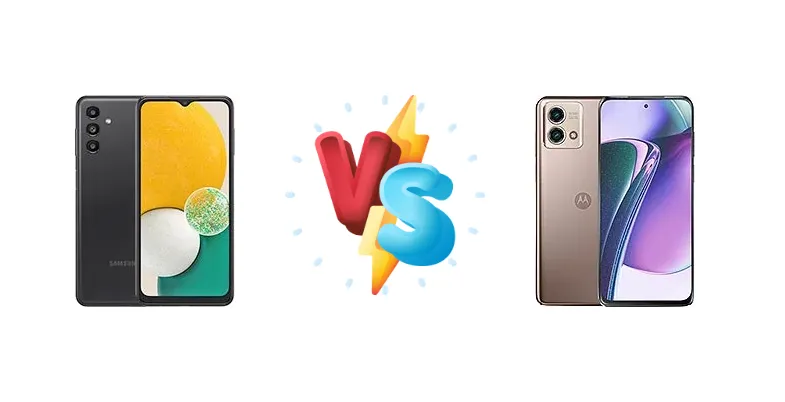
|
🏆 Quick Verdict
For most users, the Motorola Moto G Stylus 5G (2023) emerges as the better choice. Its Snapdragon 6 Gen 1, built on a more efficient 4nm process, provides a noticeable performance advantage and improved thermal management over the Galaxy A13 5G’s Dimensity 700. The faster 20W charging is also a significant benefit.
| PHONES | ||
|---|---|---|
| Phone Names | Samsung Galaxy A13 5G | Motorola Moto G Stylus 5G (2023) |
| Network | ||
|---|---|---|
| 2G bands | GSM 850 / 900 / 1800 / 1900 | GSM 850 / 900 / 1800 / 1900 |
| 3G bands | HSDPA 850 / 1700(AWS) / 1900 / 2100 | HSDPA 850 / 900 / 1700(AWS) / 1900 / 2100 |
| 4G bands | 1, 2, 3, 4, 5, 7, 12, 14, 20, 29, 30, 38, 39, 40, 41, 66 | 1, 2, 3, 4, 5, 7, 8, 12, 13, 14, 17, 18, 19, 20, 25, 26, 29, 30, 38, 39, 40, 41, 48, 66, 71 |
| 5G bands | 2, 5, 66, 77 Sub6/mmWave | 1, 2, 3, 5, 7, 12, 13, 14, 25, 26, 29, 30, 38, 41, 48, 66, 70, 71, 77, 78 SA/NSA |
| Speed | HSPA, LTE, 5G | HSPA, LTE, 5G |
| Technology | GSM / HSPA / LTE / 5G | GSM / HSPA / LTE / 5G |
| 2, 5, 41, 48, 66, 71, 77 Sub6/mmWave - SM-A136U | - | |
| Launch | ||
|---|---|---|
| Announced | 2021, December 02 | 2023, May 30 |
| Status | Available. Released 2021, December 03 | Available. Released 2023, June 02 |
| Body | ||
|---|---|---|
| Build | Glass front, plastic back, plastic frame | Glass front, plastic frame, plastic back |
| Dimensions | 164.5 x 76.5 x 8.8 mm (6.48 x 3.01 x 0.35 in) | 162.8 x 73.8 x 9.2 mm (6.41 x 2.91 x 0.36 in) |
| SIM | Nano-SIM | Nano-SIM |
| Weight | 195 g (6.88 oz) | 202 g (7.13 oz) |
| Display | ||
|---|---|---|
| Resolution | 720 x 1600 pixels, 20:9 ratio (~270 ppi density) | 1080 x 2400 pixels, 20:9 ratio (~399 ppi density) |
| Size | 6.5 inches, 102.0 cm2 (~81.1% screen-to-body ratio) | 6.6 inches, 105.2 cm2 (~87.5% screen-to-body ratio) |
| Type | PLS LCD, 90Hz | IPS LCD, 120Hz |
| Platform | ||
|---|---|---|
| CPU | Octa-core (2x2.2 GHz Cortex-A76 & 6x2.0 GHz Cortex-A55) | Octa-core (4x2.2 GHz Cortex-A78 & 4x1.8 GHz Cortex-A55) |
| Chipset | Mediatek Dimensity 700 (7 nm) | Qualcomm SM6450 Snapdragon 6 Gen 1 (4 nm) |
| GPU | Mali-G57 MC2 | Adreno 710 |
| OS | Android 11, upgradable to Android 14, One UI 6.1 | Android 13, planned upgrade to Android 14 |
| Memory | ||
|---|---|---|
| Card slot | microSDXC (dedicated slot) | microSDXC (dedicated slot) |
| Internal | 64GB 4GB RAM, 128GB 4GB RAM, 128GB 6GB RAM | 64GB 4GB RAM, 128GB 4GB RAM, 128GB 6GB RAM, 256GB 6GB RAM |
| Main Camera | ||
|---|---|---|
| Dual | - | 50 MP, f/1.9, (wide), 1.0µm, PDAF 8 MP, f/2.2, (ultrawide), 1/4.0", 1.12µm, AF |
| Features | LED flash, panorama, HDR | LED flash, HDR, panorama |
| Single | 5 MP, f/2.0, (wide) | - |
| Triple | 50 MP, f/1.8, 26mm (wide), PDAF 2 MP (macro) Auxiliary lens | - |
| Video | 1080p@30fps | 4K@30fps, 1080p@30/60fps |
| Selfie camera | ||
|---|---|---|
| Features | - | HDR |
| Single | 5 MP, f/2.0, (wide) | 16 MP, f/2.5, (wide), 1.0µm |
| Video | 1080p@30fps | 1080p@30fps |
| Sound | ||
|---|---|---|
| 3.5mm jack | Yes | - |
| 35mm jack | Yes | Yes |
| Loudspeaker | Yes | Yes, with stereo speakers |
| Comms | ||
|---|---|---|
| Bluetooth | 5.0, A2DP, LE | 5.1, A2DP, LE |
| NFC | Yes | Yes |
| Positioning | GPS, GLONASS, GALILEO | GPS (L1+L5), GALILEO |
| Radio | Unspecified | FM radio |
| USB | USB Type-C 2.0 | USB Type-C 2.0 |
| WLAN | Wi-Fi 802.11 a/b/g/n/ac, dual-band, Wi-Fi Direct | Wi-Fi 802.11 a/b/g/n/ac, dual-band |
| Features | ||
|---|---|---|
| Sensors | Fingerprint (side-mounted), accelerometer, gyro, compass, barometer | Fingerprint (side-mounted), accelerometer, gyro, proximity, compass, barometer |
| Virtual proximity sensing | - | |
| Battery | ||
|---|---|---|
| Charging | 15W wired | 20W wired |
| Type | Li-Po 5000 mAh | Li-Po 5000 mAh |
| Misc | ||
|---|---|---|
| Colors | Black | Cosmic Black, Rose Champagne |
| Models | SM-A136U, SM-A136U1, SM-A136W, SM-A136B, SM-S136DL | XT2315-1, XT2315-4 |
| Price | € 178.00 / $ 64.00 / £ 72.54 | $ 93.43 |
| SAR | 1.27 W/kg (head) 0.58 W/kg (body) | - |
Samsung Galaxy A13 5G
- Established Brand Reputation
- Potentially Wider Carrier Compatibility
- Generally Lower Price Point (depending on retailer)
- Older Chipset Architecture
- Slower 15W Charging
- Potential for Thermal Throttling
Motorola Moto G Stylus 5G (2023)
- More Efficient Snapdragon 6 Gen 1 Chipset
- Faster 20W Charging
- Integrated Stylus for Enhanced Productivity
- Motorola’s Software Update History Can Be Spotty
- May Not Be Available Through All Carriers
Display Comparison
Neither device boasts a standout display. Both likely utilize LCD panels, a common cost-saving measure in this segment. While specific brightness data isn't provided, the A13 5G's display is likely adequate for indoor use, but may struggle in direct sunlight. The Moto G Stylus 5G (2023) doesn't specify any display enhancements either, suggesting a similar experience. Bezels are expected to be noticeable on both, contributing to a less immersive viewing experience compared to higher-end devices.
Camera Comparison
Without detailed sensor information, a direct camera comparison is difficult. However, the market segment suggests both phones will rely on primary sensors around the 50MP mark. The Motorola’s image processing is likely tuned for vibrant colors, while Samsung often aims for a more natural look. The presence of a stylus on the Motorola suggests a focus on creative tasks, potentially benefiting from software optimizations for note-taking and sketching. The inclusion of a 2MP macro lens on both devices is largely a marketing tactic, offering limited practical benefit due to the small sensor size and lack of optical image stabilization (OIS).
Performance
The core difference lies in the chipsets. The Motorola Moto G Stylus 5G (2023) utilizes the Qualcomm SM6450 Snapdragon 6 Gen 1 (4nm), featuring four Cortex-A78 cores clocked at 2.2 GHz alongside four Cortex-A55 cores. This architecture represents a significant step up from the Samsung Galaxy A13 5G’s Mediatek Dimensity 700 (7nm), which employs two Cortex-A76 cores and six Cortex-A55 cores. The 4nm fabrication process of the Snapdragon 6 Gen 1 translates to improved power efficiency and reduced thermal throttling, meaning sustained performance will be higher. While both have octa-core CPUs, the A78 cores in the Snapdragon offer a performance boost over the A76 cores in the Dimensity 700. The Moto G Stylus 5G (2023) will likely handle multitasking and demanding apps more smoothly.
Battery Life
Battery life will depend heavily on usage patterns. While mAh capacity isn't specified, both phones likely house batteries in the 5000mAh range. However, the Motorola Moto G Stylus 5G (2023) gains a significant advantage with its 20W wired charging, allowing for a much faster 0-100% charge time compared to the Samsung Galaxy A13 5G’s 15W charging. The Snapdragon 6 Gen 1’s improved efficiency also contributes to potentially longer battery life under sustained load.
Buying Guide
Buy the Samsung Galaxy A13 5G if you prioritize brand recognition and a potentially wider carrier compatibility, and are comfortable with slightly slower performance and charging. Buy the Motorola Moto G Stylus 5G (2023) if you value a more modern chipset architecture, faster charging, and a smoother overall user experience, especially for multitasking and light gaming.