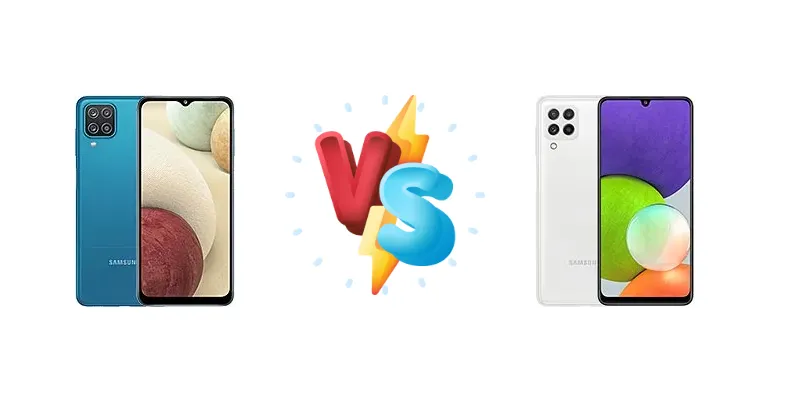
The Samsung Galaxy A12 and A22 represent Samsung’s commitment to offering affordable smartphones. While both aim to deliver essential features at a competitive price, they differ significantly in key areas like processing power and display quality. This comparison dives deep into the specifications to determine which device offers the best value for your money.
🏆 Quick Verdict
For most users, the Samsung Galaxy A22 is the superior choice. Its Helio G80 chipset provides a noticeable performance boost over the A12’s Helio P35, making it better suited for multitasking and gaming. While battery life is comparable, the A22’s brighter display enhances the overall user experience.
| Network |
|---|
| 2G bands | GSM 850 / 900 / 1800 / 1900 | GSM 850 / 900 / 1800 / 1900 |
| 3G bands | HSDPA 850 / 900 / 2100 | HSDPA 850 / 900 / 2100 |
| 4G bands | 1, 3, 5, 7, 8, 20, 28, 38, 40, 41 | 1, 3, 5, 7, 8, 20, 28, 38, 40, 41 |
| Speed | HSPA 42.2/5.76 Mbps, LTE Cat4 150/50 Mbps | HSPA, LTE |
| Technology | GSM / HSPA / LTE | GSM / HSPA / LTE |
| Launch |
|---|
| Announced | 2020, November 24. Released 2020, December 21 | 2021, June 03 |
| Status | Discontinued | Available. Released 2021, July 01 |
| Body |
|---|
| Build | Glass front, plastic back, plastic frame | Glass front, plastic frame, plastic back |
| Dimensions | 164 x 75.8 x 8.9 mm (6.46 x 2.98 x 0.35 in) | 159.3 x 73.6 x 8.4 mm (6.27 x 2.90 x 0.33 in) |
| SIM | · Nano-SIM· Nano-SIM + Nano-SIM | · Nano-SIM· Nano-SIM + Nano-SIM |
| Weight | 205 g (7.23 oz) | 186 g (6.56 oz) |
| Display |
|---|
| Resolution | 720 x 1600 pixels, 20:9 ratio (~270 ppi density) | 720 x 1600 pixels, 20:9 ratio (~274 ppi density) |
| Size | 6.5 inches, 102.0 cm2 (~82.1% screen-to-body ratio) | 6.4 inches, 98.9 cm2 (~84.3% screen-to-body ratio) |
| Type | PLS LCD | Super AMOLED, 90Hz, 600 nits |
| Platform |
|---|
| CPU | Octa-core (4x2.35 GHz Cortex-A53 & 4x1.8 GHz Cortex-A53) | Octa-core (2x2.0 GHz Cortex-A75 & 6x1.8 GHz Cortex-A55) |
| Chipset | Mediatek MT6765 Helio P35 (12 nm) | Mediatek MT6769V/CU Helio G80 (12 nm) |
| GPU | PowerVR GE8320 | Mali-G52 MC2 |
| OS | Android 10, upgradable to Android 12, One UI 4.1 | Android 11, upgradable to Android 13, One UI 5 |
| Memory |
|---|
| Card slot | microSDXC (dedicated slot) | microSDXC (dedicated slot) |
| Internal | 32GB 2GB RAM, 32GB 3GB RAM, 32GB 4GB RAM, 64GB 2GB RAM, 64GB 4GB RAM, 128GB 2GB RAM, 128GB 3GB RAM, 128GB 4GB RAM, 128GB 6GB RAM | 64GB 4GB RAM, 128GB 4GB RAM, 128GB 6GB RAM |
| | eMMC 5.1 | eMMC 5.1 |
| Main Camera |
|---|
| Go | - |
| Features | LED flash, panorama, HDR | LED flash, panorama, HDR |
| Quad | 48 MP, f/2.0, 26mm (wide), AF
5 MP, f/2.2, 123˚ (ultrawide)
2 MP (macro)
Auxiliary lens | 48 MP, f/1.8, (wide), 1/2.0", 0.8µm, PDAF, OIS
8 MP, f/2.2, 123˚ (ultrawide), 1/4.0", 1.12µm
2 MP (macro)
Auxiliary lens |
| Single | - | 13 MP, f/2.2, (wide), 1/3.1", 1.12µm |
| Video | 1080p@30fps | 1080p@30fps |
| Selfie camera |
|---|
| Single | 8 MP, f/2.2 | 13 MP, f/2.2, (wide), 1/3.1", 1.12µm |
| Video | 1080p@30fps | 1080p@30fps |
| Sound |
|---|
| 3.5mm jack | Yes | Yes |
| 35mm jack | Yes | Yes |
| Loudspeaker | Yes | Yes |
| Comms |
|---|
| Bluetooth | 5.0, A2DP, LE | 5.0, A2DP, LE |
| NFC | Yes (market/region dependent) | Yes (market/region dependent) |
| Positioning | GPS, GLONASS, GALILEO, BDS | GPS, GLONASS, GALILEO, BDS |
| Radio | FM radio, RDS, recording | FM radio |
| USB | USB Type-C 2.0 | USB Type-C 2.0 |
| WLAN | Wi-Fi 802.11 b/g/n, Wi-Fi Direct | Wi-Fi 802.11 a/b/g/n/ac, dual-band, Wi-Fi Direct |
| Features |
|---|
| Sensors | Fingerprint (side-mounted), accelerometer | Fingerprint (side-mounted), accelerometer, gyro, compass |
| | Virtual proximity sensing | Virtual proximity sensing |
| Battery |
|---|
| Charging | 15W wired | 15W wired |
| Type | Li-Po 5000 mAh | Li-Po 5000 mAh |
| Misc |
|---|
| Colors | Black, White, Blue, Red | Black, White, Mint, Violet |
| Models | SM-A125F/DSN, SM-A125F/DS, SM-A125F, SM-A125M, SM-A125U, SM-A125U1, SM-A125N, SM-A125W | SM-A225F, SM-A225F/DS, SM-A225M, SM-A225M/DS |
| Price | € 78.89 / $ 60.00 / £ 69.99 | € 193.97 / £ 160.00 |
| SAR EU | 0.67 W/kg (head) 1.38 W/kg (body) | 0.52 W/kg (head) 1.59 W/kg (body) |
| Tests |
|---|
| Battery life | Endurance rating 123h |
Endurance rating 121h
|
| Camera |
Photo / Video |
Photo / Video |
| Display |
Contrast ratio: 1363:1 (nominal) |
Contrast ratio: Infinite (nominal) |
| Loudspeaker |
-30.4 LUFS (Below average) |
-30.6 LUFS (Below average)
|
| Performance |
AnTuTu: 107189 (v8)
GeekBench: 1034 (v5.1)
GFXBench: 5fps (ES 3.1 onscreen) |
AnTuTu: 185358 (v8), 165959 (v9)
GeekBench: 5464 (v4.4), 1372 (v5.1)
GFXBench: 16fps (ES 3.1 onscreen) |
Samsung Galaxy A12
- Slightly longer battery endurance (measured)
- More affordable price point (likely)
- Sufficient for basic smartphone tasks
- Significantly weaker processor
- Dimmer display with lower contrast
- Less responsive user experience
Samsung Galaxy A22
- Faster and more efficient processor
- Brighter and more vibrant display
- Improved multitasking and gaming performance
- Slightly shorter battery endurance (measured)
- Potentially higher price point
- May experience more heat under heavy load
Display Comparison
The Samsung Galaxy A22 boasts a significantly brighter display, reaching a measured 597 nits compared to the A12’s 472 nits. This translates to better visibility outdoors and a more engaging viewing experience. While the A12 has a measured contrast ratio of 1363:1, the A22 claims an 'Infinite' contrast ratio, suggesting a superior panel capable of deeper blacks. This difference in brightness and contrast will be particularly noticeable when consuming media or browsing photos.
Camera Comparison
Both phones feature a photo/video camera setup, but the context data doesn’t provide enough detail for a meaningful comparison beyond that. Given the A22’s positioning as a slightly more premium device, it’s reasonable to assume it may have a more refined image processing algorithm and potentially a higher-resolution main sensor, though this is speculative without further information. The presence of a 2MP macro camera on both devices is unlikely to be a significant differentiating factor for most users.
Performance
The core difference between these two devices lies in their chipsets. The A22 utilizes the MediaTek Helio G80, featuring a dual-core Cortex-A75 setup alongside six Cortex-A55 cores, clocked at 2.0 GHz and 1.8 GHz respectively. This is a substantial upgrade over the A12’s Helio P35, which employs four Cortex-A53 cores at 2.35 GHz and another four at 1.8 GHz. The A75 cores in the G80 offer significantly improved single-core performance, resulting in snappier app launches and smoother multitasking. While both are 12nm chips, the architectural improvements in the G80 provide a clear advantage.
Battery Life
Both the A12 and A22 achieve an endurance rating of approximately 121-123 hours, indicating comparable battery life. Both devices also support 15W wired charging. The slight difference in endurance is likely attributable to variations in power consumption due to the A22’s more powerful processor and brighter display, but the overall real-world battery experience should be similar for typical usage patterns.
Buying Guide
Buy the Samsung Galaxy A12 if you prioritize maximum battery endurance and are primarily focused on basic smartphone tasks like calling, texting, and light social media use. Buy the Samsung Galaxy A22 if you value a brighter, more vibrant display and need a phone capable of handling more demanding applications and occasional gaming without significant lag.
Frequently Asked Questions
❓ Will the Helio G80 in the A22 struggle with demanding games like PUBG?
While the Helio G80 isn't a flagship gaming chip, it's a significant step up from the Helio P35 in the A12. You can expect playable frame rates in PUBG at medium settings, but don't anticipate a consistently smooth experience at the highest graphical settings. The A12 would likely struggle even at lower settings.
❓ Is the difference in display brightness noticeable in everyday use?
Yes, the 125-nit difference in peak brightness is quite noticeable, especially when using the phone outdoors or in brightly lit environments. The A22’s display will be much easier to see in direct sunlight, and colors will appear more vibrant.
❓ Does the A22 get significantly hotter than the A12 during prolonged use?
The Helio G80 is more powerful and therefore generates more heat than the Helio P35. While neither phone is prone to overheating, the A22 may become warmer during extended gaming sessions or when running multiple apps simultaneously. However, this is a trade-off for the improved performance.