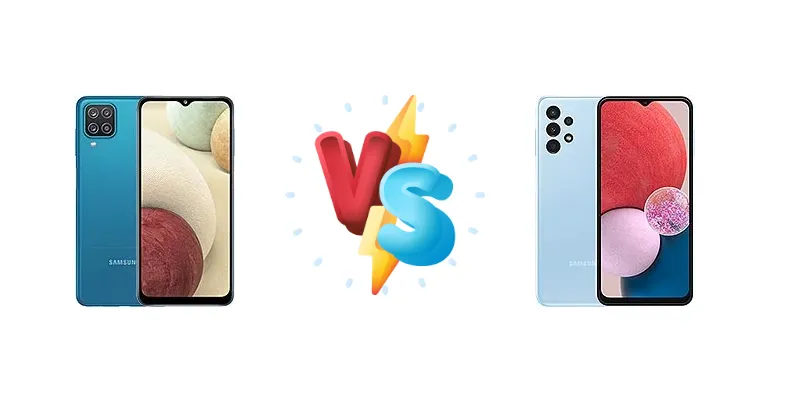
The Samsung Galaxy A12 and A13 represent Samsung's commitment to the affordable smartphone market. While both aim to deliver essential features at a low price point, the A13 introduces a newer chipset and subtle refinements. This comparison dissects the key differences to determine which device offers the best value for budget-conscious consumers.
🏆 Quick Verdict
For most users, the Samsung Galaxy A13 (SM-A137) is the better choice. The upgrade to the MediaTek Helio G80 chipset provides a noticeable performance boost over the A12’s Helio P35, making it more responsive for everyday tasks and light gaming. While battery endurance is similar, the A13’s improved processing power justifies the slight price difference.
| Network |
|---|
| 2G bands | GSM 850 / 900 / 1800 / 1900 | GSM 850 / 900 / 1800 / 1900 |
| 3G bands | HSDPA 850 / 900 / 2100 | HSDPA 850 / 900 / 2100 |
| 4G bands | 1, 3, 5, 7, 8, 20, 28, 38, 40, 41 | 1, 3, 5, 7, 8, 20, 28, 38, 40, 41 |
| Speed | HSPA 42.2/5.76 Mbps, LTE Cat4 150/50 Mbps | HSPA, LTE |
| Technology | GSM / HSPA / LTE | GSM / HSPA / LTE |
| Launch |
|---|
| Announced | 2020, November 24. Released 2020, December 21 | 2022, June |
| Status | Discontinued | Available. Released 2022, July |
| Body |
|---|
| Build | Glass front, plastic back, plastic frame | Glass front (Gorilla Glass 5), plastic frame, plastic back |
| Dimensions | 164 x 75.8 x 8.9 mm (6.46 x 2.98 x 0.35 in) | 165.1 x 76.4 x 8.8 mm (6.5 x 3.01 x 0.35 in) |
| SIM | · Nano-SIM· Nano-SIM + Nano-SIM | · Nano-SIM· Nano-SIM + Nano-SIM |
| Weight | 205 g (7.23 oz) | 195 g (6.88 oz) |
| Display |
|---|
| Protection | - | Corning Gorilla Glass 5 |
| Resolution | 720 x 1600 pixels, 20:9 ratio (~270 ppi density) | 1080 x 2408 pixels, 20:9 ratio (~400 ppi density) |
| Size | 6.5 inches, 102.0 cm2 (~82.1% screen-to-body ratio) | 6.6 inches, 104.9 cm2 (~83.2% screen-to-body ratio) |
| Type | PLS LCD | PLS LCD |
| Platform |
|---|
| CPU | Octa-core (4x2.35 GHz Cortex-A53 & 4x1.8 GHz Cortex-A53) | Octa-core (2x2.0 GHz Cortex-A75 & 6x1.8 GHz Cortex-A55) |
| Chipset | Mediatek MT6765 Helio P35 (12 nm) | Mediatek MT6769V/CU Helio G80 (12 nm) |
| GPU | PowerVR GE8320 | Mali-G52 MC2 |
| OS | Android 10, upgradable to Android 12, One UI 4.1 | Android 12, upgradable to Android 14, One UI 6.1 |
| Memory |
|---|
| Card slot | microSDXC (dedicated slot) | microSDXC (dedicated slot) |
| Internal | 32GB 2GB RAM, 32GB 3GB RAM, 32GB 4GB RAM, 64GB 2GB RAM, 64GB 4GB RAM, 128GB 2GB RAM, 128GB 3GB RAM, 128GB 4GB RAM, 128GB 6GB RAM | 32GB 3GB RAM, 32GB 4GB RAM, 64GB 4GB RAM, 128GB 4GB RAM |
| | eMMC 5.1 | eMMC 5.1 |
| Main Camera |
|---|
| Go | - |
| Features | LED flash, panorama, HDR | LED flash, panorama, HDR |
| Quad | 48 MP, f/2.0, 26mm (wide), AF
5 MP, f/2.2, 123˚ (ultrawide)
2 MP (macro)
Auxiliary lens | 50 MP, f/1.8, (wide), PDAF
5 MP, f/2.2, 123˚ (ultrawide), 1/5.0", 1.12µm
2 MP (macro)
Auxiliary lens |
| Single | - | 8 MP, f/2.2, (wide) |
| Video | 1080p@30fps | 1080p@30fps |
| Selfie camera |
|---|
| Single | 8 MP, f/2.2 | 8 MP, f/2.2, (wide) |
| Video | 1080p@30fps | 1080p@30fps |
| Sound |
|---|
| 3.5mm jack | Yes | Yes |
| 35mm jack | Yes | Yes |
| Loudspeaker | Yes | Yes |
| Comms |
|---|
| Bluetooth | 5.0, A2DP, LE | 5.2, A2DP, LE |
| NFC | Yes (market/region dependent) | Yes |
| Positioning | GPS, GLONASS, GALILEO, BDS | GPS, GLONASS, GALILEO, BDS |
| Radio | FM radio, RDS, recording | No |
| USB | USB Type-C 2.0 | USB Type-C 2.0, OTG |
| WLAN | Wi-Fi 802.11 b/g/n, Wi-Fi Direct | Wi-Fi 802.11 a/b/g/n/ac, dual-band, Wi-Fi Direct |
| Features |
|---|
| Sensors | Fingerprint (side-mounted), accelerometer | Fingerprint (side-mounted), accelerometer, compass |
| | Virtual proximity sensing | Virtual proximity sensing |
| Battery |
|---|
| Charging | 15W wired | 15W wired |
| Type | Li-Po 5000 mAh | Li-Po 5000 mAh |
| Misc |
|---|
| Colors | Black, White, Blue, Red | Black, White, Blue |
| Models | SM-A125F/DSN, SM-A125F/DS, SM-A125F, SM-A125M, SM-A125U, SM-A125U1, SM-A125N, SM-A125W | SM-A137F, SM-A137F/DSN, SM-A137F/DS |
| Price | € 78.89 / $ 60.00 / £ 69.99 | About 180 EUR |
| SAR EU | 0.67 W/kg (head) 1.38 W/kg (body) | 0.35 W/kg (head) 1.22 W/kg (body) |
| Tests |
|---|
| Battery life | Endurance rating 123h | - |
| Camera |
Photo / Video | - |
| Display |
Contrast ratio: 1363:1 (nominal) | - |
| Loudspeaker |
-30.4 LUFS (Below average) | - |
| Performance |
AnTuTu: 107189 (v8)
GeekBench: 1034 (v5.1)
GFXBench: 5fps (ES 3.1 onscreen) | - |
Samsung Galaxy A12
- Excellent battery endurance (123h)
- Lower price point (likely)
- Sufficient for basic smartphone tasks
- Underpowered Helio P35 chipset
- Slower app loading times
- Less responsive multitasking
Samsung Galaxy A13 (SM-A137)
- More powerful Helio G80 chipset
- Improved multitasking and app responsiveness
- Better gaming performance (casual titles)
- Battery life potentially slightly lower than A12
- Higher price point
- Charging speed remains slow (15W)
Display Comparison
Both the A12 and A13 share a similar display experience, though specific details are limited for the A13. The A12 boasts a measured peak brightness of 472 nits and a 1363:1 contrast ratio. Without comparable data for the A13, it’s reasonable to assume a similar level of brightness and contrast, typical for this price segment. The lack of high refresh rate panels on either device means scrolling and animations won’t be as fluid as on more expensive phones. The A13’s display size is likely similar, focusing on maximizing screen real estate within a budget-friendly form factor.
Camera Comparison
Both phones are listed as having 'Photo / Video' capabilities, but detailed camera specifications are absent. Given their price point, it’s safe to assume both rely on basic camera setups. The A13’s improved processing power *may* lead to slightly better image processing, but the primary sensor and lens quality are likely comparable. The inclusion of a 2MP macro camera on both devices is largely a marketing feature, offering limited practical benefit due to the low resolution and lack of optical image stabilization (OIS).
Performance
The core difference between these two devices lies in their chipsets. The Galaxy A12 utilizes the MediaTek Helio P35 (12nm), featuring an octa-core CPU with a split configuration of 4x2.35 GHz Cortex-A53 and 4x1.8 GHz Cortex-A53 cores. The A13 steps up to the MediaTek Helio G80 (12nm), employing a more modern CPU architecture with 2x2.0 GHz Cortex-A75 and 6x1.8 GHz Cortex-A55 cores. The Cortex-A75 cores in the G80 offer significantly improved single-core performance, resulting in snappier app launches and smoother multitasking. This architectural shift translates to a more responsive user experience, particularly noticeable when switching between applications or browsing the web.
Battery Life
The Galaxy A12 boasts an endurance rating of 123 hours, indicating excellent battery life for moderate usage. The A13’s battery capacity isn’t specified, but given the more powerful chipset, it’s likely similar in size to maintain comparable endurance. Both phones support 15W wired charging, meaning charging times will be relatively slow compared to devices with faster charging capabilities. The A13’s more efficient chipset *could* slightly offset the power draw, potentially leading to marginally longer battery life in certain scenarios, but the difference is unlikely to be substantial.
Buying Guide
Buy the Samsung Galaxy A12 if your primary need is maximizing battery life and you primarily use your phone for basic tasks like calls, texts, and light social media. It’s a solid option for those on a very tight budget. Buy the Samsung Galaxy A13 (SM-A137) if you prioritize smoother performance for multitasking, streaming, and casual gaming, and are willing to spend a little more for a more responsive experience.
Frequently Asked Questions
❓ Will the Galaxy A13 handle demanding games like PUBG or Call of Duty?
While the Helio G80 is an improvement over the P35, the Galaxy A13 is not designed for high-end gaming. You'll be able to play less demanding titles and casual games comfortably, but expect to lower graphics settings and potentially experience frame drops in more intensive games like PUBG or Call of Duty.
❓ Is the difference in performance between the Helio P35 and Helio G80 noticeable in everyday use?
Yes, the difference is noticeable. The Helio G80’s Cortex-A75 cores provide a significant boost in single-core performance, resulting in snappier app launches, smoother scrolling, and a more responsive overall user experience. Tasks like web browsing and switching between apps will feel considerably faster on the A13.
❓ Does the Galaxy A13 support fast charging, and how long does it take to fully charge?
Both the A12 and A13 support 15W wired charging, which is relatively slow compared to modern smartphones. Expect a full charge to take approximately 2-3 hours, depending on the charger and battery level.
❓ How does the camera quality compare between the A12 and A13, considering both lack detailed specs?
Without specific sensor details, it's difficult to definitively say. However, the A13’s more powerful processor *could* result in slightly better image processing, leading to improved dynamic range and noise reduction. Don't expect a dramatic difference, though, as both likely utilize similar budget camera modules.