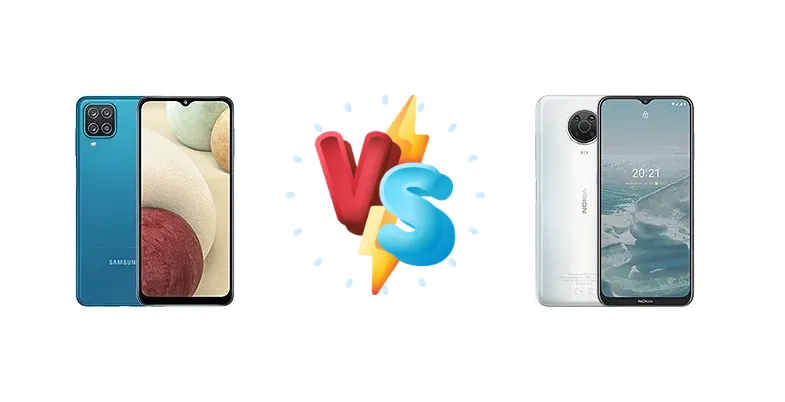
The Samsung Galaxy A12 and Nokia G20 represent the extreme end of the budget smartphone market. Both aim to deliver essential smartphone functionality at the lowest possible price, but they take different approaches. This comparison dissects their key specifications to determine which offers the best value for users prioritizing longevity and usability.
🏆 Quick Verdict
For most users, the Samsung Galaxy A12 is the better choice. While both phones utilize Mediatek’s Helio series, the A12’s brighter 472-nit display and slightly better-documented endurance rating of 123 hours give it a practical edge over the Nokia G20’s 10W charging and limited spec sheet.
| Network |
|---|
| 2G bands | GSM 850 / 900 / 1800 / 1900 | GSM 850 / 900 / 1800 / 1900 |
| 3G bands | HSDPA 850 / 900 / 2100 | HSDPA 850 / 900 / 1900 / 2100 - International |
| 4G bands | 1, 3, 5, 7, 8, 20, 28, 38, 40, 41 | 1, 3, 5, 7, 8, 20, 28, 38, 40, 41 - International |
| Speed | HSPA 42.2/5.76 Mbps, LTE Cat4 150/50 Mbps | HSPA 42.2/5.76 Mbps, LTE Cat4 150/50 Mbps |
| Technology | GSM / HSPA / LTE | GSM / HSPA / LTE |
| | - | 1, 2, 3, 4, 5, 7, 8, 12, 17, 28, 66 - LATAM |
| Launch |
|---|
| Announced | 2020, November 24. Released 2020, December 21 | 2021, April 08 |
| Status | Discontinued | Available. Released 2021, May 17 |
| Body |
|---|
| Build | Glass front, plastic back, plastic frame | - |
| Dimensions | 164 x 75.8 x 8.9 mm (6.46 x 2.98 x 0.35 in) | 164.9 x 76 x 9.2 mm (6.49 x 2.99 x 0.36 in) |
| SIM | · Nano-SIM· Nano-SIM + Nano-SIM | · Nano-SIM· Nano-SIM + Nano-SIM |
| Weight | 205 g (7.23 oz) | 197 g (6.95 oz) |
| | - | Splash protection |
| Display |
|---|
| Resolution | 720 x 1600 pixels, 20:9 ratio (~270 ppi density) | 720 x 1600 pixels, 20:9 ratio (~269 ppi density) |
| Size | 6.5 inches, 102.0 cm2 (~82.1% screen-to-body ratio) | 6.52 inches, 102.6 cm2 (~81.9% screen-to-body ratio) |
| Type | PLS LCD | IPS LCD |
| Platform |
|---|
| CPU | Octa-core (4x2.35 GHz Cortex-A53 & 4x1.8 GHz Cortex-A53) | Octa-core (4x2.3 GHz Cortex-A53 & 4x1.8 GHz Cortex-A53) |
| Chipset | Mediatek MT6765 Helio P35 (12 nm) | Mediatek MT6765G Helio G35 (12 nm) |
| GPU | PowerVR GE8320 | PowerVR GE8320 |
| OS | Android 10, upgradable to Android 12, One UI 4.1 | Android 11, upgradable to Android 13 |
| Memory |
|---|
| Card slot | microSDXC (dedicated slot) | microSDXC (dedicated slot) |
| Internal | 32GB 2GB RAM, 32GB 3GB RAM, 32GB 4GB RAM, 64GB 2GB RAM, 64GB 4GB RAM, 128GB 2GB RAM, 128GB 3GB RAM, 128GB 4GB RAM, 128GB 6GB RAM | 64GB 4GB RAM, 128GB 4GB RAM |
| | eMMC 5.1 | - |
| Main Camera |
|---|
| Go | - |
| Features | LED flash, panorama, HDR | LED flash, HDR, panorama |
| Quad | 48 MP, f/2.0, 26mm (wide), AF
5 MP, f/2.2, 123˚ (ultrawide)
2 MP (macro)
Auxiliary lens | 48 MP, f/1.8, (wide), PDAF
5 MP, (ultrawide)
2 MP (macro)
Auxiliary lens |
| Single | - | 8 MP, (wide) |
| Video | 1080p@30fps | 1080p@30fps |
| Selfie camera |
|---|
| Single | 8 MP, f/2.2 | 8 MP, (wide) |
| Video | 1080p@30fps | 1080p@30fps |
| Sound |
|---|
| 3.5mm jack | Yes | Yes |
| 35mm jack | Yes | Yes |
| Loudspeaker | Yes | Yes |
| Comms |
|---|
| Bluetooth | 5.0, A2DP, LE | 5.0, A2DP, LE |
| NFC | Yes (market/region dependent) | Yes (market/region dependent) |
| Positioning | GPS, GLONASS, GALILEO, BDS | GPS, GLONASS, BDS |
| Radio | FM radio, RDS, recording | FM radio |
| USB | USB Type-C 2.0 | USB Type-C 2.0, OTG |
| WLAN | Wi-Fi 802.11 b/g/n, Wi-Fi Direct | Wi-Fi 802.11 b/g/n |
| Features |
|---|
| Sensors | Fingerprint (side-mounted), accelerometer | Fingerprint (side-mounted), accelerometer, gyro, proximity |
| | Virtual proximity sensing | - |
| Battery |
|---|
| Charging | 15W wired | 10W wired |
| Type | Li-Po 5000 mAh | Li-Po 5050 mAh |
| Misc |
|---|
| Colors | Black, White, Blue, Red | Glacier, Night |
| Models | SM-A125F/DSN, SM-A125F/DS, SM-A125F, SM-A125M, SM-A125U, SM-A125U1, SM-A125N, SM-A125W | TA-1336, TA-1343, TA-1347, TA-1372, TA-1365 |
| Price | € 78.89 / $ 60.00 / £ 69.99 | About 90 EUR |
| SAR | - | 1.01 W/kg (head) 1.02 W/kg (body) |
| SAR EU | 0.67 W/kg (head) 1.38 W/kg (body) | 0.49 W/kg (head) 1.13 W/kg (body) |
| Tests |
|---|
| Battery life | Endurance rating 123h | - |
| Camera |
Photo / Video | - |
| Display |
Contrast ratio: 1363:1 (nominal) | - |
| Loudspeaker |
-30.4 LUFS (Below average) | - |
| Performance |
AnTuTu: 107189 (v8)
GeekBench: 1034 (v5.1)
GFXBench: 5fps (ES 3.1 onscreen) | - |
Samsung Galaxy A12
- Brighter display for better outdoor visibility
- Faster 15W charging
- Slightly better documented endurance rating
- Helio P35 chipset is aging
- Camera specs are vague
Nokia G20
- Clean Android experience
- Potentially longer software support (Nokia's promise)
- Slightly newer Helio G35 chipset
- Slow 10W charging
- Limited display specifications
- Performance is comparable to the A12 despite newer chipset
Display Comparison
The Samsung Galaxy A12 boasts a significantly brighter display, reaching a measured 472 nits, compared to the Nokia G20’s unlisted brightness. This difference is crucial for outdoor visibility. While both likely utilize LCD panels, the A12’s 1363:1 contrast ratio suggests a more vibrant image. The Nokia G20’s display specifications are sparse, making a direct comparison of color accuracy and viewing angles difficult, but it’s reasonable to assume it will be less impressive than the A12.
Camera Comparison
Both phones list 'Photo / Video' capabilities, but lack specific details regarding sensor size, aperture, or image processing. This suggests a focus on basic functionality rather than photographic excellence. The absence of details implies both likely feature primary sensors around the 13MP mark, accompanied by lower-resolution auxiliary lenses (often 2MP macro or depth sensors). Given the lack of Optical Image Stabilization (OIS) on either device, image quality will be heavily reliant on software processing and lighting conditions. It's safe to assume both will perform adequately in good light but struggle in low-light scenarios.
Performance
Both devices are powered by Mediatek’s Helio series, but the Nokia G20 uses the Helio G35, while the A12 features the Helio P35. The G35 is a slightly newer chip, with a marginally higher CPU clock speed (2.3 GHz vs 2.35 GHz), but the core architecture remains identical – an octa-core configuration with four Cortex-A53 cores at 2.3/2.35 GHz and four at 1.8 GHz. This means real-world performance differences will be minimal, with both phones struggling with demanding tasks. Neither phone specifies RAM type or speed, but given the price point, LPDDR4X is the likely standard. Thermal management is unlikely to be a concern with these low-power chipsets.
Battery Life
The Samsung Galaxy A12 has an endurance rating of 123 hours, indicating solid battery life for moderate usage. It supports 15W wired charging, which, while not fast, is significantly quicker than the Nokia G20’s 10W charging. The Nokia G20’s battery capacity is not specified, but given its focus on longevity, it likely has a comparable or slightly larger capacity. However, the slower charging speed means it will take considerably longer to replenish, potentially negating any capacity advantage.
Buying Guide
Buy the Samsung Galaxy A12 if you need a brighter, more visible screen for outdoor use and value a slightly more established ecosystem. It’s ideal for users who consume a lot of media or frequently use their phone in sunlight. Buy the Nokia G20 if you prioritize a clean Android experience and potentially longer software support, though its performance and charging capabilities are noticeably weaker.
Frequently Asked Questions
❓ Does the Mediatek Helio P35 in the Samsung Galaxy A12 struggle with multitasking?
Yes, the Helio P35 is a budget chipset. While capable of handling basic tasks like calls, messaging, and social media, it will exhibit noticeable slowdowns when multitasking with several apps or running demanding applications. Expect some lag when switching between apps.
❓ How long does it realistically take to fully charge the Nokia G20 with its 10W charger?
Given the 10W charging speed and likely battery capacity around 5000mAh, a full charge from 0% to 100% on the Nokia G20 will likely take between 3.5 to 4.5 hours. This is significantly slower than the Samsung Galaxy A12’s 15W charging.
❓ Are the 2MP macro cameras on either phone worth using?
Generally, 2MP macro cameras on budget phones offer limited utility. Image quality is often poor, lacking detail and sharpness. They are best used in ideal lighting conditions and should not be expected to produce professional-looking macro shots.
❓ What Android version do these phones ship with, and how many updates are guaranteed?
The Samsung Galaxy A12 originally shipped with Android 10, upgradable to Android 13. Update support is limited. The Nokia G20 launched with Android 11 and Nokia promises 3 years of security updates, but major Android version upgrades are not guaranteed. This makes the Nokia G20 potentially better for long-term security.