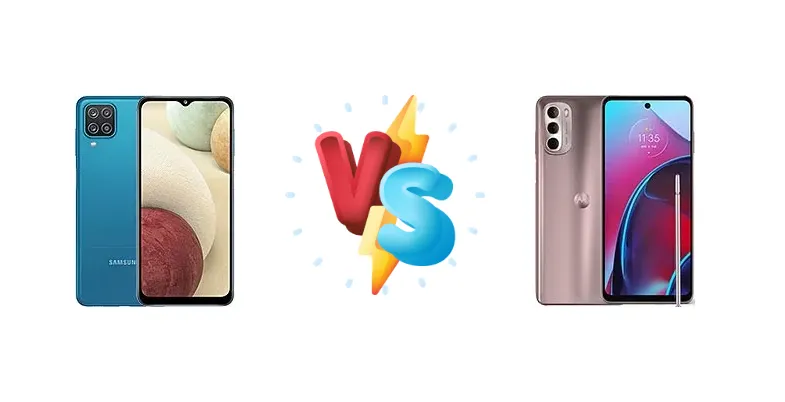
The Samsung Galaxy A12 and Motorola Moto G Stylus (2022) represent two distinct approaches to the budget smartphone market. The A12 prioritizes endurance and a lower entry price, while the Moto G Stylus (2022) aims to offer a more modern chipset and the added functionality of a built-in stylus. This comparison dissects their key differences to determine which device delivers the best value.
🏆 Quick Verdict
For the average user prioritizing longevity and basic functionality, the Samsung Galaxy A12 emerges as the winner. Its significantly superior endurance rating of 123 hours provides peace of mind, outweighing the Moto G Stylus (2022)'s slightly more powerful processor. However, users who heavily utilize note-taking or require a bit more processing power will find the Moto G Stylus (2022) a worthwhile alternative.
| Network |
|---|
| 2G bands | GSM 850 / 900 / 1800 / 1900 | GSM 850 / 900 / 1800 / 1900 |
| 3G bands | HSDPA 850 / 900 / 2100 | HSDPA 850 / 900 / 1700(AWS) / 1900 / 2100 |
| 4G bands | 1, 3, 5, 7, 8, 20, 28, 38, 40, 41 | 1, 2, 3, 4, 5, 7, 8, 12, 13, 14, 17, 25, 26, 29, 30, 38, 41, 66, 71 |
| Speed | HSPA 42.2/5.76 Mbps, LTE Cat4 150/50 Mbps | HSPA, LTE |
| Technology | GSM / HSPA / LTE | GSM / HSPA / LTE |
| Launch |
|---|
| Announced | 2020, November 24. Released 2020, December 21 | 2022, February 03 |
| Status | Discontinued | Available. Released 2022, February 17 |
| Body |
|---|
| Build | Glass front, plastic back, plastic frame | - |
| Dimensions | 164 x 75.8 x 8.9 mm (6.46 x 2.98 x 0.35 in) | 170.2 x 75.9 x 9.5 mm (6.70 x 2.99 x 0.37 in) |
| SIM | · Nano-SIM· Nano-SIM + Nano-SIM | Nano-SIM |
| Weight | 205 g (7.23 oz) | 216 g (7.62 oz) |
| | - | Stylus
Water-repellent coating |
| Display |
|---|
| Resolution | 720 x 1600 pixels, 20:9 ratio (~270 ppi density) | 1080 x 2460 pixels (~396 ppi density) |
| Size | 6.5 inches, 102.0 cm2 (~82.1% screen-to-body ratio) | 6.8 inches, 109.3 cm2 (~84.6% screen-to-body ratio) |
| Type | PLS LCD | IPS LCD, 90Hz |
| Platform |
|---|
| CPU | Octa-core (4x2.35 GHz Cortex-A53 & 4x1.8 GHz Cortex-A53) | Octa-core (2x2.0 GHz Cortex-A75 & 6x1.8 GHz Cortex-A55) |
| Chipset | Mediatek MT6765 Helio P35 (12 nm) | Mediatek MT6769H Helio G88 (12 nm) |
| GPU | PowerVR GE8320 | Mali-G52 MC2 |
| OS | Android 10, upgradable to Android 12, One UI 4.1 | Android 11 |
| Memory |
|---|
| Card slot | microSDXC (dedicated slot) | microSDXC (dedicated slot) |
| Internal | 32GB 2GB RAM, 32GB 3GB RAM, 32GB 4GB RAM, 64GB 2GB RAM, 64GB 4GB RAM, 128GB 2GB RAM, 128GB 3GB RAM, 128GB 4GB RAM, 128GB 6GB RAM | 64GB 4GB RAM, 128GB 4GB RAM, 128GB 6GB RAM |
| | eMMC 5.1 | - |
| Main Camera |
|---|
| Go | - |
| Features | LED flash, panorama, HDR | LED flash, HDR, panorama |
| Quad | 48 MP, f/2.0, 26mm (wide), AF
5 MP, f/2.2, 123˚ (ultrawide)
2 MP (macro)
Auxiliary lens | - |
| Triple | - | 50 MP, f/1.9, 26mm (wide), 0.64µm, PDAF
8 MP, f/2.2, 118˚ (ultrawide), 1/4.0, 1.12µm
Auxiliary lens |
| Video | 1080p@30fps | 1080p@30/60fps; gyro-EIS |
| Selfie camera |
|---|
| Features | - | HDR |
| Single | 8 MP, f/2.2 | 16 MP, f/2.2, (wide), 1/3.06", 1.0µm |
| Video | 1080p@30fps | 1080p@30fps |
| Sound |
|---|
| 3.5mm jack | Yes | Yes |
| 35mm jack | Yes | Yes |
| Loudspeaker | Yes | Yes |
| Comms |
|---|
| Bluetooth | 5.0, A2DP, LE | 5.0, A2DP, LE |
| NFC | Yes (market/region dependent) | No |
| Positioning | GPS, GLONASS, GALILEO, BDS | GPS, GLONASS, BDS, GALILEO |
| Radio | FM radio, RDS, recording | No |
| USB | USB Type-C 2.0 | USB Type-C 2.0 |
| WLAN | Wi-Fi 802.11 b/g/n, Wi-Fi Direct | Wi-Fi 802.11 a/b/g/n/ac, dual-band, Wi-Fi Direct |
| Features |
|---|
| Sensors | Fingerprint (side-mounted), accelerometer | Fingerprint (side-mounted), accelerometer, gyro, proximity |
| | Virtual proximity sensing | - |
| Battery |
|---|
| Charging | 15W wired | 10W wired |
| Type | Li-Po 5000 mAh | Li-Po 5000 mAh |
| Misc |
|---|
| Colors | Black, White, Blue, Red | Twilight Blue, Metallic Rose |
| Models | SM-A125F/DSN, SM-A125F/DS, SM-A125F, SM-A125M, SM-A125U, SM-A125U1, SM-A125N, SM-A125W | - |
| Price | € 78.89 / $ 60.00 / £ 69.99 | $ 90.99 |
| SAR EU | 0.67 W/kg (head) 1.38 W/kg (body) | - |
| Tests |
|---|
| Battery life | Endurance rating 123h | - |
| Camera |
Photo / Video | - |
| Display |
Contrast ratio: 1363:1 (nominal) | - |
| Loudspeaker |
-30.4 LUFS (Below average) | - |
| Performance |
AnTuTu: 107189 (v8)
GeekBench: 1034 (v5.1)
GFXBench: 5fps (ES 3.1 onscreen) | - |
Samsung Galaxy A12
- Exceptional battery life (123h endurance)
- Faster 15W charging
- Lower price point (likely)
- Older, less powerful Helio P35 chipset
- Display specifications are basic
Motorola Moto G Stylus (2022)
- More modern Helio G88 chipset for improved performance
- Integrated stylus for note-taking and drawing
- Potentially more responsive user experience
- Slower 10W charging
- Likely shorter battery life compared to A12
- Missing display specifications
Display Comparison
The Samsung Galaxy A12 boasts a measured peak brightness of 472 nits and a 1363:1 contrast ratio, providing a reasonably viewable experience, though it lacks the advanced features found in higher-end displays. The Moto G Stylus (2022) display specifications are not provided, but given its market positioning, it likely offers similar brightness levels. The A12’s contrast ratio suggests a decent image quality for media consumption, but the lack of information on the Moto G Stylus (2022) makes a direct comparison difficult. Users prioritizing outdoor visibility may find the A12’s 472 nits adequate, but not exceptional.
Camera Comparison
Both devices feature 'Photo / Video' capabilities, but detailed camera specifications are absent. Given the budget nature of both phones, image quality is likely to be similar, with performance heavily reliant on software processing. The absence of information regarding sensor size and aperture makes a meaningful comparison impossible. It's reasonable to assume both phones will struggle in low-light conditions, and the inclusion of a 2MP macro lens on either device is unlikely to provide significant photographic value.
Performance
The Motorola Moto G Stylus (2022) holds a clear advantage in processing power, utilizing the Mediatek Helio G88 chipset with an octa-core configuration featuring 2x2.0 GHz Cortex-A75 and 6x1.8 GHz Cortex-A55 cores. This contrasts with the Samsung Galaxy A12’s older Mediatek Helio P35, which employs 4x2.35 GHz Cortex-A53 and 4x1.8 GHz Cortex-A53 cores. The G88’s Cortex-A75 cores represent a significant architectural improvement over the A53 cores in the A12, resulting in faster application loading and smoother multitasking. While both chipsets are fabricated on a 12nm process, the G88’s more efficient core design translates to better overall performance.
Battery Life
The Samsung Galaxy A12 shines in battery endurance, achieving a remarkable 123-hour rating. The Moto G Stylus (2022) battery capacity and endurance are not specified, but its 10W wired charging is significantly slower than the A12’s 15W charging. While the G Stylus (2022) may have a larger battery capacity, the A12’s superior endurance suggests more efficient power management. Users prioritizing all-day (or multi-day) battery life will strongly favor the Galaxy A12.
Buying Guide
Buy the Samsung Galaxy A12 if you need exceptional battery life and a reliable, if basic, smartphone experience for everyday tasks like calling, texting, and light social media. Buy the Motorola Moto G Stylus (2022) if you frequently take handwritten notes, sketch, or prefer a slightly more responsive user experience thanks to the Helio G88 chipset, and are willing to trade some battery life for that functionality.
Frequently Asked Questions
❓ Will the Helio P35 in the Galaxy A12 struggle with demanding apps or games?
Yes, the Helio P35 is an entry-level chipset. While it can handle basic tasks like calling, texting, and social media, it will likely exhibit lag and slowdowns when running resource-intensive applications or games. The Moto G Stylus (2022) with its Helio G88 will offer a noticeably smoother experience in these scenarios.
❓ How much faster is the 15W charging on the Galaxy A12 compared to the 10W charging on the Moto G Stylus (2022)?
While a direct time comparison isn't possible without testing, 15W charging is generally 50% faster than 10W charging. This means the Galaxy A12 will reach a full charge in less time, offering greater convenience for users who need to quickly top up their battery.
❓ Is the stylus on the Moto G Stylus (2022) accurate enough for detailed note-taking or drawing?
The accuracy of the stylus will depend on the digitizer and software implementation. Motorola's stylus generally offers a reasonable level of precision for basic note-taking and sketching, but it likely won't match the responsiveness of styluses found on higher-end devices like the Samsung Galaxy S23 Ultra.