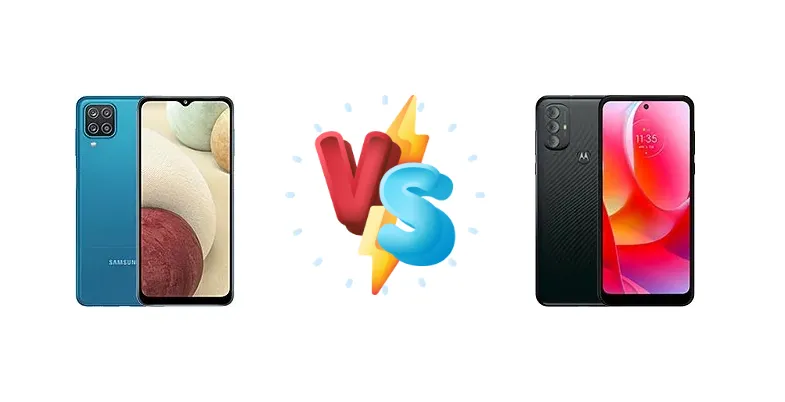
The Samsung Galaxy A12 and Motorola Moto G Power (2022) represent two popular choices in the ultra-budget smartphone segment. While both aim to deliver essential functionality at a low price, they take different approaches to achieving this. The A12 prioritizes a brighter display, while the Moto G Power focuses on a slightly newer chipset. This comparison will dissect their key differences to help you determine which device best suits your needs.
🏆 Quick Verdict
For the average user prioritizing display visibility and overall endurance, the Samsung Galaxy A12 emerges as the better choice. Its significantly brighter 472-nit display and measured 123-hour endurance rating outweigh the Moto G Power’s marginally newer chipset, especially given both utilize the same 12nm process.
| Network |
|---|
| 2G bands | GSM 850 / 900 / 1800 / 1900 | GSM 850 / 900 / 1800 / 1900 |
| 3G bands | HSDPA 850 / 900 / 2100 | HSDPA 850 / 900 / 1700(AWS) / 1900 / 2100 |
| 4G bands | 1, 3, 5, 7, 8, 20, 28, 38, 40, 41 | 1, 2, 3, 4, 5, 7, 8, 12, 13, 14, 17, 25, 26, 29, 30, 38, 41, 66, 71 - USA |
| Speed | HSPA 42.2/5.76 Mbps, LTE Cat4 150/50 Mbps | HSPA, LTE |
| Technology | GSM / HSPA / LTE | GSM / HSPA / LTE |
| Launch |
|---|
| Announced | 2020, November 24. Released 2020, December 21 | 2021, November 17 |
| Status | Discontinued | Available. Released 2022, February 22 |
| Body |
|---|
| Build | Glass front, plastic back, plastic frame | Glass front, plastic back, plastic frame |
| Dimensions | 164 x 75.8 x 8.9 mm (6.46 x 2.98 x 0.35 in) | 167.2 x 76.5 x 9.4 mm (6.58 x 3.01 x 0.37 in) |
| SIM | · Nano-SIM· Nano-SIM + Nano-SIM | Nano-SIM |
| Weight | 205 g (7.23 oz) | 203 g (7.16 oz) |
| | - | Water-repellent coating |
| Display |
|---|
| Resolution | 720 x 1600 pixels, 20:9 ratio (~270 ppi density) | 720 x 1600 pixels, 20:9 ratio (~270 ppi density) |
| Size | 6.5 inches, 102.0 cm2 (~82.1% screen-to-body ratio) | 6.5 inches, 102.0 cm2 (~79.7% screen-to-body ratio) |
| Type | PLS LCD | IPS LCD, 90Hz |
| Platform |
|---|
| CPU | Octa-core (4x2.35 GHz Cortex-A53 & 4x1.8 GHz Cortex-A53) | - |
| Chipset | Mediatek MT6765 Helio P35 (12 nm) | Mediatek MT6765 Helio G37 (12 nm) |
| GPU | PowerVR GE8320 | - |
| OS | Android 10, upgradable to Android 12, One UI 4.1 | Android 11 |
| Memory |
|---|
| Card slot | microSDXC (dedicated slot) | microSDXC (dedicated slot) |
| Internal | 32GB 2GB RAM, 32GB 3GB RAM, 32GB 4GB RAM, 64GB 2GB RAM, 64GB 4GB RAM, 128GB 2GB RAM, 128GB 3GB RAM, 128GB 4GB RAM, 128GB 6GB RAM | 64GB 4GB RAM, 128GB 4GB RAM |
| | eMMC 5.1 | eMMC 5.1 |
| Main Camera |
|---|
| Go | - |
| Features | LED flash, panorama, HDR | LED flash, HDR |
| Quad | 48 MP, f/2.0, 26mm (wide), AF
5 MP, f/2.2, 123˚ (ultrawide)
2 MP (macro)
Auxiliary lens | - |
| Triple | - | 50 MP, f/1.8, (wide), 0.65µm, PDAF
2 MP (macro)
Auxiliary lens |
| Video | 1080p@30fps | 1080p@30fps, gyro-EIS |
| Selfie camera |
|---|
| Single | 8 MP, f/2.2 | 8 MP, f/2.0, 1.12µm |
| Video | 1080p@30fps | 1080p@30fps |
| Sound |
|---|
| 3.5mm jack | Yes | Yes |
| 35mm jack | Yes | Yes |
| Loudspeaker | Yes | Yes |
| Comms |
|---|
| Bluetooth | 5.0, A2DP, LE | 5.0, A2DP, LE |
| NFC | Yes (market/region dependent) | No |
| Positioning | GPS, GLONASS, GALILEO, BDS | GPS, GLONASS, GALILEO |
| Radio | FM radio, RDS, recording | Unspecified |
| USB | USB Type-C 2.0 | USB Type-C 2.0 |
| WLAN | Wi-Fi 802.11 b/g/n, Wi-Fi Direct | Wi-Fi 802.11 a/b/g/n/ac, dual-band, Wi-Fi Direct |
| Features |
|---|
| Sensors | Fingerprint (side-mounted), accelerometer | Fingerprint (side-mounted), accelerometer, gyro, proximity, compass, barometer |
| | Virtual proximity sensing | - |
| Battery |
|---|
| Charging | 15W wired | 10W wired |
| Type | Li-Po 5000 mAh | Li-Po 5000 mAh |
| Misc |
|---|
| Colors | Black, White, Blue, Red | Black |
| Models | SM-A125F/DSN, SM-A125F/DS, SM-A125F, SM-A125M, SM-A125U, SM-A125U1, SM-A125N, SM-A125W | - |
| Price | € 78.89 / $ 60.00 / £ 69.99 | About 70 EUR |
| SAR EU | 0.67 W/kg (head) 1.38 W/kg (body) | - |
| Tests |
|---|
| Battery life | Endurance rating 123h | - |
| Camera |
Photo / Video | - |
| Display |
Contrast ratio: 1363:1 (nominal) | - |
| Loudspeaker |
-30.4 LUFS (Below average) | - |
| Performance |
AnTuTu: 107189 (v8)
GeekBench: 1034 (v5.1)
GFXBench: 5fps (ES 3.1 onscreen) | - |
Samsung Galaxy A12
- Brighter display for better outdoor visibility
- Faster 15W charging
- Stronger measured battery endurance (123h)
- Older chipset (Helio P35)
- Basic camera system with limited detail
Motorola Moto G Power (2022)
- Slightly newer chipset (Helio G37)
- Potentially longer battery life (unconfirmed capacity)
- Motorola’s clean Android software experience
- Slower 10W charging
- Likely dimmer display
- Limited camera detail
Display Comparison
The Samsung Galaxy A12 boasts a measured peak brightness of 472 nits, a substantial advantage over the Moto G Power (brightness data unavailable, but typically lower in this segment). This difference is crucial for outdoor visibility. While both likely utilize LCD panels, the A12’s 1363:1 contrast ratio suggests better black levels and a more dynamic image. The Moto G Power’s display specifications are less detailed, suggesting a more basic panel aimed at minimizing cost. Users sensitive to flicker will need to investigate PWM frequencies, as this data is unavailable for both devices.
Camera Comparison
Both phones feature basic camera setups, with details limited to 'Photo / Video' capabilities. Without specific sensor size or aperture information, a direct comparison is difficult. It’s safe to assume both rely on budget sensors and image processing. The inclusion of a 2MP macro camera on both devices is largely a marketing tactic, offering limited practical benefit due to the low resolution and lack of optical image stabilization. Image quality will likely be comparable, with performance heavily reliant on software processing.
Performance
Both devices are powered by Mediatek Helio chips fabricated on a 12nm process, indicating similar power efficiency. However, the Motorola Moto G Power (2022) features the Helio G37, a slightly newer iteration than the Galaxy A12’s Helio P35. The G37 offers a modest performance uplift, primarily in GPU capabilities, but the CPU architecture remains largely the same – an octa-core configuration with Cortex-A53 cores. This means real-world performance differences will be subtle, primarily noticeable in graphically demanding tasks. Neither chipset is designed for intensive gaming or multitasking.
Battery Life
The Motorola Moto G Power (2022) is named for its battery life, but the Samsung Galaxy A12 holds its own with a measured endurance rating of 123 hours. While the Moto G Power’s battery capacity is not specified, its 10W charging is significantly slower than the Galaxy A12’s 15W charging. This means the A12 will reach a full charge faster, even if the Moto G Power’s battery capacity is slightly larger. The similar chipsets and 12nm fabrication process suggest comparable power consumption, making the A12’s endurance rating a strong indicator of real-world performance.
Buying Guide
Buy the Samsung Galaxy A12 if you frequently use your phone outdoors or in brightly lit environments and value a more vibrant viewing experience. Its higher display brightness makes a tangible difference. Buy the Motorola Moto G Power (2022) if you prioritize a slightly newer chipset and are less concerned with display brightness, and are looking for a phone that will last a long time on a single charge.
Frequently Asked Questions
❓ Does the Helio P35 in the Galaxy A12 struggle with multitasking?
The Helio P35 is an entry-level chipset. While capable of handling basic tasks like calling, texting, and social media, it will exhibit slowdowns with heavy multitasking or demanding applications. Limiting the number of open apps and avoiding resource-intensive games will improve performance.
❓ Is the 10W charging on the Moto G Power (2022) noticeably slow?
Yes, 10W charging is significantly slower than the 15W charging on the Galaxy A12. Expect a much longer time to reach a full charge, potentially taking several hours from a low battery level. This is a trade-off for potentially slightly longer battery life, but convenience is sacrificed.
❓ Are the camera results from either phone suitable for social media sharing?
Both phones can capture acceptable photos for casual social media sharing in good lighting conditions. However, expect limited detail, dynamic range, and low-light performance. The 2MP macro cameras on both devices are unlikely to produce impressive results.