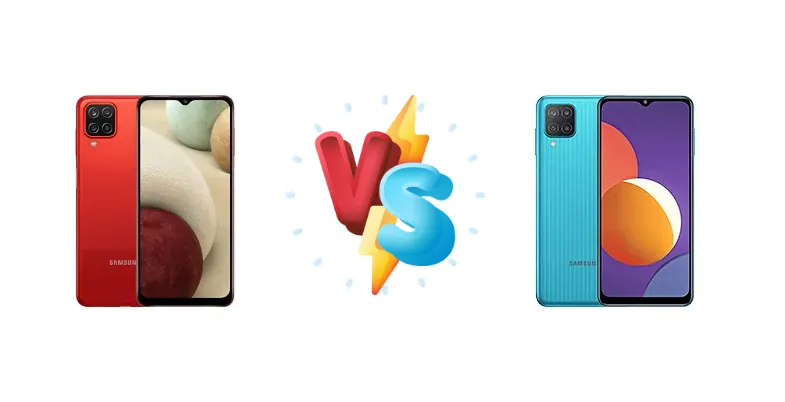
The Samsung Galaxy A12 Nacho and M12 present a curious case: two phones released around the same time, targeting similar price points, and – crucially – powered by the exact same Exynos 850 chipset. This comparison isn't about raw power differences, but rather about how Samsung subtly differentiates these devices through design choices and market positioning, impacting the user experience.
🏆 Quick Verdict
For the average user prioritizing a slightly more refined software experience and potentially better long-term software support, the Galaxy A12 Nacho is the better choice. However, the M12 remains a compelling option if found at a significantly lower price, as the core performance is indistinguishable.
| Network |
|---|
| 2G bands | GSM 850 / 900 / 1800 / 1900 | GSM 850 / 900 / 1800 / 1900 |
| 3G bands | HSDPA 850 / 900 / 2100 | HSDPA 850 / 900 / 1700(AWS) / 1900 / 2100 |
| 4G bands | 1, 3, 5, 7, 8, 20, 28, 38, 40, 41 | 1, 2, 3, 4, 5, 7, 8, 12, 17, 20, 26, 28, 38, 40, 41, 66 |
| Speed | HSPA 42.2/5.76 Mbps, LTE Cat4 150/50 Mbps | HSPA, LTE |
| Technology | GSM / HSPA / LTE | GSM / HSPA / LTE |
| Launch |
|---|
| Announced | 2021, August 09 | 2021, April 19 |
| Status | Available. Released 2021, August 09 | Available. Released 2021, April 30 |
| Body |
|---|
| Build | Glass front, plastic back, plastic frame | Glass front, plastic back, plastic frame |
| Dimensions | 164 x 75.8 x 8.9 mm (6.46 x 2.98 x 0.35 in) | 164 x 75.9 x 9.7 mm (6.46 x 2.99 x 0.38 in) |
| SIM | · Nano-SIM· Nano-SIM + Nano-SIM | Nano-SIM + Nano-SIM |
| Weight | 205 g (7.23 oz) | 212 g (7.48 oz) |
| Display |
|---|
| Resolution | 720 x 1600 pixels, 20:9 ratio (~270 ppi density) | 720 x 1600 pixels, 20:9 ratio (~270 ppi density) |
| Size | 6.5 inches, 102.0 cm2 (~82.1% screen-to-body ratio) | 6.5 inches, 102.0 cm2 (~81.9% screen-to-body ratio) |
| Type | PLS LCD | PLS LCD, 90Hz |
| Platform |
|---|
| CPU | Octa-core (4x2.0 GHz Cortex-A55 & 4x2.0 GHz Cortex-A55) | Octa-core (4x2.0 GHz Cortex-A55 & 4x2.0 GHz Cortex-A55) |
| Chipset | Exynos 850 (8 nm) | Exynos 850 (8 nm) |
| GPU | Mali-G52 | Mali-G52 |
| OS | Android 11, upgradable to Android 13, One UI 5.1 | Android 11, One UI Core 3.1 |
| Memory |
|---|
| Card slot | microSDXC (dedicated slot) | microSDXC (dedicated slot) |
| Internal | 32GB 3GB RAM, 32GB 4GB RAM, 64GB 4GB RAM, 128GB 3GB RAM, 128GB 4GB RAM | 32GB 3GB RAM, 32GB 4GB RAM, 64GB 4GB RAM, 128GB 4GB RAM |
| | eMMC 5.1 | eMMC 5.1 |
| Main Camera |
|---|
| Features | LED flash, panorama, HDR | LED flash, panorama, HDR |
| Quad | 48 MP, f/2.0, 26mm (wide), AF
5 MP, f/2.2, 123˚ (ultrawide)
2 MP (macro)
Auxiliary lens | 48 MP, f/2.0, (wide), 1/2.0", 0.8µm, PDAF
5 MP, f/2.2, 123˚ (ultrawide)
2 MP (macro)
Auxiliary lens |
| Single | 8 MP, f/2.2 | 8 MP, f/2.2, (wide) |
| Video | 1080p@30fps | 1080p@30fps |
| Selfie camera |
|---|
| Features | - | HDR |
| Single | 8 MP, f/2.2 | 8 MP, f/2.2, (wide) |
| Video | 1080p@30fps | 1080p@30fps |
| Sound |
|---|
| 3.5mm jack | Yes | Yes |
| 35mm jack | Yes | Yes |
| Loudspeaker | Yes | Yes |
| Comms |
|---|
| Bluetooth | 5.0, A2DP, LE | 5.0, A2DP, LE |
| NFC | Yes (market/region dependent) | Yes |
| Positioning | GPS, GLONASS, GALILEO, BDS | GPS, GLONASS, GALILEO, BDS |
| Radio | FM radio, RDS, recording | Unspecified |
| USB | USB Type-C 2.0 | USB Type-C 2.0 |
| WLAN | Wi-Fi 802.11 b/g/n, Wi-Fi Direct | Wi-Fi 802.11 b/g/n, Wi-Fi Direct |
| Features |
|---|
| Sensors | Fingerprint (side-mounted), accelerometer | Fingerprint (side-mounted), accelerometer |
| | Virtual proximity sensing | Virtual proximity sensing |
| Battery |
|---|
| Charging | 15W wired | 15W wired |
| Type | Li-Po 5000 mAh | Li-Po 5000 mAh |
| Misc |
|---|
| Colors | Black, Blue, Red | Black, Blue, Green |
| Models | SM-A127F/DSN, SM-A127F/DS, SM-A127F, SM-A127M, SM-A127U | SM-M127F, SM-M127F/DSN, SM-M127N |
| Price | About 130 EUR | About 170 EUR |
| SAR EU | 0.67 W/kg (head) 1.38 W/kg (body) | 0.54 W/kg (head) 1.39 W/kg (body) |
Samsung Galaxy A12 Nacho
- Potentially cleaner software experience with One UI.
- Likely to receive more consistent software updates.
- May have slightly better build quality.
- Price may be slightly higher than the M12.
- No significant performance advantage over the M12.
Samsung Galaxy M12
- Generally more affordable than the A12 Nacho.
- Identical performance to the A12 Nacho.
- Good value for money.
- Potentially less frequent software updates.
- May have a less refined software experience.
Display Comparison
Both the A12 Nacho and M12 lack detailed display specifications in the provided data. However, given their market segment, we can assume both utilize PLS LCD panels. The absence of high refresh rates or advanced features like LTPO suggests a focus on cost optimization. The user experience will likely be similar, with color accuracy and peak brightness being the differentiating factors, though without specific data, it's impossible to determine which performs better. Bezels are likely comparable, contributing to a similar overall screen-to-body ratio.
Camera Comparison
Camera details are limited. Both phones likely feature a multi-camera setup, but the provided data doesn't specify sensor sizes or lens apertures. Given the price point, we can expect a primary sensor accompanied by ultra-wide and depth sensors, potentially with a 2MP macro lens. The image processing algorithms will likely be similar, resulting in comparable photo and video quality. Without specific sensor information, it's difficult to assess which phone captures better images, but the primary sensor's resolution and aperture will be the key determinants.
Performance
The heart of both devices is the Exynos 850 (8nm). This octa-core processor, featuring four 2.0 GHz Cortex-A55 cores and another four at the same clock speed, delivers comparable performance in both phones. The 8nm fabrication process offers a reasonable balance between power efficiency and performance. Real-world performance will be nearly identical for everyday tasks like browsing, social media, and light gaming. The lack of LPDDR5x RAM specification suggests both likely use LPDDR4x, further solidifying the performance parity. Thermal management will also be similar, with the Exynos 850 not being a particularly power-hungry chip.
Battery Life
Both the A12 Nacho and M12 support 15W wired charging. While not fast charging by today's standards, it's adequate for their target audience. Battery capacity isn't specified, but given the similar form factors and target markets, they likely have comparable battery sizes (around 5000mAh). A full charge from 0-100% will likely take around 2.5 to 3 hours. The Exynos 850's efficiency contributes to reasonable battery life, allowing for all-day usage with moderate use.
Buying Guide
Buy the Samsung Galaxy A12 Nacho if you value a potentially cleaner software experience with One UI and anticipate more consistent software updates. This phone is ideal for users who rely heavily on Samsung's ecosystem and prefer a slightly more polished feel. Buy the Samsung Galaxy M12 if your primary concern is maximizing value for money and you're comfortable with a potentially less frequent update schedule. This is the phone for budget-conscious users who prioritize affordability above all else.
Frequently Asked Questions
❓ Does the Exynos 850 chip in either phone struggle with demanding games like PUBG or Call of Duty?
The Exynos 850 is a capable chip for casual gaming, but it's not designed for high-end gaming at maximum settings. You'll likely need to lower the graphics settings to medium or low to achieve a smooth and playable experience in demanding titles like PUBG or Call of Duty. Both phones will perform similarly in this regard.
❓ Is the 2MP macro camera on either phone actually useful for taking detailed close-up photos?
Generally, 2MP macro cameras on budget phones offer limited utility. The low resolution results in images lacking detail and sharpness. While it can be fun to experiment with, don't expect professional-quality macro photography from either the A12 Nacho or the M12.
❓ How long will software updates be supported on the A12 Nacho compared to the M12?
Samsung typically provides longer software support for its A-series devices compared to the M-series. The A12 Nacho is likely to receive at least one major Android update and several years of security patches, while the M12 may receive fewer updates. This is a key consideration for users who prioritize long-term software support.